Why Regional Market Regimes Define Structural Timing in Systematic Trading
Regional market regimes determine more than market context. They define the operating state in
which systematic engines must decide whether to act or remain inactive. Most trading
infrastructure treats regional differences as a data format problem. Dovest treats them as a
structural compatibility question. This article examines why structural timing, not cycle
prediction, provides the correct framework for navigating regional market regimes across ASX,
US, and other institutional markets.
Cycle-based thinking asks: which phase are we in? Structural timing asks: what does the current
environment permit? These are fundamentally different questions. The answer to each question
produces a different type of system. One system predicts. The other system observes, assesses,
and responds.
For systematic infrastructure designed to operate across multiple markets, the difference is
not philosophical. It is architectural. The way a system frames timing determines how it builds
its permission layer, its filtration logic, and its risk governance. Regional market regimes
sit at the centre of all three.
Regional Market Regimes and the Limits of Cycle-Based Thinking
Most systematic frameworks rely on market cycles to orient capital deployment decisions. Cycles
suggest that markets pass through predictable phases: recovery, expansion, contraction, and
decline. However, this framing introduces a structural problem for any engine operating across
multiple regions.
Why Cycles Mislead Systematic Engines
Cycles assume that timing depends on position within a sequence. A cycle-based system asks which
phase it is in, then acts accordingly. By contrast, a structural framework asks only what the
current observable environment supports.
That difference matters in practice. Cycle-based thinking requires the system to hold a view
about future conditions. Structural timing requires only that the system read present conditions
accurately and respond within defined permission rules.
Furthermore, cycles assume that all regional markets follow broadly similar trajectories.
In practice, this assumption breaks down quickly. The ASX may be exhibiting stable, low-volatility
conditions on the same day that US markets absorb a significant stress event. These are not the
same regime. Therefore, they cannot receive the same execution permission from a single engine.
A systematic engine that treats global markets as a unified cycle underestimates the structural
divergence between regions. Consequently, its permission layer receives inputs that do not
reflect actual operating conditions. The result is misaligned capital deployment.
Regional Market Regimes as Operating States
At Dovest, regional market regimes function as operating states, not as cycle phases. An operating
state defines what the engine is permitted to do under current conditions. It does not predict what
conditions will look like next quarter.
This distinction matters because systematic engines cannot act on predictions they cannot verify.
They act on observable conditions they can assess in real time. Regional market regimes provide
that observable layer.
Each region produces a unique combination of volatility structure, liquidity depth, microstructure
behaviour, and regulatory timing constraints. These are not background factors. They are the actual
environment in which capital operates. The engine must read that environment clearly before the
permission layer can function correctly.
Additionally, an operating state can change within a single session. A regime that opened as
stable may shift into stress territory by mid-morning. A system built on cycle assumptions
cannot detect or respond to intra-session regime changes. A system built on structural operating
states can.
What Structural Timing Actually Measures
Structural timing is not about entering a position at the optimal moment within a cycle. It is
about confirming that the current environment supports the specific type of behaviour the engine
was designed to capture.
The Difference Between Timing and Prediction
Prediction asks: when will price move? Structural timing asks: does the current environment
permit the engine to act?
These questions require different infrastructure. Prediction requires a view of the future.
Structural timing requires a clear and auditable reading of the present.
For systematic engines, this distinction determines how the permission layer functions. When a
system predicts, it accepts uncertainty as a design feature. When a system reads structural
timing, it accepts inactivity as a legitimate and correct output.
Inactivity becomes the right output when structural conditions fall below the permission
threshold. Moreover, that threshold must be calibrated to the specific regional operating state,
not to a generic global average. The same threshold applied uniformly across regions produces
permission errors at the regional level.
Regional Market Regimes and Structural Compatibility
Structural compatibility means the engine’s logic aligns with current regional conditions. Regional
market regimes define whether that alignment exists.
For example, a mean-reversion engine designed to capture short-term dislocations operates well
when the regional regime supports controlled liquidity and defined volatility structure. However,
the same engine performs poorly when the regime shifts to fragmented liquidity and elevated
volatility. The signal may still appear. The structural compatibility no longer holds.
In that situation, the engine must ask: does the current regional operating state support this
type of behaviour? If not, the filtration layer must absorb the signal without passing it to the
permission layer. Structural compatibility is a prerequisite for permission, not a secondary
consideration.
Therefore, every systematic engine must embed regional regime compatibility assessment directly
into its filtration and permission architecture. It cannot rely on the signal layer to make that
assessment.
How Regional Market Regimes Shape Execution Permission
Execution permission is not a simple on/off switch. It is a layered assessment that draws on
multiple structural inputs. Regional market regimes are among the most significant inputs in
that assessment. A strong signal cannot override an incompatible regime state.
Regime Detection and Permission Logic
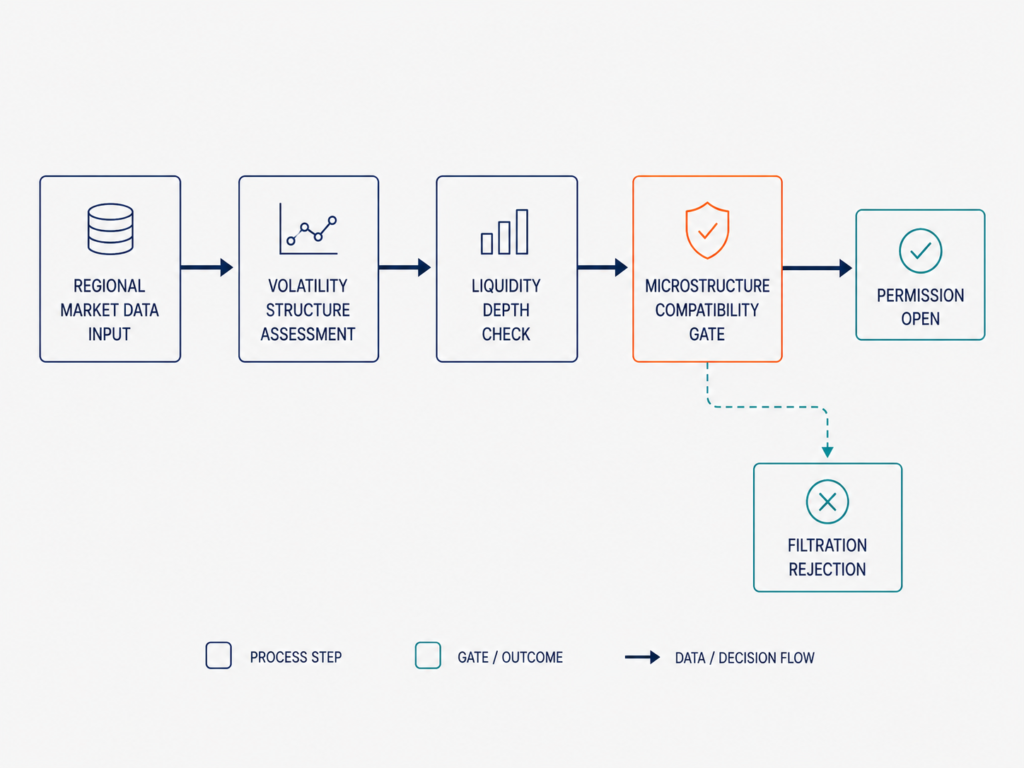
The engine detects regional regime state by observing a defined set of structural indicators.
These include volatility behaviour, liquidity depth, order book stability, and recent price
action patterns. Together, they define the current operating state for that specific region.
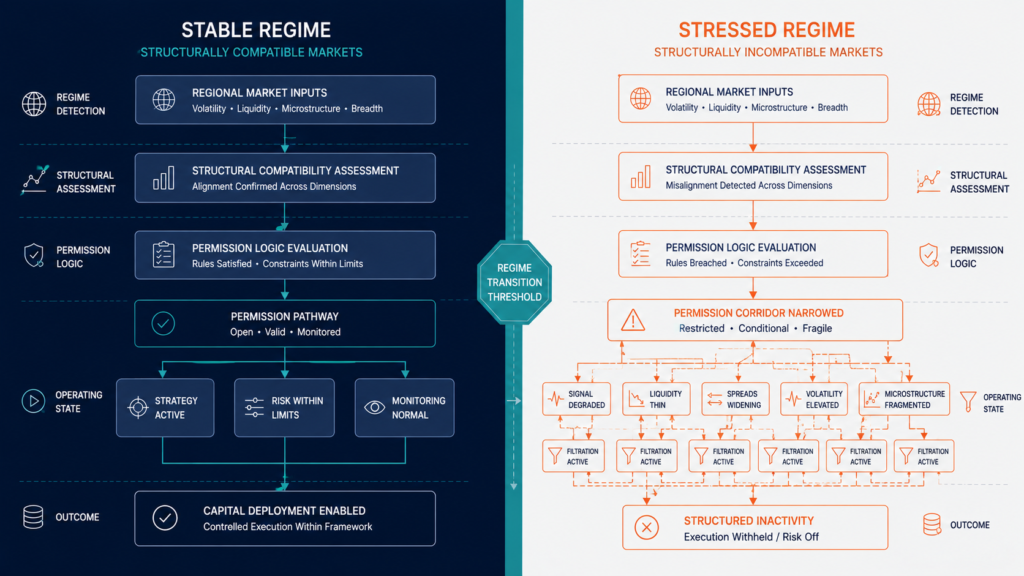
When the detected regime is compatible with the engine’s logic, the permission layer opens.
When the detected regime signals stress, fragmentation, or incompatibility, the permission
layer narrows or closes entirely. This is the structural role of regime detection: it sets the
permission boundary before any individual signal is evaluated.
This process is structural. It does not involve discretion. The engine applies a defined
framework and reaches a binary outcome: permission granted, or permission denied. Governance
logs both outcomes equally.
How Permission Changes Across Regional Market Regimes
Permission does not remain constant across regions. A regime-aware engine must assess each
market separately and apply region-specific permission logic.
Consequently, a system may remain fully active in one regional market while maintaining
structured inactivity in another on the same day. This is not inefficiency. It is precision.
The engine responds to what each region’s operating state actually permits, not to what a
global average suggests.
Additionally, permission levels can shift rapidly when a regional market regime changes. A
stable ASX session may move into a stress state within hours. When that happens, the engine
must detect the shift, update its regime assessment, and narrow permission accordingly. The
speed of that detection is a governance design question, not a signal-quality question. Faster
regime detection produces earlier permission narrowing, which reduces exposure during the
transition period.
The Filtration Layer and Market Compatibility
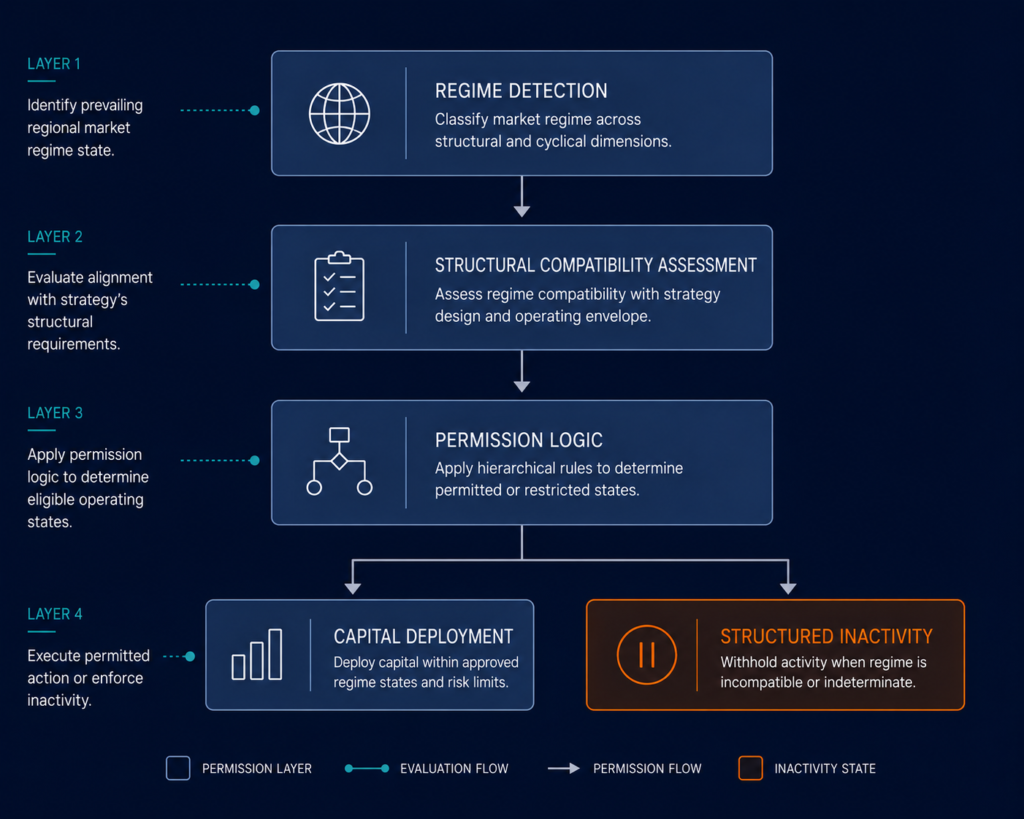
The filtration layer sits between behaviour detection and execution permission. Its role is to
prevent incompatible conditions from reaching the capital deployment layer. Regional regime state
is one of the primary inputs the filtration layer uses to make that determination.
What Filtration Absorbs When Structure Fails
When operating conditions produce structural incompatibility, the filtration layer rejects the
input. This is not a failure. It is the system functioning as designed.
Filtration outcomes based on structural incompatibility include several observable conditions.
Volatility structure too fragmented to support clean behaviour detection represents one outcome.
Liquidity depth too shallow to permit controlled position sizing represents another.
Moreover, microstructure behaviour inconsistent with the engine’s capture logic is a third
trigger. Order flow patterns suggesting regime transition rather than stable state are a fourth.
Each condition is assessed independently. However, any single failure is sufficient to block
the signal from reaching the permission layer.
Each of these outcomes produces the same result: the filtration layer absorbs the signal, and
the permission layer receives nothing. As a result, no capital deploys. The system waits without
external instruction. Inactivity is the output, not a default.
Data Quality Within Regional Market Regimes
Data quality varies across regional market regimes. This is not simply a feed-quality problem.
It reflects genuine structural differences in how regional markets produce and distribute
information.
The ASX, for instance, operates within a distinct microstructure compared to US equity markets.
Tick data patterns, auction mechanisms, and corporate action timing all differ meaningfully.
Furthermore, liquidity concentration across the trading session follows region-specific patterns
that a generic filter cannot accommodate accurately.
A filtration layer that ignores regional data quality differences treats all inputs as structurally
equivalent. That assumption produces unreliable permission outputs. The system may open permission
based on data that does not accurately reflect the regional operating state.
Therefore, data trust within each regional regime is a first-order infrastructure requirement.
It is not a secondary cleanup task applied after signal generation. Understanding how microstructure
differences across regional markets shape system behaviour provides essential foundation for
regime-aware filtration. The framework for
microstructure variance across regions
captures these structural distinctions in depth.
Regional Market Regimes in ASX and US Context
Dovest’s current infrastructure focuses on the ASX. The roadmap includes US market preparation
as the next phase of expansion. These two markets represent meaningfully different regional regime
environments. The differences are not superficial. They affect every layer of the system from
data ingestion to exit logic.
ASX Operating Characteristics and Structural Timing
The ASX operates in a structurally distinct environment. Market depth is shallower relative
to major US indices. The trading session is shorter. Liquidity concentration is higher in the
morning session and thinner in the afternoon.
These characteristics shape structural timing in specific ways. Mean-reversion behaviour may
resolve more quickly in ASX conditions when morning liquidity supports it. However, afternoon
sessions carry higher friction costs and thinner order books. Consequently, the permission
layer applies ASX-specific regime filters rather than generic global ones.
Global Sentiment Exposure and the ASX Regime
Furthermore, the ASX is exposed to global sentiment shifts that occur entirely outside its
trading hours. By the time the ASX opens, regional regime conditions may have already changed
in response to overnight US or European market movements. The engine must account for that
structural lag when assessing the operating state at market open. A clean morning reading does
not necessarily reflect the previous session’s global behaviour. In this way, the filtration
layer must incorporate overnight context before permission opens for the new session.
US Market Regime Profile and Regional Differences
The US equity market operates across a significantly larger instrument universe with deeper liquidity.
However, deeper liquidity does not mean lower structural complexity. Regional market regimes in the US include fragmentation across multiple trading venues, variable spread behaviour during different session periods, and distinct pre-market and after-hours dynamics.
Why US Expansion Requires a New Interface
For a mean-reversion engine calibrated on ASX logic, US market expansion requires a new data interface, not a new core strategy.
The mean-reversion behaviour pattern is market-agnostic by design. However, regime detection parameters must be recalibrated for the US market’s specific structural timing characteristics.
Volatility thresholds, liquidity filters, and session-specific constraints all need region-specific calibration.
Same Core Logic, New Regional Interface
This is the scalability principle at the foundation of Dovest’s expansion approach: same logic, new interface.
The core engine does not change. The regional regime detection and data interface layers adapt to the new operating environment.
That separation between core logic and regional interface is what makes the infrastructure genuinely scalable rather than simply portable.
Risk Architecture Under Changing Conditions
Risk architecture must account for regional regime state at every layer. A position that carries
acceptable risk under a stable operating environment may carry unacceptable risk when the regime
shifts. The risk layer cannot treat regime change as background noise.
Risk Constraints Under Changing Regional Market Regimes
Risk constraints operate in two modes: static and regime-conditional.
Static constraints define the maximum acceptable exposure regardless of regime state. These are
hard floors. They do not change when conditions change. Instead, they define the absolute outer
boundary of permissible capital deployment under any circumstances.
Regime-conditional constraints add a second layer. When regional market regimes show elevated
stress, volatility fragmentation, or liquidity deterioration, these constraints tighten. The
engine reduces exposure to reflect the reduced structural quality of the current operating state.
The reduction is proportional to the severity of regime deterioration, not applied as a binary
halt.
This two-layer approach ensures that risk architecture responds to actual conditions rather than
fixed assumptions. As a result, the system does not treat a stress regime the same way it treats
a stable one. However, both operate within the static hard floor at all times. The regime layer
can only tighten within the boundaries the static layer defines. It cannot expand beyond them.
Drawdown Logic and Exposure Control
Drawdown management connects directly to regime state. When a region’s operating environment
produces elevated drawdown risk, the halt policy must respond proportionally.
Specifically, the engine should track whether drawdown events correlate with regime transitions.
If they do, that correlation provides a diagnostic signal at the infrastructure level. The regime
transition itself may precede the drawdown event. In that case, earlier regime detection leads
to earlier permission narrowing, which leads to reduced capital exposure before the drawdown
fully materialises.
This is not cycle prediction. It is structural observation applied to risk governance. The system
observes current conditions, detects structural transition signals, and tightens constraints in
response. Additionally, the post-session review process should examine whether the permission
layer responded correctly to each regime event. That review loop strengthens the system’s
regime detection calibration over time.
The relationship between regime stress and system output quality provides the structural foundation
for this risk architecture layer. Examining
system behaviour under stress regimes
shows how regime-aware design produces more stable and explainable drawdown profiles across
changing conditions.
Building Infrastructure That Respects Regional Market Regimes
A systematic engine that ignores regional market regimes is not global infrastructure. It is a
local engine with unexamined assumptions applied to new markets. The assumptions may hold in the
original market. In a new regional environment, they may fail silently.
Monitoring Regional Regime Transitions
Monitoring must include specific regime transition detection. The engine cannot rely only on
stable-state signals. It must also detect when a regional regime moves from one operating state
to another.
Regime transitions are structurally significant events. They change the permission landscape,
alter filtration outcomes, and introduce uncertainty into data quality assessment. Therefore,
monitoring must treat regime transitions as first-class events, not background fluctuations.
When the monitoring layer detects a transition, the engine flags the shift, reassesses the
permission layer, and applies conservative defaults until the new regime state is confirmed and
stable. The transition period itself carries higher structural uncertainty than either the
preceding or succeeding stable state. Conservative defaults during that period are a design
feature, not a performance limitation.
Furthermore, monitoring should produce a regime transition log. This log records when transitions
occurred, what the detection threshold was, and how the permission layer responded. That record
supports post-session review and ongoing system calibration.
Governance and Regional Market Regime Accountability
Governance connects regional market regimes to accountability at an institutional level.
Every permission decision that references regime state must be logged, reviewable, and explainable. Without this layer, regime awareness can easily become another source of hidden discretion inside the engine.
Why Regime Decisions Need Governance
This matters for several reasons.
First, an engine that cannot explain why it narrowed permission during a specific ASX session cannot be audited in any meaningful sense.
Second, an engine that adjusts US market parameters without documented rationale introduces silent drift into its own operating logic.
Third, governance across regions must remain consistent in structure even when it differs in parameters.
The system may treat ASX, US, or other regional markets differently at the parameter level. But the logic of accountability must remain the same.
Preventing Silent Regional Drift
Regional market regimes change.
The governance layer ensures those changes are recorded, not absorbed silently into system behaviour.
By design, this produces an engine whose behaviour can be reviewed, questioned, and systematically improved across every regional operating environment it encounters.
Governance is not a compliance requirement imposed from outside. It is the structural mechanism that keeps regime-aware decision-making auditable over time.
Regime Awareness as a Structural Requirement
Regional market regimes are not market background. They define the operating state in which
systematic engines must decide whether to act, reduce exposure, or remain inactive. A system
that cannot read regional regime state cannot apply accurate execution permission. It can only
apply generic rules to non-generic conditions.
Structural timing is the discipline of reading that operating state clearly and responding
according to defined, auditable rules. It is not about predicting what cycles will bring.
It is about confirming that the current environment permits the kind of behaviour the engine
was built to capture.
The Permission Layer Needs the Regime Layer
For systematic infrastructure designed to expand across markets, regime-aware design is
foundational. Capital behaviour, filtration logic, execution permission, and risk architecture
all depend on accurately reading regional market regimes in real time. Additionally, governance
ensures those readings remain traceable and accountable across every session and every market.
A system that ignores regional regime state may identify signals. However, it cannot confirm
whether those signals have permission to reach capital. The permission layer needs the regime
layer to function correctly. That is not a technical detail. It is a structural requirement.
Author Box:
Binh Trinh is the founder of Dovest, a systematic trading infrastructure company focused on
market behaviour, risk permission, and decision discipline. Her work approaches trading systems
not as signal machines, but as operating structures where capital acts only when context, risk,
and execution conditions align. Dovest content is published for institutional research and
educational purposes.
Disclaimer:
Dovest content is provided for institutional research and educational purposes only. It does not
constitute financial advice, investment advice, trading signals, or a recommendation to buy or
sell any financial product. References to systematic trading infrastructure, monitoring, and
governance describe research and design principles. They should not be read as performance claims
or product availability statements.