Why Liquidity Deterioration Demands Disciplined System Response
Liquidity deterioration rarely arrives as a single event. Instead, it builds quietly inside the order book before any chart reveals the change. By the time price action confirms it, execution conditions have already shifted, and the assumptions built into the signal layer no longer hold.
This article examines liquidity deterioration through a behaviour-first lens. Specifically, it looks at how systematic infrastructure should respond when depth thins, quote stability weakens, and venue conditions stop supporting clean execution. In this view, execution is never granted automatically. As such, it must be earned by the environment, not assumed by the model.
For Dovest, the conversation about market structure begins here. Furthermore, the conversation about risk architecture cannot move forward without it.
What Liquidity Deterioration Actually Means in Market Structure
The phrase sounds clinical. However, the operational meaning is precise. Liquidity deterioration describes a measurable shift in the conditions that allow capital to enter and exit a market without distortion.
Defining liquidity deterioration as a structural change
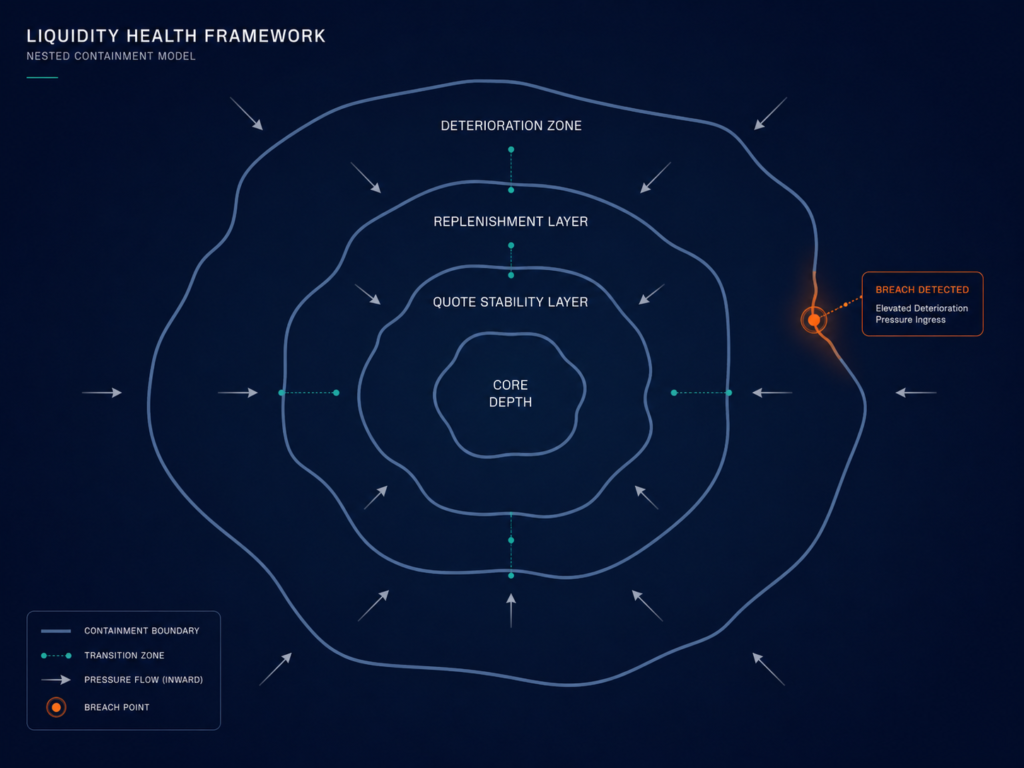
Most retail conversations treat liquidity as a binary state. By contrast, institutional thinking treats it as a layered property. Depth on each side of the book, the stability of the top quote, the persistence of resting orders, and the rate at which the book replenishes after an aggressive print all contribute. When one of these properties weakens, the overall structure changes, even before the price moves.
In practice, this means a market can look calm on a chart while the conditions underneath have already degraded. Therefore, surface signals provide insufficient information for execution decisions.
How depth and quote stability shape this state
Depth defines what capital can absorb without moving the price. Quote stability defines how long a price level holds before it disappears. Together, these two properties define execution feasibility. As a result, when either weakens, the same trade idea carries different operational risk.
Why this differs from a volatility shift
Volatility and liquidity often move together. Nevertheless, they describe different things. Volatility describes how far the price travels. Liquidity describes how the market absorbs the journey. A market can experience high volatility with healthy depth, and a market can experience low volatility with fragile depth. For this reason, treating them as the same metric leads to systematic mispricing of execution cost.
Why Liquidity Deterioration Forces Execution Discipline
A system that ignores this distinction will eventually pay for it. Specifically, the price appears in slippage, in failed exits, and in trades that looked good on paper but produced a different result in live conditions.
How it breaks naive execution assumptions
Backtests typically assume that historical prints could have been transacted. In reality, a meaningful share of those prints occurred under conditions a live order would not have received. Consequently, backtests overstate executable performance whenever liquidity deterioration is present in the sample.
A disciplined system corrects for this. Moreover, it treats liquidity quality as a separate filter, not as a free assumption.
The cost of ignoring liquidity deterioration signals
When a system trades through deteriorating conditions, three things compound. First, the slippage on entry widens. Second, the bid-ask round trip eats more of the expected edge. Third, exits become more expensive than the model predicted, since the same conditions that hurt the entry usually persist into the exit window. Therefore, ignoring liquidity signals does not just raise costs once. Instead, it raises them on both legs of the trade.
Liquidity deterioration and slippage attribution
A well-built monitoring layer separates slippage caused by volatility from slippage caused by liquidity deterioration. As such, post-trade analysis becomes diagnostic rather than descriptive. The system learns which conditions produced unacceptable execution, and the engineering team can update filtration thresholds with evidence, not intuition.
Behaviour-First Response to Liquidity Deterioration
Detection is only the first step. Furthermore, the harder design question is what the system should do once deterioration is identified.
How systematic engines should treat this state
The behaviour-first principle states that the engine reacts to conditions, not to forecasts. Consequently, when conditions weaken, the engine narrows what it is allowed to do. A new entry that would have passed under healthy conditions should not automatically pass under degraded conditions. In this way, the rules respond to the environment without requiring a discretionary override.
This approach connects directly to ideas explored in system behaviour under stress regimes. Both pieces share the same operating principle: the engine must remain the same engine across regimes, while its permitted actions change with the environment.
Skip logic and structural thresholds
A skip is not a defensive reaction. Instead, it is a designed output. The system has rules that say, under defined conditions, no trade is the correct trade. Moreover, this rule is non-negotiable. By design, skip logic protects the system from acting in conditions where the expected edge cannot survive realistic execution friction.
Permission narrowing during liquidity deterioration
Permission narrowing operates as a continuous gradient, not a binary switch. As conditions degrade, the system allows fewer instruments, smaller sizes, and tighter holding windows. Similarly, when conditions improve, permission widens again. As a result, the system maintains continuity of behaviour while reflecting the environment honestly.
Regime Context Around Liquidity Deterioration
The same deterioration pattern can mean different things in different regimes. Therefore, regime context is not optional. It is a primary input.
Calm regimes versus stress regimes
In calm regimes, a small drop in depth often reverses within minutes. By contrast, the same drop in a stress regime can persist for sessions. The pattern looks identical at first glance. However, the persistence profile differs significantly. For this reason, systems that treat depth signals identically across regimes will misjudge how long deterioration will last.
Session boundaries and venue behaviour
Sessions open and close with predictable changes in book structure. Additionally, auction periods, opening prints, and pre-close minutes carry their own liquidity profile. Therefore, a system that does not distinguish session-driven deterioration from event-driven deterioration will react incorrectly to both. The first type usually self-resolves. The second type usually does not.
Cross-market liquidity deterioration signals
Liquidity deterioration in one market often forecasts the same condition in correlated markets. Equally, it sometimes does not. The relationship depends on the cause. As such, monitoring should observe correlated markets as context, not as confirmation. The connection between regional structure and liquidity health is examined further in microstructure variance across regions, which discusses how venue-specific behaviour shapes execution expectations.
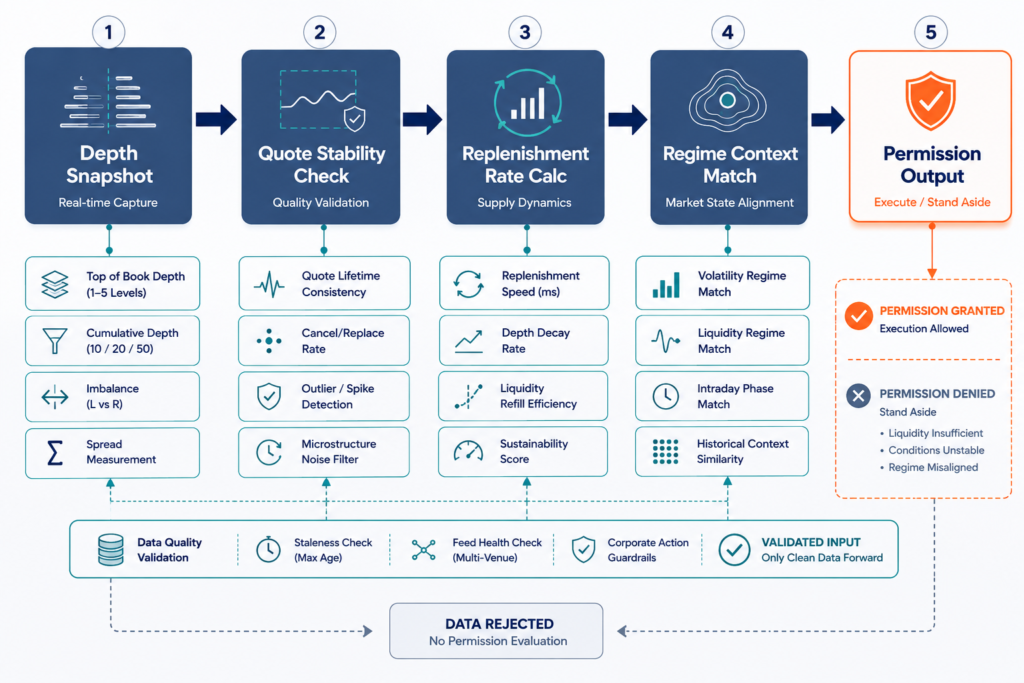
Risk Architecture Under Liquidity Deterioration
Risk architecture decides what the system is allowed to lose, and under what conditions. Furthermore, liquidity is a primary input into that calculation.
Position sizing constraints in this state
Position size in a healthy market and position size in a deteriorating market should not be the same number. By design, the system reduces size when depth thins, since the exit cost on the same notional grows. In practice, this means the same signal produces different capital deployment depending on the operating environment.
Exit logic when liquidity deterioration accelerates
A holding position behaves differently when liquidity worsens during the holding period. Specifically, the available exit window narrows. The system therefore needs exit logic that responds to deterioration during the trade, not only at entry. In this way, the system avoids becoming trapped in a position that no longer matches the environment that allowed it to enter.
Pre-commitment rules during liquidity deterioration
Pre-commitment rules define what the system must do under named conditions, before those conditions arrive. As such, they remove discretion from the moment of stress. The principle is explored at length in research on pre-commitment as a structural discipline, but the application here is direct. Specifically, when liquidity falls below a defined threshold, the response is already written. Therefore, the operator cannot override it under pressure.
Monitoring Frameworks for Liquidity Deterioration
Monitoring transforms observation into structured intelligence. Moreover, it gives the engineering team the data needed to update thresholds without guessing.
Observable indicators of liquidity deterioration
Several indicators contribute. The top-of-book quote duration, the depth at one and five basis points away from the touch, the replenishment time after an aggressive print, and the imbalance between bid and ask depth all provide signal. Furthermore, none of them work alone. Therefore, the framework reads them as a composite, not as a single threshold.
Logging deterioration for post-trade review
Every trade should carry a record of the liquidity state at entry and exit. By design, this record allows the team to ask whether a poor result came from a wrong signal or a wrong environment. Without this distinction, post-trade review becomes opinion. With it, post-trade review becomes evidence.
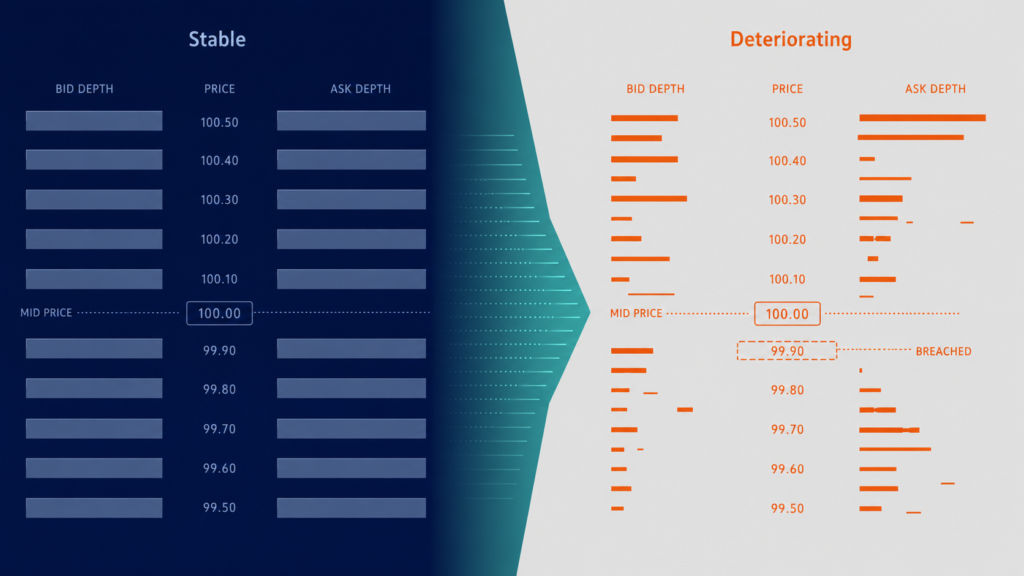
Why Execution Must Be Earned, Not Assumed
The behaviour-first frame closes the loop. Specifically, it rejects the idea that a signal automatically deserves a fill. Instead, it asks whether the environment supports the trade the model wants to take.
Liquidity deterioration as the gatekeeper of execution
Conditions decide whether capital moves. By design, the system asks for permission from the environment, not from the model. As a result, signals that would have executed in a healthy book become observations only when the book is unhealthy. The model still records the opportunity. However, the engine declines to act. In this way, the system preserves its statistical profile across regimes, rather than allowing strong months to mask weak execution quality.
The institutional view on this discipline
Institutional allocators look for engines that behave the same way across environments. Furthermore, they look for systems that can explain why they did not trade as clearly as they explain why they did. In practice, that explanation often comes back to the same structural input. Specifically, the environment did not earn the right to be traded. As such, the engine kept capital still, and the next trade waited for conditions that supported it.
This is the operational meaning of behaviour-first infrastructure. Equally, this is why Dovest treats liquidity deterioration not as a side concern, but as a primary input into the permission layer that sits in front of every potential execution.
Continue learning about systematic behaviour frameworks
Dovest publishes research on the structural foundations of systematic trading infrastructure. Read the next system note in the series to continue exploring how environment-based reasoning shapes engine design.
Author
This article is part of Dovest’s institutional research series on systematic trading infrastructure. Dovest is an Australia-based engineering-first company focused on the structure, constraints, and governance that make systematic trading engine behaviour stable, explainable, and auditable under real-world stress. The research series is written by the Dovest team, drawing on multi-year work in market microstructure, behaviour-first system design, and live engine monitoring.
Disclaimer
This content is published for institutional research and educational purposes. It does not constitute financial advice, investment advice, trading signals, or any recommendation to buy or sell financial instruments. References to systematic trading infrastructure, monitoring frameworks, and governance principles describe research and design concepts. They should not be read as performance claims, audited results, or product availability statements.