Why Execution Stability Matters More Than Speed
Execution stability describes how consistently a trading engine turns a decision into a filled order. It is not about being fast. Instead, it is about being predictable. A system with strong execution stability behaves the same way on a calm Tuesday and a violent Thursday. Furthermore, it produces fills that fall within a known, narrow band rather than a wide and surprising one. For institutional infrastructure, that predictability matters more than raw speed. Speed can win a single fill. Execution stability, by contrast, wins the thousand fills that follow.
Most retail frameworks chase the fastest possible entry. By contrast, systematic infrastructure treats execution as a behaviour to control, not a race to win. The goal is a fill an engineer can model in advance. A fast but variable execution layer cannot be modelled. A slightly slower but steady one can. As such, the engine trades a small amount of speed for a large amount of certainty.
This article examines execution stability as a system architecture property. In particular, it covers what stability means, why predictability beats speed, how engineers build it, and how disciplined systems measure it. The approach stays behaviour-first throughout. Structure comes first, and prediction never enters the design.
What Execution Stability Means in Systematic Trading
Execution is the layer where a decision becomes a position. It sits between the signal and the market. For that reason, it is also where many systems quietly lose their discipline. A clean signal can still produce a messy fill, and the engine has to account for that gap. Moreover, the execution layer is where intent meets reality. As such, it deserves the same engineering attention as the signal logic itself.
Execution stability as a behavioural property
Execution stability is a behaviour, not a setting. It describes how the execution layer responds when conditions change. A stable layer fills orders within a consistent range of cost and timing. An unstable one swings between cheap fills and expensive ones without warning.
For systematic engines, that consistency is the whole point. A behaviour that holds across regimes can support a model. By contrast, a behaviour that varies wildly cannot. Therefore, the engine values stability because it makes the rest of the system predictable.
Consider two engines that share the same signal. The first fills within a tight, repeatable band. The second fills well one day and poorly the next. Furthermore, only the first can be trusted to scale. In this way, execution stability becomes the quiet difference between a system that grows and one that stalls.
Stability versus a single fast fill
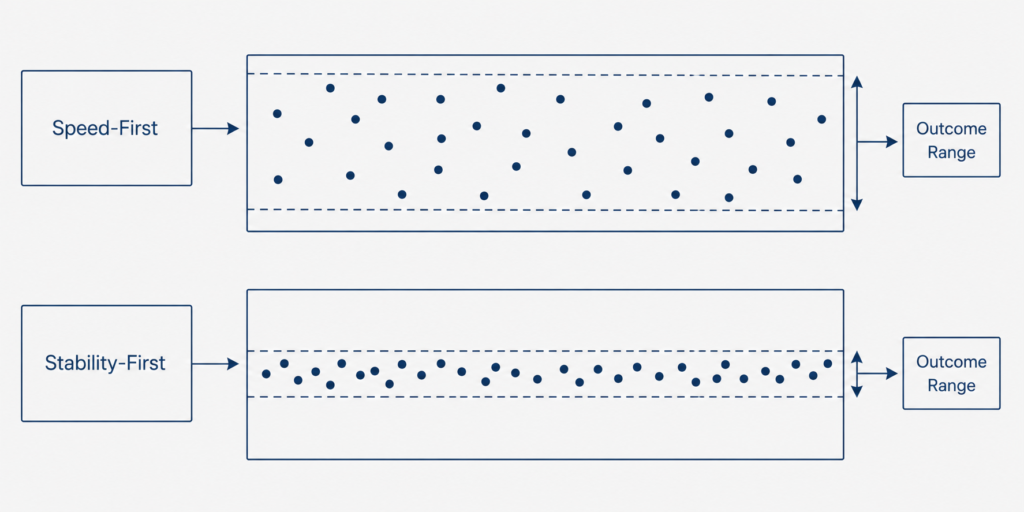
A fast fill feels like success. However, one fast fill proves very little. The real question is whether the next hundred fills behave the same way. Speed measures a single moment. Stability measures a pattern across many.
As such, a disciplined engine cares far less about its best fill than about the spread between its best and its worst. A narrow spread signals control. By contrast, a wide one signals a layer that has not been engineered for consistency.
Furthermore, a single fast fill can hide a fragile process. The speed may have come from an aggressive order type that will misbehave under stress. Therefore, the engine looks past the impressive moment and studies the distribution behind it.
Why execution stability is structural
Execution stability does not appear by chance. Instead, it comes from structure. The order path, the sizing logic, and the venue rules all shape how a fill behaves. Therefore, stability is an outcome of design, not luck.
When engineers change one part of the path, they change the stability of every fill that follows. In this way, execution becomes an architectural concern rather than an afterthought. Moreover, the engine treats the execution layer with the same rigour it applies to signal logic. Consequently, stability is reviewed deliberately, never assumed.
Why Predictability Beats Speed
Speed is easy to admire. It is visible, it is measurable, and it feels like an edge. Predictability is quieter. However, for infrastructure built to last, predictability is the property that actually compounds over time. Therefore, the choice between the two is an architectural decision rather than a matter of taste.
Predictability as an engineering goal
Engineers do not optimise for the best possible case. Instead, they optimise for the narrowest possible range. A predictable execution layer lets every other layer plan around it. The risk layer can size with confidence. Moreover, the monitoring layer can flag real drift instead of normal noise.
As a result, predictability is not a soft preference. It functions as a hard engineering requirement. A system that cannot predict its own behaviour cannot be trusted to scale.
In practice, this changes how the team measures success. The question is not how good the best fill was. Instead, it is how tight the whole range stayed. As such, a narrower band counts as progress even when the average does not move.
What speed actually optimises
Speed optimises for one number, the time to fill. That number is real, but it is narrow. It says nothing about cost variance, slippage, or behaviour under stress.
Furthermore, a system tuned purely for speed often becomes fragile. It performs well in calm conditions and then breaks when the market turns. Speed, taken in isolation, is an incomplete objective.
Moreover, speed creates a false sense of control. A fast fill looks decisive, yet it tells the engine nothing about repeatability. For this reason, the engine treats time-to-fill as one input among several, never as the headline goal.
Why predictable execution scales
A predictable execution layer scales cleanly. Add capital, add venues, or add markets, and the behaviour stays within a known band. By contrast, a speed-first layer scales unevenly. Its variance grows as conditions widen.
Therefore, predictability is what lets a system grow without its behaviour drifting. This is the same principle behind calm system output in systematic trading, where steadiness is treated as a designed result rather than a lucky one.
Additionally, predictable behaviour is easier to explain to the people who depend on it. A risk officer can reason about a known band. By contrast, a wide and shifting range resists explanation. In this way, predictability is also what makes the system auditable.
The Hidden Cost of Optimising for Speed
A speed-first execution layer carries costs that do not show up immediately. Instead, they appear later, under pressure, when the system is asked to behave consistently and cannot. As such, the true price of speed is often paid on a delay.
Speed introduces variance
Every shortcut taken for speed adds variance somewhere else. Aggressive order types fill faster but at less predictable prices. Skipping a validation step saves milliseconds but widens the range of outcomes.
As a result, the system becomes harder to model with each speed optimisation. Variance is the hidden invoice for speed, and it arrives later than the benefit does.
Moreover, variance rarely stays where it started. A shortcut in routing can show up later as inconsistent timing. Therefore, the engine traces each speed choice through to its downstream effect before accepting it.
The cost of an unmodellable system
A system that cannot be modelled cannot be trusted with size. If execution behaviour is unpredictable, the risk layer must assume the worst case. Consequently, it sizes down to stay safe.
In this way, a fast but unstable engine actually deploys less capital than a slower, stable one. Speed bought at the cost of predictability reduces the very capacity it was meant to improve. As such, the headline advantage hides a structural penalty.
There is a further cost, too. An edge built on speed is fragile by nature. Infrastructure improves, competitors catch up, and the advantage erodes. By contrast, an edge built on stability does not depend on being faster than anyone else. Instead, it depends on being consistent, which is far harder to compete away. Therefore, stability is the more durable foundation for infrastructure meant to last years, not quarters.
How Execution Stability Is Engineered
Execution stability is built, not hoped for. Systematic infrastructure treats it as a design target with explicit, testable components. The engine does not improvise its execution behaviour in the moment. Therefore, stability is treated as a deliverable, with clear components and regular review.
Engineering execution stability into the order path
The order path is where stability begins. Engineers define how an order is split, timed, and routed before any session opens. Each choice has a known effect on the spread of outcomes.
As such, the path is tuned for a narrow result band, not a fast headline number. The engine then follows that path the same way every time. Repetition is what turns a good design into a stable behaviour.
In addition, the path is documented so that any engineer can see why it behaves the way it does. In this way, stability does not live in one person’s head. Instead, it lives in the architecture itself.
Pre-committed execution rules
Execution stability depends on pre-commitment. The rules for order size, timing, and venue exist before the trade does. The engine does not decide them under live pressure.
This connects directly to pre-commitment rules made before pain, where decisions are fixed in advance precisely so that stress cannot rewrite them. In practice, pre-commitment is what turns intention into stable behaviour.
Moreover, pre-commitment removes the hardest decision from the worst possible moment. By the time pressure arrives, the rule already exists. Consequently, the engine executes a plan rather than a reaction.
Execution stability through constraint
Constraint is the engine’s main tool for stability. Limits on order size, participation rate, and venue exposure all narrow the range of possible fills. A constrained execution layer cannot chase the fastest fill, and that is the point.
By design, it trades the option of a brilliant fill for the certainty of a consistent one. Furthermore, those constraints make the layer testable, because a bounded system has a bounded set of outcomes to check.
In practice, the engineer accepts that the system will sometimes miss a great fill. However, it will also avoid the worst ones. As such, the constrained layer trades a wide range for a dependable one, and that trade is deliberate.
Execution Stability Across Market Conditions
A stability claim only matters if it holds when conditions change. Calm markets make almost any execution layer look good. Stress is the real test, and the engine has to be ready for it. Therefore, the system is designed for the hard day, not the easy one.
Execution stability in calm regimes
In calm regimes, execution stability is easy to take for granted. Spreads are tight, depth is reliable, and fills land where expected. However, a disciplined engine does not relax here.
Instead, it uses calm conditions to measure its baseline. That baseline becomes the reference against which stress is later judged. As such, calm is not a holiday for the engine. It is a measurement window.
Furthermore, the baseline gathered in calm conditions has to be honest. An engine that flatters itself here will misjudge stress later. For this reason, the calm-period measurement is treated as a serious input, not a formality.
Execution stability under stress
Under stress, execution stability is tested directly. Spreads widen, depth thins, and pauses appear. A stable engine responds with the same logic it always uses, only with tighter constraints.
It does not abandon its rules to chase a fill. As such, stress does not change the engine’s behaviour. It only changes the inputs that behaviour receives. The logic stays fixed while the conditions move around it.
Moreover, the engine expects stress rather than being surprised by it. Wider spreads and thinner depth are planned-for inputs, not emergencies. In this way, the system meets a hard session with the same composure it shows on a quiet one.
Execution stability across venues
Execution stability also has to survive a change of venue. Each market has its own order types, timing, and liquidity profile. Therefore, the engine re-measures stability for every venue rather than assuming it carries over.
The logic stays the same. The calibration does not. In this way, the engine stays market-agnostic without becoming careless about the differences between venues.
In practice, this means a venue is never trusted on reputation alone. The engine measures it, records the profile, and only then applies its rules. Consequently, expansion stays an engineering exercise rather than a leap of faith.
Measuring Execution Stability
Execution stability cannot be managed if it cannot be measured. Systematic infrastructure turns it into numbers the engine can track over time, session after session. Therefore, measurement is continuous rather than occasional.
Metrics for execution stability
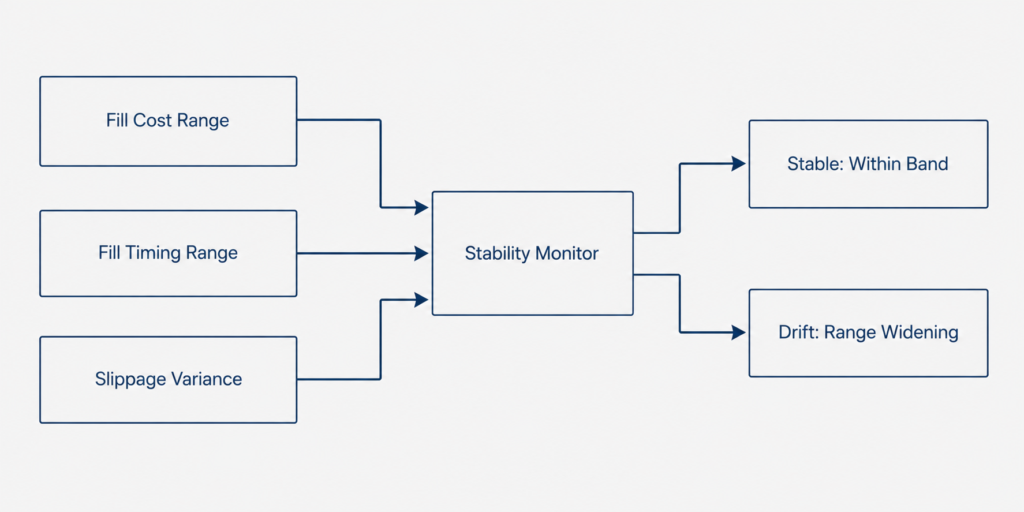
The core metrics are spreads, not averages. The engine tracks the range of fill cost, the range of fill timing, and how both move across regimes. A narrow, steady range signals stability. By contrast, a widening range signals drift.
As a result, the engine watches the spread of outcomes, not just the mean. An average can look healthy while the range underneath it quietly widens.
Furthermore, the engine compares today’s range against its own history. A range that holds is healthy. By contrast, a range that creeps wider, even slowly, is the first sign of trouble.
Slippage variance as a stability signal
Slippage variance is one of the clearest stability signals. A stable engine produces slippage that clusters tightly around its expected value. By contrast, an unstable one produces slippage that scatters.
Therefore, rising slippage variance is an early warning, often visible before any single fill looks alarming. As such, the engine treats that variance as a measurable property to monitor continuously.
A single trade, however, says almost nothing on its own. The signal lives in the distribution across many trades. For this reason, the engine reads stability as a rolling property, not a per-trade verdict. In practice, that means judging the system on its consistency, not on its luckiest or unluckiest fill. One outlier is noise. By contrast, a shifting distribution is information the engine must act on.
Execution Stability and Risk Architecture
Execution stability only earns its place when it changes how the system manages risk. A stable execution layer is not an end in itself. Instead, it is a foundation the risk layer can build on. Therefore, the value of stability is measured by what the risk layer can do because of it.
Execution stability and position sizing
Stable execution lets the risk layer size with confidence. When fills behave within a known band, the engine can commit capital without padding heavily for surprise. By contrast, unstable execution forces the risk layer to hold back.
Therefore, execution stability directly expands how much capital the system can responsibly deploy. Predictability and capacity are linked, not opposed.
In practice, this link runs both ways. Better stability allows more size, and more size makes stability matter more. As such, the two reinforce each other inside a well-built system.
Execution stability and drawdown control
Execution stability also supports drawdown control. Predictable fills make losses predictable in shape, even when they are not predictable in timing. Consequently, the engine can set halt and reduction rules that actually behave as designed.
An unstable execution layer would make those same rules unreliable. As such, stability is what makes risk policy enforceable rather than aspirational.
Furthermore, predictable losses are easier to survive. The engine knows roughly what a bad run looks like, even if it cannot know when it arrives. In this way, the halt rules trigger on real signals rather than on noise.
The Limits of Execution Stability
Execution stability is a powerful property, but it is not the whole system. A disciplined engine understands where stability ends and other layers must take over. As such, it respects the boundary between what stability can and cannot do.
When execution stability is not enough
Execution stability cannot fix a poor decision. A stable fill on a bad entry is still a bad trade. Furthermore, stability says nothing about whether the engine should have acted at all.
For this reason, the engine treats execution stability as one layer among several. It never lets stability stand in for filtration or risk logic. Moreover, a stable layer can execute a flawed plan very reliably, and that is not a strength. Therefore, the engine keeps filtration and decision logic upstream, where they belong.
In addition, execution stability cannot rescue a system from poor data or a broken assumption. It can only deliver, reliably, whatever the layers above it decide. As such, the engine measures stability honestly and reports its limits plainly. Pretending one layer can carry the whole system is itself a form of drift.
Execution stability is not slowness
Execution stability is sometimes mistaken for being slow on purpose. That is a misreading. A stable engine is as fast as it can be within its constraints. It simply refuses to buy speed with variance.
In practice, stability and reasonable speed coexist. The engine gives up only the speed that would cost it predictability, and it keeps the rest. As such, stability and pace are partners rather than opposites, and the discipline lies in knowing which speed is worth keeping.
Therefore, the goal is never slowness for its own sake. The goal is a pace the system can repeat without surprise. In this way, the distinction keeps the engine honest about what it is actually optimising for.
Predictability beats speed because infrastructure is judged over thousands of fills, not one. Execution stability is the property that keeps those fills inside a known band, calm day or violent one. By engineering it into the order path, constraining it deliberately, and measuring it over time, a systematic engine stays modellable, auditable, and repeatable. In this way, execution stability supports the core Dovest principle. Structure comes first, and prediction never enters the design.
Continue Exploring Dovest Research
Explore more behavioural research from Dovest. The series builds a structure-first view of systematic trading, one framework at a time.
About the Author
This article reflects the research perspective of the Dovest team. Dovest designs systematic trading infrastructure with a behaviour-first philosophy. The focus stays on structure, filtration, and risk architecture that keep engine behaviour stable, explainable, and consistent across markets. Dovest writes from an engineering standpoint, not a forecasting one. Every framework here describes how disciplined systems reason, rather than what any market will do next.
Disclaimer
This article is for educational and informational purposes only. It does not constitute financial, investment, or trading advice. Dovest does not provide signals, forecasts, or guaranteed outcomes. Readers should not treat anything here as a recommendation to buy or sell any security. Furthermore, readers should consult a licensed professional before making any financial decision.