How Latency and Queue Risk Reshape Execution Reality
Latency and queue risk rarely appear in performance reports. Nevertheless, they shape every execution outcome the engine produces. By the time slippage shows up in the post-trade record, the underlying conditions that caused it have already moved on.
This article examines latency and queue risk as structural inputs into systematic execution. Specifically, it looks at how delay between decision and venue, combined with uncertainty about where a resting order sits in the book, change what the engine should be allowed to do. As such, the conversation is not about speed for its own sake. Instead, it is about whether the engine acknowledges the conditions under which its instructions actually reach the market.
For Dovest, this connects directly to the behaviour-first principle. Furthermore, it explains why infrastructure decisions sit upstream of risk architecture rather than parallel to it.
What Latency and Queue Risk Actually Mean
The two terms travel together. However, they describe different mechanics. Treating them as one input leads to systematic mispricing of execution cost.
Defining latency in market access terms
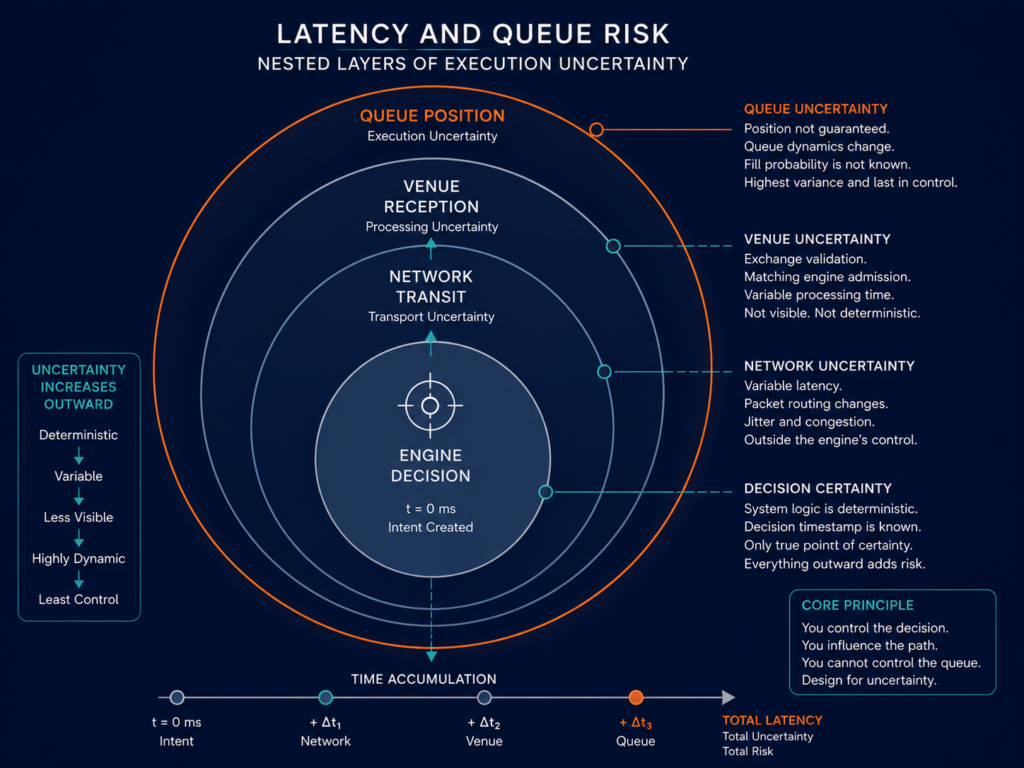
Latency describes the time between when the engine decides and when the venue receives. Specifically, it covers network transit, gateway processing, broker routing, and exchange acknowledgement. Each segment adds time, and each segment varies under conditions the engine does not directly observe. As a result, the same instruction can reach the venue under different conditions depending on the moment it leaves.
In practice, a system that ignores this variation behaves as if its instructions arrive instantly. Furthermore, this assumption is wrong in ways that compound during exactly the conditions when execution matters most.
Defining queue risk in order book terms
Queue risk describes the uncertainty about where a resting order sits relative to other orders at the same price. Specifically, the question is whether the order will execute before or after the prints that move the price away from it. As such, queue risk is not about whether the order fills. It is about which fills the order receives and which it misses.
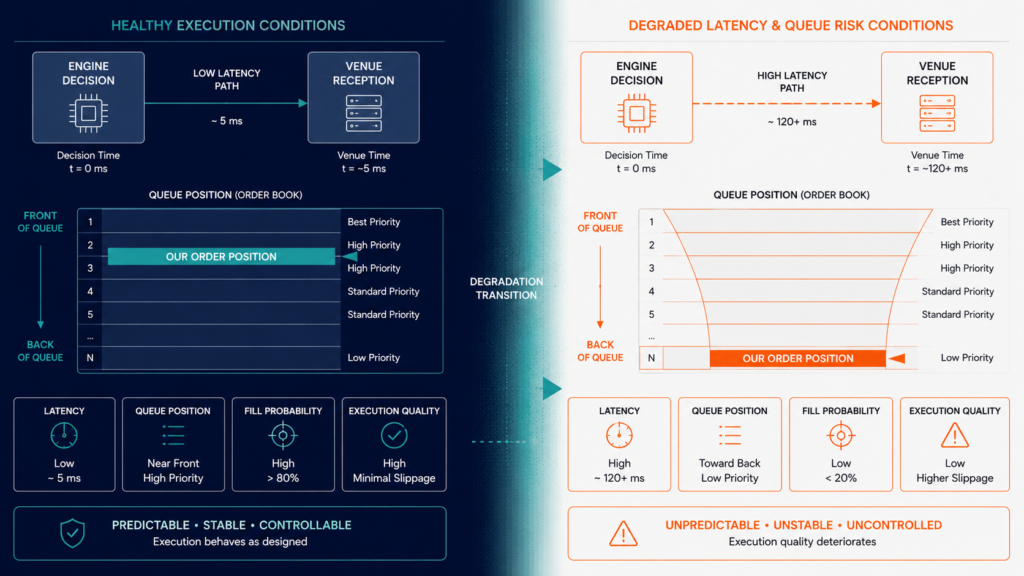
A passive order at a given price may be at the front of the queue or near the back. Therefore, the same price level can produce very different execution outcomes depending on queue position, even when the chart looks identical.
The link between latency and queue risk
Latency shapes initial queue position. Moreover, every millisecond between decision and arrival is a millisecond during which other orders can take the spot the engine intended to claim. By design, this means latency does not just delay execution. Instead, it changes the queue position the order receives, which changes the probability and quality of the eventual fill.
Why Latency and Queue Risk Affect Systematic Execution
A model that performed well in backtests usually assumed that historical prints were available to its orders. By contrast, live execution surfaces the gap between that assumption and reality.
How market access delays degrade fills
When latency widens, the engine’s instructions arrive into a market that has already moved. Therefore, the price level the engine intended to act on may no longer exist by the time the order lands. Specifically, the order receives a worse position, a worse fill, or no fill at all. As a result, the model’s edge survives only as a fraction of what the backtest implied.
This degradation does not appear as a single missed trade. Furthermore, it appears as a systematic shift in the distribution of fills. The good fills become slightly less good. The marginal fills disappear. The cumulative cost is structural, not incidental.
Why backtests overstate executable performance
Backtest assumptions typically grant the model access to historical liquidity that, in live conditions, would have been claimed by faster participants. Equally, backtests assume the order placed itself at the moment the decision was made. In practice, latency creates a gap during which the executable opportunity changes shape.
A backtest that does not model latency and queue risk overstates achievable performance. As such, the live engine produces results that look worse than the model promised, and the team faces the difficult task of distinguishing model failure from execution friction.
The Behaviour of Queue Position Under Real Conditions
Queue position is often treated as a static property. By contrast, it is dynamic, and its dynamics matter most under exactly the conditions that test the engine.
What queue position actually controls
Queue position controls which prints the order receives. Specifically, front-of-queue orders execute against early prints at the level, while back-of-queue orders execute only against late prints, if at all. Furthermore, the fills a back-of-queue order receives are systematically the ones the front-of-queue orders chose to skip. Therefore, the quality of fill is not random. It is a function of position.
In practice, this means an engine that does not model its likely queue position is reading expected execution at the wrong end of the distribution.
How position dynamics shift during stress
During stress, queue dynamics change in two ways. First, the queue refills more aggressively as faster participants reposition. Second, the participants ahead of the engine are increasingly the ones with better information about the next move. As such, the back of the queue during stress is statistically a worse place to be than the back of the queue during calm.
This is examined further in research on system behaviour under stress regimes, which discusses how the same structural inputs produce different execution outcomes when conditions tighten.
How the Engine Should Respond to Queue Risk
Detection is one part of the response. Furthermore, the harder design question is what the engine should do when conditions degrade.
Permission narrowing under degraded conditions
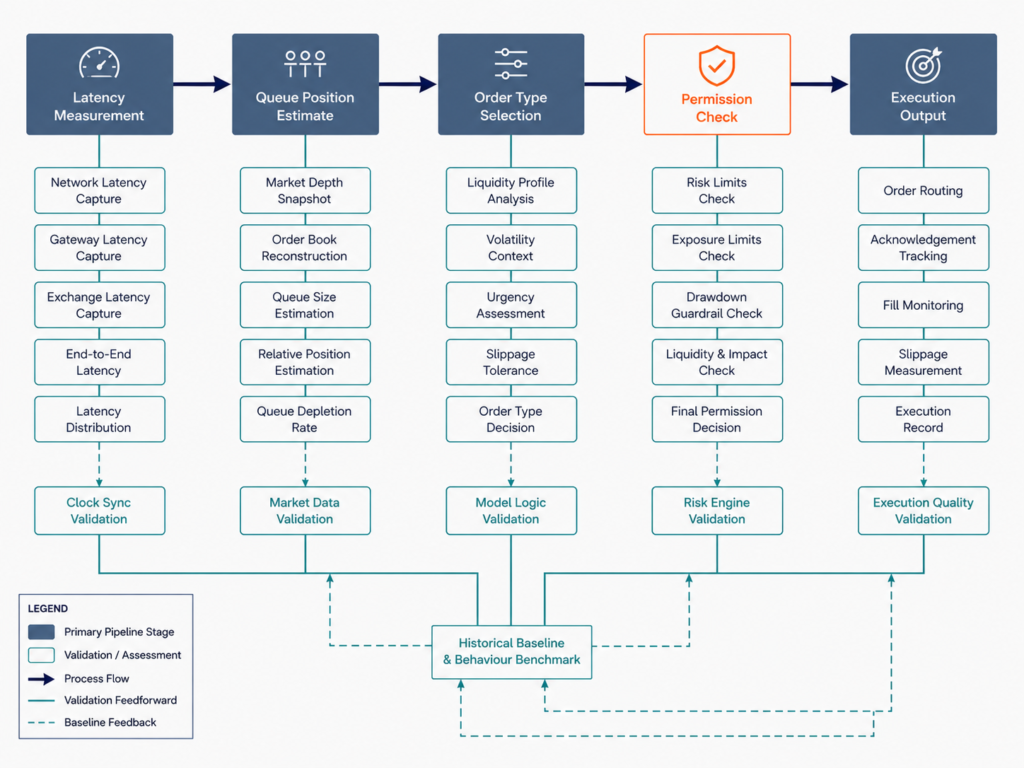
When latency widens or queue dynamics deteriorate, the engine should narrow what it is allowed to do. Specifically, the system reduces the set of instruments it is willing to act on, tightens the conditions under which a passive order is acceptable, and may shift toward order types that do not depend on queue position at all. As a result, the engine’s behaviour responds to the environment without requiring an operator override.
This is the operational meaning of permission narrowing. By design, it preserves the engine’s identity across changing conditions, since the rules that govern narrowing are written in advance.
Skip logic when queue risk is high
A skip is not a defensive reaction. Instead, it is a designed output. When queue risk crosses a defined threshold, the correct action is no action. Moreover, this rule must hold without exception, since the moment exceptions are allowed, the rule loses its protective function.
Skip logic under queue risk also protects the engine from a subtler failure mode. Specifically, it prevents the engine from accumulating positions through marginal fills that would not have existed in a healthy execution environment.
Order type choices for queue risk
Different order types carry different exposure to queue risk. Specifically, marketable orders eliminate queue risk by accepting worse price. Passive orders accept queue risk in exchange for better price. Conditional orders sit somewhere in between, depending on how the venue interprets them. As such, order type selection is itself a response to queue conditions, and a system that uses the same order type regardless of conditions is leaving an input unused.
In practice, the engine should be able to shift order type based on observed conditions, and this shift should be governed by rules rather than judgement.
Latency and Queue Risk in Risk Architecture
Risk architecture decides what the system is allowed to lose under what conditions. Furthermore, latency and queue risk are inputs into that calculation, not separate concerns handled by the execution layer alone.
Sizing under execution uncertainty
Position size in a healthy execution environment and position size under degraded latency should not be the same number. Specifically, the larger the position, the more the exit depends on receiving good queue positions on the way out. Therefore, when conditions suggest queue positions will be poor, size must come down to keep exit cost within acceptable bounds.
In practice, this means the sizing logic reads execution conditions directly, not just signal conditions. As a result, the same setup produces different deployment depending on the operating environment.
Risk constraints that read latency directly
A risk constraint that ignores latency assumes the engine’s exit instruction will reach the venue at the speed of the decision. By contrast, a constraint that reads latency adjusts the worst-case exit assumption to reflect actual conditions. Moreover, this adjustment can be the difference between a stop that contains the loss and a stop that prints well past the intended level.
Therefore, risk architecture that does not include latency is a risk architecture that systematically underestimates worst-case exposure.
Monitoring Latency and Queue Risk
Monitoring transforms observation into structured intelligence. Equally, it provides the evidence the team needs to update thresholds without guessing.
Observable indicators of execution degradation
Several indicators contribute to a monitoring framework. Specifically, the time between order send and venue acknowledgement, the time between venue acknowledgement and first fill or cancel, the percentage of passive orders that complete versus cancel unfilled, and the variance of these metrics over rolling windows. Furthermore, none of them work alone. The framework reads them as a composite.
By design, a single elevated reading is rarely meaningful. By contrast, a sustained shift in the composite is the signal that conditions have changed.
Logging order behaviour for post-trade review
Every order should leave a record of the conditions present at the time. Specifically, the latency at order send, the queue position estimate at acknowledgement, the type of order used, and the eventual outcome. As a result, post-trade review becomes diagnostic. The team can ask whether a poor fill came from a wrong signal or a wrong environment, and the answer arrives from the log, not from intuition.
This connects to the monitoring philosophy explored in research on monitoring pipelines and behaviour drift, which treats execution behaviour as observable rather than inferred.
Slippage attribution through a queue lens
Slippage analysis often stops at the difference between intended price and executed price. However, a queue lens decomposes that number further. Specifically, was the slippage caused by latency widening, by queue position being worse than expected, or by the price level itself disappearing before the order arrived? In practice, each of these has different implications for the engine’s future behaviour, and treating them as one number loses information that matters.
Latency and Queue Risk Across Venues and Regimes
The same engine logic produces different execution outcomes on different venues. Furthermore, the differences are larger than the venue’s marketing materials usually suggest.
Queue behaviour across regions
Different venues operate different matching engines, different tick structures, and different participant compositions. As such, queue dynamics on one venue do not transfer cleanly to another. An order type that performs well on one exchange may underperform on another with what appears to be similar rules.
The regional component is examined in microstructure variance across regions, which addresses how venue-specific behaviour shapes execution expectations.
How regime transitions affect execution
Regime transitions affect queue dynamics in ways that single-regime backtests cannot capture. Specifically, the participant composition changes during transitions, and the orders that get to the front of the queue come from a different mix of strategies. As a result, the engine’s expected position shifts under conditions that look superficially similar but are operationally different. Therefore, queue assumptions valid in one regime do not automatically hold across a transition.
Why Queue Risk Belongs in Engine Identity
Engine identity is the property that lets the same engine carry meaning across time. Furthermore, that identity includes how the engine treats execution conditions, not just signal conditions.
Queue risk and execution discipline
An engine that always trades the same way regardless of queue conditions is not disciplined. Instead, it is consistent in a way that ignores a key input. By design, true discipline includes the willingness to adjust order type, narrow permission, or skip entirely when the execution environment does not support the trade. As such, queue risk awareness is part of the discipline, not a separate concern handled elsewhere.
In practice, the engine’s response to queue risk should be reproducible. The same conditions today and the same conditions next month should produce the same response. Moreover, this reproducibility is what allows the team to demonstrate, with evidence, that the engine handles execution conditions consistently.
What allocators see when this is acknowledged
Institutional allocators evaluate not just whether an engine produces returns, but whether it explains how those returns were earned. Specifically, an engine that can attribute slippage to its causes, that adjusts behaviour when execution conditions deteriorate, and that can show the rules governing those adjustments is operating at a different level of transparency than one that treats execution as a black box.
Therefore, queue risk acknowledgement is not just an engineering improvement. Equally, it is part of the institutional case that the engine can be trusted across the conditions allocators care about.
This is why Dovest treats latency and queue risk as primary inputs into the permission layer that sits in front of every potential execution, rather than as concerns handled only after the trade.
Continue learning about systematic behaviour frameworks
Dovest publishes research on the structural foundations of systematic trading infrastructure. Read the next system note in the series to continue exploring how execution conditions shape engine behaviour across venues and regimes.
Author
This article is part of Dovest’s institutional research series on systematic trading infrastructure. Dovest is an Australia-based engineering-first company focused on the structure, constraints, and governance that make systematic trading engine behaviour stable, explainable, and auditable under real-world stress. The research series is written by the Dovest team, drawing on multi-year work in market microstructure, behaviour-first system design, and live engine monitoring.
Disclaimer
This content is published for institutional research and educational purposes. It does not constitute financial advice, investment advice, trading signals, or any recommendation to buy or sell financial instruments. References to systematic trading infrastructure, monitoring frameworks, and governance principles describe research and design concepts. They should not be read as performance claims, audited results, or product availability statements.