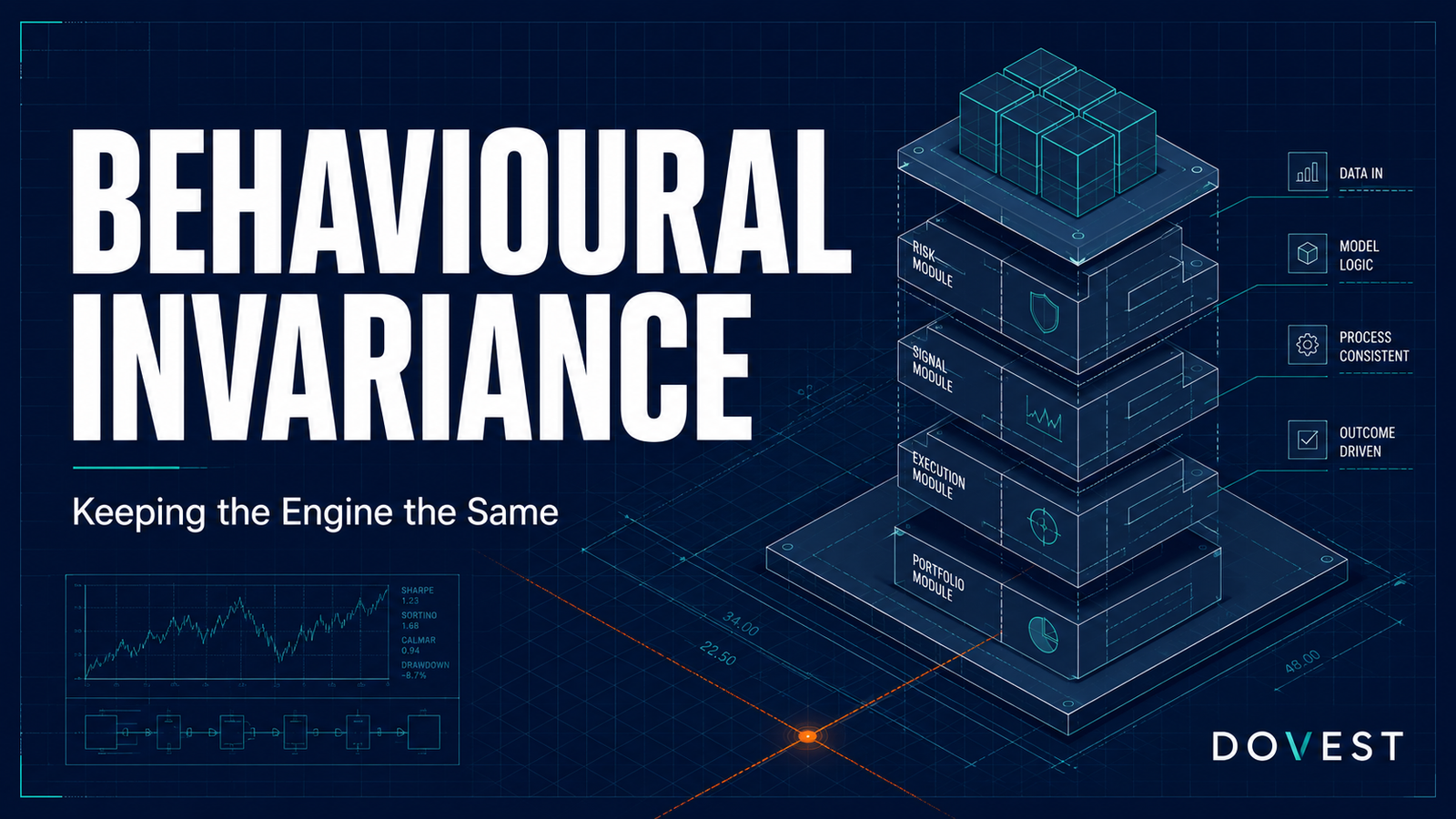
Behavioural Invariance: Why a Systematic Engine Must Stay the Same Engine
Behavioural invariance is the principle that a systematic engine must behave the same way across changing conditions, even when performance varies. The market changes. By design, the engine does not. As such, what allocators evaluate is not the return profile alone, but whether the system that produced those returns is still the same system that will produce the next ones.
This article unpacks behavioural invariance as a structural property of systematic trading infrastructure. Furthermore, it explains why the discipline matters more than performance, why it sits at the centre of institutional credibility, and how engineering choices either preserve or quietly erode it. For Dovest, behavioural invariance is not a marketing concept. Instead, it is the foundation that allows risk, governance, and monitoring to mean anything at all.
What Behavioural Invariance Actually Means
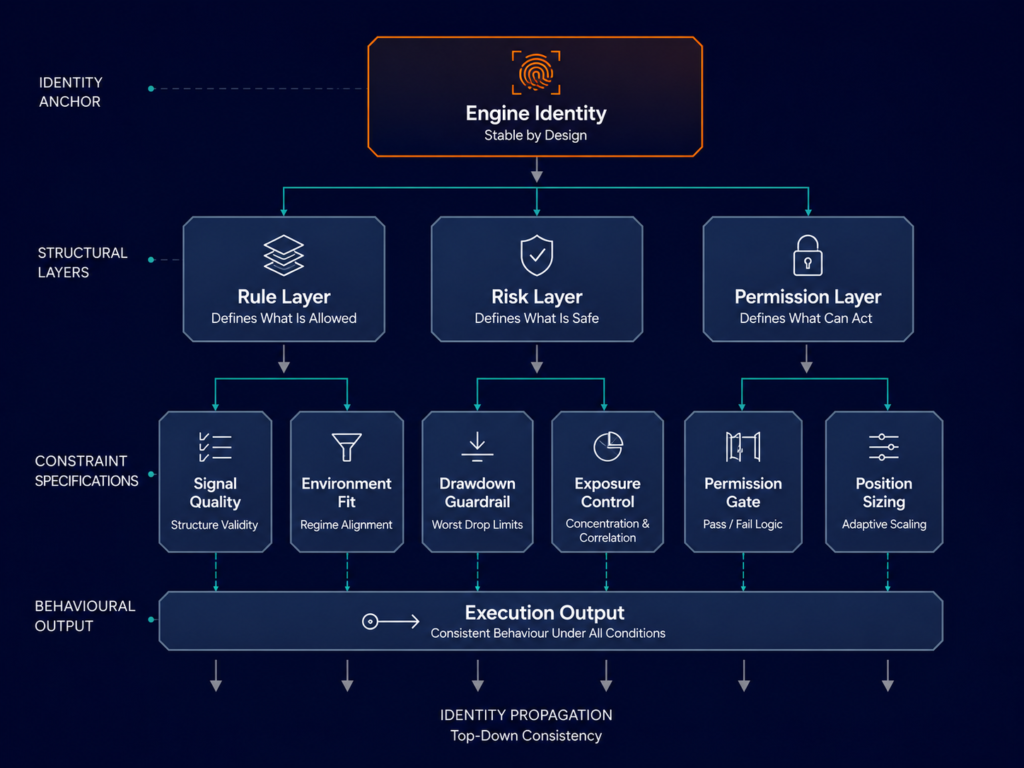
The phrase sounds technical. Nevertheless, the operational meaning is concrete. A system exhibits behavioural invariance when its decision logic, its risk constraints, and its execution discipline remain consistent regardless of the market it is operating in today.
Defining behavioural invariance in operational terms
A system has behavioural invariance when the same inputs produce the same kinds of decisions across regimes. Specifically, a calm month and a volatile month should not alter how the engine evaluates entries, how it sizes positions, or how it skips when conditions fail. The output may differ. However, the reasoning that generates the output stays fixed.
In practice, this means the engine’s identity is encoded in its rules, not in its results. Therefore, the rules themselves become the object of audit, not the equity curve.
How invariance differs from rigidity
A common misreading equates invariance with rigidity. By contrast, invariance describes consistent reasoning, not unchanging action. A rigid system would trade the same way regardless of conditions. As a result, it would fail the moment conditions shifted. An invariant system reacts to conditions through the same logic every time. Consequently, its visible actions change while its internal logic does not.
This distinction matters because the institutional reader needs to see that the engine adapts to environments through structure, not through discretion.
Why behavioural invariance is a structural property
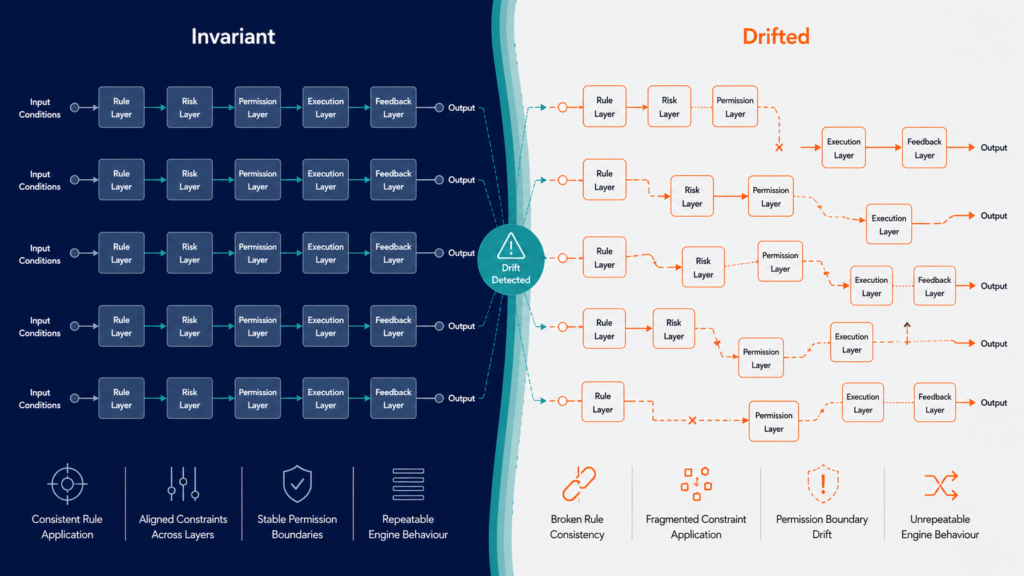
The invariance does not live in any single component. Moreover, it lives in the architecture itself. The way layers are sequenced, the way risk constraints sit ahead of signal evaluation, the way permission narrows and widens with conditions, all combine to produce a system whose behaviour is reproducible. Therefore, invariance is not enforced by a rule at the top. Instead, it emerges from how the engine is built.
Why Behavioural Invariance Defines a Systematic Engine
A systematic engine without invariance is, in operational terms, a discretionary engine wearing systematic clothing. Furthermore, the appearance can hold for months before the underlying inconsistency reveals itself.
Behavioural invariance as engine identity
Identity, in this context, means the engine recognisable across time. Specifically, an institutional reader should be able to look at decisions made twelve months ago and decisions made today and conclude that the same logic produced both. As such, the engine carries an identity that is independent of its recent results.
This identity is what allocators are actually evaluating when they review a track record. They are not just asking whether returns were good. By design, they are asking whether the engine that produced them is still operating under the same constraints today.
The cost of losing behavioural invariance
When invariance breaks, the cost arrives in stages. Early on, the system may produce slightly better results during favourable months by relaxing a rule that was holding it back. However, this short-term improvement carries a hidden bill. Equally, the same relaxation will produce worse outcomes during unfavourable months, since the original constraint existed for a reason. As a result, the system trades the consistency of its behaviour for the volatility of its outcomes.
Behavioural invariance protects the engine from this drift. By contrast, the absence of invariance hides it until conditions reveal it.
Why systematic engines need invariance
Systematic infrastructure exists to remove discretionary inconsistency from execution. Therefore, the value proposition collapses if the system itself becomes inconsistent. An engine that occasionally overrides its own rules during stress is not systematic in any operationally meaningful sense. It is partially discretionary. Furthermore, the part that is discretionary tends to be the part that decides what happens during the moments that matter most.
Behavioural Invariance Across Market Regimes
Regimes change. By design, the engine does not. Furthermore, this is the cleanest test of whether behavioural invariance is actually present or merely claimed.
Behavioural invariance in calm regimes
Calm regimes are the easiest place to maintain invariance, since the system rarely encounters pressure that tests its discipline. Nevertheless, calm regimes also produce the temptation to widen exposure, to relax filters, or to take signals the engine would otherwise skip. Therefore, the discipline of staying invariant during calm months is what makes invariance during volatile months possible. A system that loosens itself during easy conditions has already changed its identity before the next stress event arrives.
This dynamic is examined in system behaviour under stress regimes, which addresses how engines that survive stress are usually those that did not relax during the prior calm period.
Behavioural invariance under stress regimes
Stress regimes test invariance differently. Specifically, they test whether the system will execute its own skip rules under pressure, whether risk constraints hold when emotional incentive pushes against them, and whether the operator can refrain from overriding the engine. In practice, this is where most systems fail. Moreover, the failure is not usually visible as a single dramatic decision. Instead, it shows up as a small adjustment that becomes a pattern, then becomes a habit, then becomes the new default.
Transition handling without losing invariance
The hardest test arrives during regime transitions, since the conditions that defined the prior regime no longer hold but the conditions that will define the next regime have not stabilised. As such, the engine must continue to apply its rules consistently while the inputs it is reading change underneath. Therefore, invariance during transitions is preserved by the rules themselves, not by the operator’s judgement about which regime is currently in effect.
Risk Architecture Under Behavioural Invariance
Risk architecture is where invariance shows up most clearly. By design, the rules that define risk must hold regardless of recent performance.
Risk rules that preserve behavioural invariance
A risk rule is invariant when it produces the same response to the same input every time. For example, a drawdown threshold that triggers reduced exposure must trigger reduced exposure every time it is hit. Furthermore, the trigger must not be relaxed because the operator believes the next month will recover. In practice, the moment a risk rule is conditional on belief about the future, it is no longer invariant. As a result, it stops protecting the engine from its own optimism.
Position sizing under invariance
Position sizing offers a similar test. Specifically, the size assigned to a given setup under given conditions should be reproducible. The same conditions today and the same conditions next month should produce the same size, allowing for changes in capital base. Moreover, when sizing varies for reasons that cannot be traced back to a rule, invariance has been compromised. Therefore, the documentation of sizing logic becomes part of the proof that the engine remains the same engine.
Pre-commitment as an invariance mechanism
Pre-commitment rules are written before stress arrives, precisely so that stress cannot rewrite them. As such, they are one of the cleanest mechanisms for enforcing invariance. The decision is made under calm conditions, recorded, and applied automatically when the triggering condition appears. Equally, the operator’s role becomes verification, not deliberation. In this way, the engine maintains continuity of behaviour across exactly the moments when discretion would most want to intervene.
Monitoring the Engine for Drift
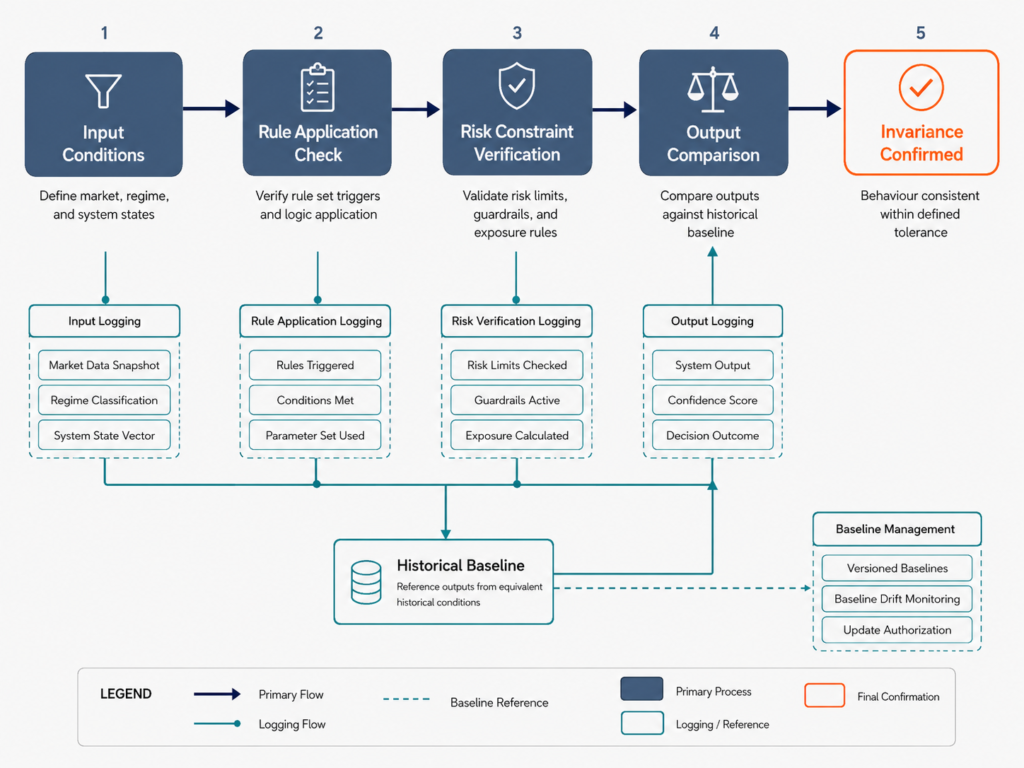
Invariance is not assumed. By design, it is verified continuously. Furthermore, the verification framework is what allows the team to say, with evidence, that the engine today is the engine that was deployed.
Observable signals of behavioural drift
Drift rarely announces itself. Instead, it accumulates in small inconsistencies that only become visible when reviewed against a baseline. Specifically, the team should observe whether skips happen at the expected rate, whether sizing distributions match historical norms, whether risk triggers fire when their conditions appear, and whether the engine’s response time to deteriorating conditions has changed. As such, each of these observations forms a piece of the invariance proof.
Logging behaviour state continuously
Every decision the engine makes should leave a record. Moreover, the record should include the conditions present at the time, the rules that fired, and the outputs that resulted. In practice, this logging discipline turns invariance from a claim into a verifiable property. Therefore, when the team is asked whether the engine has drifted, the answer is not an opinion. The answer is a comparison against the log.
This approach connects to the broader monitoring philosophy explored in research on early warning systems, which treats behavioural change as an observable rather than an inferred quantity.
Versioning without breaking continuity
Engines evolve. However, evolution must be deliberate. Specifically, any change to the rule set should be recorded as a version, with the rationale, the date, and the expected behavioural impact. As a result, when behaviour changes, the team can identify whether the change came from a versioned update or from unintended drift. Without versioning, the two are indistinguishable.
Performance Versus Behavioural Invariance
A common confusion treats consistent performance as evidence of invariance. By contrast, the two are different properties, and they can move independently.
Performance can vary while behaviour holds
Returns vary because conditions vary. Furthermore, an invariant engine in a difficult environment will produce different returns than the same engine in a favourable environment. This variation is expected. Equally, it is the correct outcome, since the engine is responding to the conditions it actually faces, not the conditions it would prefer. As such, performance variation is consistent with invariance, provided the reasoning that produced it remains the same.
Why behavioural invariance is not consistency of returns
Consistent returns can be produced by a system that is quietly changing its behaviour to chase results. Therefore, return consistency is not, on its own, evidence that the engine is invariant. Moreover, return consistency without invariance is often more dangerous than visible return variation, since it suggests the system has been optimised to produce a target outcome rather than to apply a fixed logic.
Reading performance through invariance
The institutional way to read performance is through the lens of invariance. Specifically, the question is not just whether returns were positive, but whether the engine that produced those returns applied the same rules it applies today. By design, this reframes the conversation. Furthermore, it shifts the evaluation from outcomes to the system that generated them.
Engineering Choices That Protect the Engine
Invariance is preserved by engineering, not by intention. Moreover, every architectural decision either supports or weakens it.
Constraints that enforce behavioural invariance
The strongest defence against drift is structural. Specifically, when the rules are encoded such that they cannot be casually overridden, drift becomes a deliberate act rather than an accidental one. Furthermore, this often means writing the rules into the system in a way that requires a formal change-control process to modify. As such, the friction of changing the engine becomes part of the engine’s protection.
Change control as protection
A change-control process is not bureaucracy. By design, it is the mechanism that ensures every modification is recorded, reviewed, and justified before it enters the system. Therefore, the engine that exists after a change is documented to be different in specific ways. Without this process, changes accumulate invisibly, and the engine becomes something other than what it was originally validated to be.
The role of skip logic in preserving invariance
Skip logic deserves particular attention. Specifically, an engine that can decide not to act under defined conditions retains its invariance during exactly the moments when discretionary systems most often fail. As such, the rule that says “do not trade here” is one of the most important rules in the system. Equally, it is the rule that operators are most likely to want to override, which is precisely why it must be structurally protected.
Why Allocators Need Behavioural Invariance Evidence
Allocators evaluate systematic engines as long-duration commitments. Furthermore, the commitment only holds value if the engine they are committing to today is the engine they will still have a year from now.
What allocators see when invariance holds
When invariance holds, the allocator can read the engine’s history as a continuous record. Specifically, they can see how the engine behaved during a stress event two years ago and know, with reasonable confidence, that it will behave the same way during the next one. As a result, the allocation decision becomes possible. Without invariance, the decision becomes a guess about which version of the engine they are currently funding.
Behavioural invariance and institutional trust
Trust, in institutional contexts, is built on reproducibility. Moreover, reproducibility is the operational meaning of invariance. Therefore, an engine that demonstrates behavioural invariance over time accumulates trust in a way that performance alone cannot generate. In practice, this is why Dovest treats invariance as the foundation of its architecture, ahead of any conversation about returns or capacity.
This is the institutional view on systematic trading infrastructure. The engine must stay the same engine. Furthermore, the discipline of keeping it the same is what allows everything else, including risk architecture, monitoring, and governance, to function as designed.
Continue learning about systematic behaviour frameworks
Dovest publishes research on the structural foundations of systematic trading infrastructure. Read the next system note in the series to continue exploring how engineering decisions shape engine identity across changing market conditions.
Author
This article is part of Dovest’s institutional research series on systematic trading infrastructure. Dovest is an Australia-based engineering-first company focused on the structure, constraints, and governance that make systematic trading engine behaviour stable, explainable, and auditable under real-world stress. The research series is written by the Dovest team, drawing on multi-year work in market microstructure, behaviour-first system design, and live engine monitoring.
Disclaimer
This content is published for institutional research and educational purposes. It does not constitute financial advice, investment advice, trading signals, or any recommendation to buy or sell financial instruments. References to systematic trading infrastructure, monitoring frameworks, and governance principles describe research and design concepts. They should not be read as performance claims, audited results, or product availability statements.