Why Calm System Output Transforms Systematic Trading Architecture
Most traders chase calm as a mindset. They read psychology books, practise meditation, and build morning routines. However, calm system output operates on a different principle entirely. In systematic trading infrastructure, calm does not come from the operator. Instead, the architecture produces it. The system generates behavioural stability through structure, constraints, and pre-defined logic. Therefore, calm becomes an engineering output, not a personal achievement.
This distinction matters for institutional design. When calm depends on human discipline, it fails under stress. By contrast, when calm system output emerges from architecture, it persists regardless of market conditions. Dovest builds on this principle. The framework treats operator emotion as irrelevant to execution quality. Constraints, filtration, and risk logic produce the stability that matters.
What Calm System Output Really Means
Redefining Calm as an Engineering Variable
Retail trading culture frames calm as emotional regulation. Traders learn to “control their emotions” and “stay disciplined.” However, this framing places the burden on human psychology. In practice, human discipline degrades under fatigue, boredom, and sustained drawdown.
Specifically, calm system output reframes the entire concept. It treats calm as a measurable property of system behaviour. A well-architected engine produces consistent outputs across varying market conditions. The system does not panic. Similarly, it does not overtrade or chase. As a result, the observable behaviour remains stable because the architecture enforces stability.
This reframing carries significant implications. Engineers do not need to build emotional resilience into operators. Instead, they build structural constraints into systems. The architecture itself becomes the source of discipline.
Moreover, this distinction changes how teams evaluate system performance. A system that produces erratic outputs under stress reveals an architectural weakness, not an operator weakness. Consequently, the engineering response focuses on tightening constraints rather than training operators. The framework improves through structural iteration. Each constraint adjustment narrows the range of possible outputs. Over time, this compounding discipline makes calm system output increasingly reliable without any change in operator behaviour.
How Calm System Output Differs from Emotional Control
Emotional control requires continuous effort. A trader must actively suppress impulses during every session. Furthermore, this effort compounds under stress. The more volatile the market, the harder emotional control becomes.
By contrast, calm system output requires no ongoing effort from the operator. The system enforces its own constraints automatically. Specifically, pre-commitment rules lock decisions before pain arrives. Filtration logic rejects unsuitable environments before entry. Similarly, exit logic executes without hesitation or renegotiation.
In this way, the difference becomes structural. Emotional control depends on the weakest link in human cognition. Architectural stability depends on the strongest link in system design. One degrades under pressure. The other persists through it.
Additionally, emotional control creates an invisible dependency. The system’s performance becomes tied to the operator’s personal state. Sleep quality, personal stress, and even caffeine intake affect execution quality. Systematic infrastructure eliminates this dependency entirely. The architecture performs the same way regardless of who monitors it. As a result, the system’s behavioural quality decouples from individual human variability.
Why Emotion Fails as a Trading Input
The Cost of Discretionary Override
Discretionary override introduces variance at the worst possible moment. When a system generates a signal, the human operator second-guesses it. Some delay entry. Others reduce size. A few skip the trade entirely. Consequently, the system’s expected behaviour no longer matches its actual behaviour.
This variance destroys auditability. Allocators cannot evaluate a system that operators routinely override. Moreover, the overrides cluster around high-stress moments, precisely when the system’s logic matters most. The result compounds over time. Each override erodes the statistical foundation that justified the system’s design.
Furthermore, discretionary override creates a feedback loop. One override lowers the threshold for the next. The operator learns that overriding produces short-term comfort. Consequently, overrides become habitual rather than exceptional. The system still runs, but the operator has quietly replaced its logic with personal judgment. In this way, the entire infrastructure degrades while appearing functional on the surface.
Boredom and the Danger of Reactive Decisions
Stress receives most of the attention in trading psychology. However, boredom presents an equally dangerous threat. During quiet market periods, operators grow restless. Some enter positions outside the system’s parameters. Others adjust filters to generate more activity. Additionally, many rationalise these adjustments as “improvements.”
In practice, reactive decisions degrade system integrity. The engine’s behaviour drifts without any change to its code. For this reason, systematic infrastructure must remove the operator from the execution loop entirely. The system trades when conditions align. It waits when they do not. Boredom becomes irrelevant as an input.

How Architecture Produces Calm System Output
Constraint Logic and Calm Output Quality
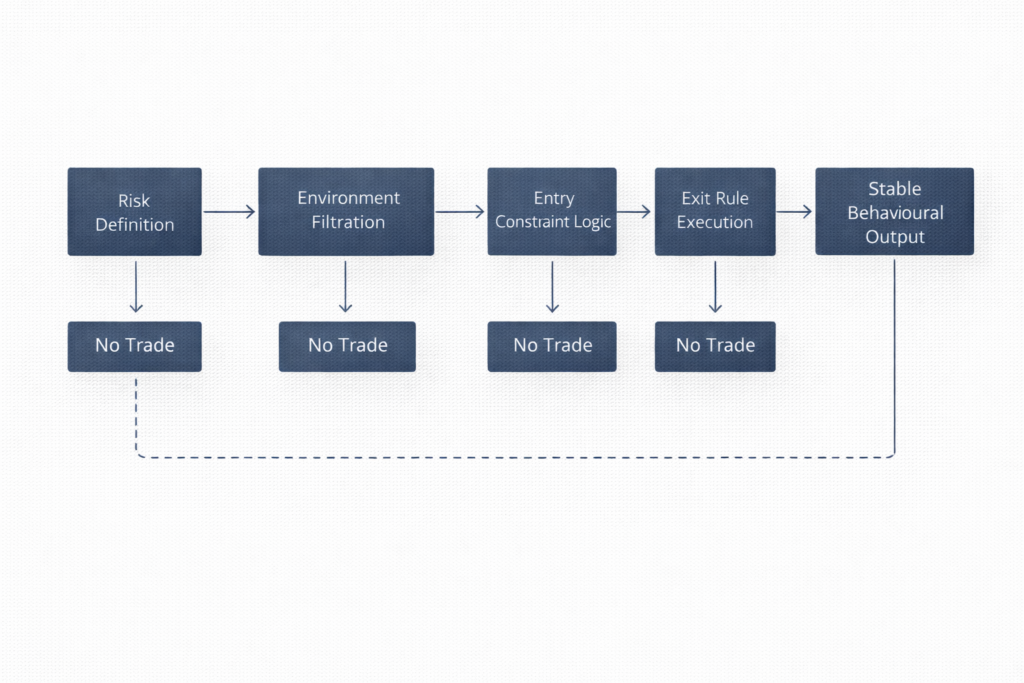
Every constraint reduces the system’s degrees of freedom. Fewer degrees of freedom mean fewer opportunities for erratic behaviour. Specifically, entry constraints define exactly which conditions permit capital deployment. The system checks environment, volatility regime, and liquidity depth before any execution occurs.
These constraints operate independently of operator sentiment. Instead, the architecture evaluates conditions against pre-defined thresholds. If conditions fail, the system produces no trade. Therefore, the output remains stable because the architecture permits nothing else.
Furthermore, this principle extends beyond entry. Holding logic constrains position management. Exit logic constrains closure timing. Each layer reduces optionality. As a result, the system converges toward consistent, predictable behaviour by design.
Exit Rules and System Output Stability
Exit logic represents one of the most critical architectural layers. Many systems define strong entry criteria but leave exits to discretion. In practice, this creates the exact vulnerability that destroys behavioural stability.
Systematic exit rules remove this vulnerability entirely. By design, the framework defines exit conditions before any position opens. Time-based exits, threshold exits, and regime-change exits all operate without human input. Consequently, the system closes positions based on pre-committed logic, not real-time emotion.
In particular, this matters because exits cluster around maximum psychological pressure. Profits trigger greed. Losses trigger fear. Both emotions distort discretionary decisions. However, pre-defined exit rules bypass these distortions completely. The pre-commitment rules and decisions made before pain framework explains why locking exits early preserves behavioural quality across all conditions.
Structural Layers Behind Calm System Output
Risk Definition Anchors System Output
Risk architecture operates as the foundation layer. The framework defines maximum exposure, position sizing, and drawdown limits before any signal evaluation occurs. In particular, these definitions constrain the worst-case scenario at the point of entry.
When risk constraints hold firm, the system’s behaviour during adverse conditions remains predictable. Consequently, the engine does not scramble to reduce exposure during a drawdown. Instead, exposure limits already reflect the anticipated downside. Therefore, calm system output begins with risk definition, not signal quality.
Institutional frameworks treat downside-focused risk architecture as the primary design constraint. Signal logic operates within boundaries that risk architecture establishes. This hierarchy produces stability because the most important decisions happen first.
Moreover, risk definition creates psychological insulation for the broader operation. When the worst-case scenario sits within acceptable limits before any trade opens, the entire execution chain operates without urgency. Drawdowns do not trigger panic because the framework already accounts for them. Consequently, the architecture absorbs adverse outcomes without behavioural disruption. The system continues operating within its documented parameters regardless of short-term results.
Position Sizing Supports Calm Output
Size determines the system’s behavioural footprint. A position that represents 0.5% of capital creates different pressure dynamics than one representing 5%. However, in systematic infrastructure, the operator’s psychology becomes irrelevant to sizing decisions.
Instead, position sizing follows algorithmic rules. The system calculates size based on volatility, regime, and available capacity. It never adjusts size based on recent performance or operator confidence. As a result, sizing remains consistent across winning and losing periods alike.
This consistency contributes directly to behavioural stability. The system never “bets big” after a streak. It never reduces size from fear. Sizing logic produces the same output regardless of recent history. In this way, calm emerges from mathematical discipline, not emotional regulation.
Filtration Logic and Calm System Output
Environment Gates Protect System Output
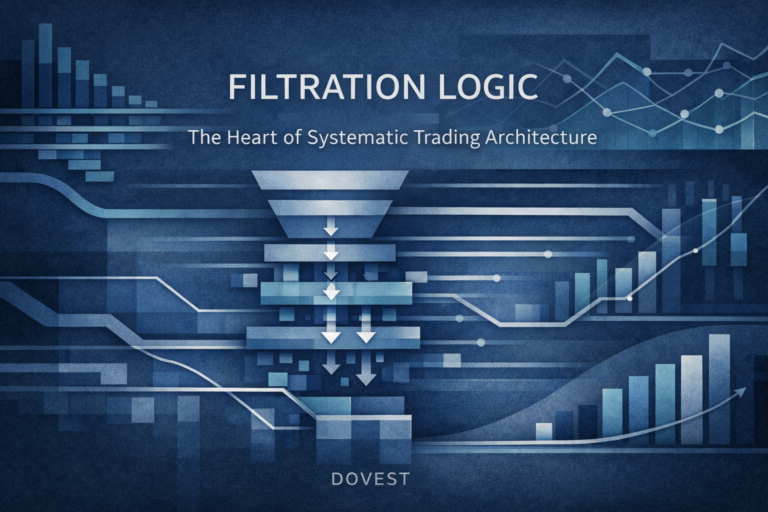
Filtration logic acts as the system’s first line of defence. Before evaluating any signal, the framework assesses the trading environment. Volatility regime, liquidity conditions, and structural context all pass through independent filters.
Each filter operates as a gate. Therefore, if the environment fails any gate, the system does not proceed to signal evaluation. Specifically, this means the system rejects entire sessions when conditions fall outside defined parameters. The result preserves behavioural quality by avoiding environments where the system’s edge diminishes.
This approach differs fundamentally from retail logic. Retail traders look for signals first and consider environment second. Systematic infrastructure reverses this hierarchy. Environment determines whether the system’s logic applies. Signals only matter within suitable environments.
Additionally, gate-based filtration prevents the system from adapting to unsuitable conditions. Many retail strategies attempt to “work in all environments.” However, this flexibility introduces fragility. A system that trades everywhere accumulates exposure in environments where its edge does not exist. By contrast, strict environment gates ensure the system only operates where its behavioural model applies. Consequently, the output quality remains high because the input quality stays controlled.
How Rejection Preserves Calm Output
A system that rejects frequently demonstrates filtration quality, not failure. High rejection rates indicate that the architecture maintains strict standards. Instead, the system trades only when multiple conditions align simultaneously.
In practice, this produces long periods of inactivity. The system waits. It observes. It evaluates. Then it rejects. For retail traders, inactivity feels like failure. For systematic infrastructure, it represents discipline in action.
Furthermore, rejection preserves the statistical integrity of executed trades. Every trade that passes through filtration carries higher expected quality. The system’s record reflects only conditions where its logic applies. As a result, behavioural consistency improves because the sample excludes unsuitable environments entirely.
Monitoring Without Intervention
Observation Replaces Manual Oversight
Systematic monitoring serves a specific purpose. It observes system behaviour without altering it. The monitoring pipeline tracks execution quality, slippage, fill rates, and regime alignment in real time. However, it does not intervene in execution decisions.
This separation matters for behavioural stability. In discretionary frameworks, monitoring and intervention happen simultaneously. The trader watches the market and adjusts in real time. In systematic infrastructure, monitoring feeds an observation layer only. Intervention follows pre-defined escalation rules, not real-time judgment.
As such, the monitoring layer reinforces stability. The system continues executing its logic while the observation pipeline records every detail. Engineers review these records after sessions, not during them.
In addition, this separation creates a clean audit trail. Every execution occurs without human interference. Every observation records what actually happened, not what an operator intended. Therefore, the monitoring data reflects pure system behaviour. Allocators can review this data with confidence that no human intervention contaminated the results. This transparency strengthens institutional credibility at every level of due diligence.
Alert Design and Escalation Protocols
Alert systems define when human attention becomes necessary. However, they do not define what action to take. The alert pipeline categorises events by severity. Low-severity alerts generate logs. Medium-severity alerts trigger notifications. High-severity alerts activate pre-defined halt protocols.
In particular, halt protocols represent the system’s most important safety mechanism. When conditions breach critical thresholds, the system stops trading automatically. It does not rely on an operator noticing a problem. Instead, the architecture self-enforces its own boundaries.
This design produces calm system output at the governance level. The system protects itself. Engineers review halt events after they occur. The architecture handles emergencies through structure, not through human reaction speed.
Nevertheless, alert design requires careful calibration. Too many alerts desensitise operators. Too few alerts leave critical events unnoticed. Therefore, the alert pipeline must balance sensitivity with actionability. Each alert tier serves a distinct purpose. Logs capture everything for later analysis. Notifications flag conditions that warrant attention. Halt protocols protect the system from catastrophic exposure. By design, this tiered approach keeps human involvement proportional to event severity.

Why Allocators Value Calm System Output
Behavioural Consistency as System Output
Allocators evaluate systems on behavioural consistency, not peak performance. A system that generates extraordinary returns in one quarter but erratic behaviour in the next creates evaluation problems. Consequently, allocators favour frameworks that produce predictable behavioural signatures across market conditions.
Architectural stability provides exactly this predictability. The system behaves the same way during volatility spikes as during quiet sessions. It filters, constrains, and executes according to the same logic regardless of external conditions. This consistency makes the system auditable and comparable across time periods.
Moreover, behavioural consistency simplifies risk attribution. When the system behaves predictably, allocators can isolate whether outcomes resulted from market conditions or system logic. This separation drives institutional confidence.
In particular, consistent behaviour enables meaningful comparison across time periods. An allocator reviewing six months of system output can identify whether the architecture maintained its behavioural signature through different market regimes. If the system behaves the same way during trend days, range days, and volatility events, the architecture demonstrates robustness. Consequently, allocators gain confidence that the framework will continue performing within documented parameters. This predictability separates institutional infrastructure from discretionary approaches that produce inconsistent behavioural profiles.
System Output as Due Diligence Evidence
Due diligence processes focus on repeatability. Allocators ask whether the system will behave tomorrow the way it behaved yesterday. Specifically, they examine whether behavioural stability depends on operator skill or architectural design.
However, systems that depend on operator calm fail this test. Personnel changes, fatigue cycles, and stress events all create behavioural variance. By contrast, architecture-driven stability persists across operator changes. The system’s behaviour belongs to the architecture, not the individual.
For this reason, stable system output serves as direct evidence of engineering quality. The architecture demonstrates its own discipline. Allocators verify constraint logic, filtration rules, and exit protocols independently. The system’s consistency becomes auditable proof that structure governs behaviour.
Engineering Repeatability Through Structure
Version Control and Behaviour Preservation
System architecture requires version discipline. Every change to constraint logic, filtration rules, or exit parameters receives documentation and version tagging. This practice ensures that behavioural changes trace back to specific architectural decisions.
In addition, version control enables rollback capability. If a parameter change degrades behavioural stability, engineers revert to the previous version. The system returns to its prior stable state. This capability only exists because the architecture treats behaviour as a versioned, measurable property.
Without version control, systems drift. Small parameter adjustments accumulate over time. The system’s behaviour gradually changes without any single decision causing the shift. Version discipline prevents this drift by making every change explicit, documented, and reversible.
Similarly, version control supports institutional governance requirements. Regulators and allocators expect documented change histories. They want to see when parameters changed, why they changed, and what effect each change produced. Therefore, version discipline serves both engineering and compliance purposes simultaneously. The framework maintains behavioural integrity while generating the documentation trail that institutional stakeholders require.
From Architecture to Institutional Trust
Calm system output represents more than operational stability. It represents a philosophy of system design. The architecture accepts responsibility for behavioural quality. It does not delegate discipline to operators. It does not rely on emotional regulation. Instead, it engineers the conditions that make stability inevitable.
This philosophy builds institutional trust over time. Each session of consistent behaviour reinforces the framework’s credibility. Allocators observe that the system performs as documented. Engineers verify that constraints hold under stress. In practice, the architecture proves itself through repetition, not through promises. Therefore, trust accumulates session by session, not through marketing claims or performance projections.
Ultimately, calm is not something systematic trading infrastructure aspires to achieve. The architecture produces it. By design, every constraint, filter, and rule contributes to this output. The system does not try to be calm. It simply operates that way, because the structure permits nothing else.
For this reason, calm system output stands as the clearest indicator of architectural maturity. Young systems produce volatile behaviour because their constraints remain incomplete. Mature systems produce stable behaviour because every layer enforces discipline independently. The progression from volatility to calm reflects the progression from incomplete architecture to comprehensive engineering. In this way, calm becomes both the goal and the proof of systematic trading infrastructure done right.
Continue Learning
Continue learning about systematic behaviour frameworks and infrastructure-first trading principles. Dovest publishes ongoing research on structure, filtration, and governance in systematic trading architecture.
About the Author
Dovest Research | Systematic Trading Infrastructure
Dovest designs and monitors systematic trading engines with a focus on behavioural stability, structural discipline, and institutional-grade governance. All content reflects foundational research, behaviour-first methodology, and engineering-grade reasoning.
Disclaimer: This article represents institutional research and educational content only. It does not constitute trading advice, signal provision, or performance claims. Systematic trading involves risk. Past frameworks do not guarantee future outcomes.