Why Allocation Scaling Should Follow Behaviour, Not ROI
Allocation scaling sits at the centre of institutional capital management. Most operators treat the decision as an output of recent returns. Larger allocations follow stronger ROI. Smaller allocations follow weakness. By contrast, behaviour-first systematic frameworks treat scaling decisions as questions about system stability, not about reward. The question becomes whether the engine continues to behave correctly, not whether last quarter looked good.
This distinction matters because ROI is a lagging indicator. Behaviour is a leading one. As such, scaling capital based on returns places fresh institutional money behind conditions that may already be deteriorating. In practice, this is one of the most common ways systematic operations break under pressure.
The Problem with ROI-Driven Allocation Scaling
Most allocation frameworks anchor on performance. Capital flows toward what worked recently. However, recent results are noisy. A two-month return window can absorb structural drift, regime shifts, and broken risk controls without showing the damage. Operators reading ROI alone cannot distinguish luck from design.
As a result, ROI-led scaling decisions tend to amplify the wrong signals. Stronger returns frequently coincide with looser risk states, larger exposure windows, or accidental regime alignment. By the time those conditions reverse, additional capital has already arrived. The fragility was already there. The very results that justified the scale-up obscured it.
Why Recent Returns Mislead Allocation Scaling
Returns describe the past. Scaling decisions, by contrast, commit the next period. Therefore, an allocation decision built on returns faces the wrong direction. Furthermore, the conditions that produced the returns may have already shifted. In particular, mean-reversion engines often deliver their strongest numbers during fragile regimes where dislocations resolve quickly. As such, those same conditions can flip to extended trends with very little warning. Scaling capital on the strength of those past quarters increases exposure to the next regime, not the prior one.
How ROI Anchors Distort Risk Perception
ROI feels concrete. Risk feels abstract. Consequently, allocators tend to weigh recent returns more heavily than abstract risk constraints, even when the constraints carry more information. In practice, this leads to a slow inversion of priorities. The engine starts getting judged by what it returned, not how it behaved. Moreover, the same behaviour producing strong returns in one regime may produce drawdowns in another. By contrast, behaviour metrics remain stable across regimes when the framework anchors them correctly.
What Behaviour-Based Decisions Actually Measure
Behaviour-first frameworks ask a different question. Instead of asking what the engine produced, they ask whether the engine produced it the way the design intended. This shift redefines what scaling actually responds to. By design, behaviour-based scaling responds to internal system state, not external results.
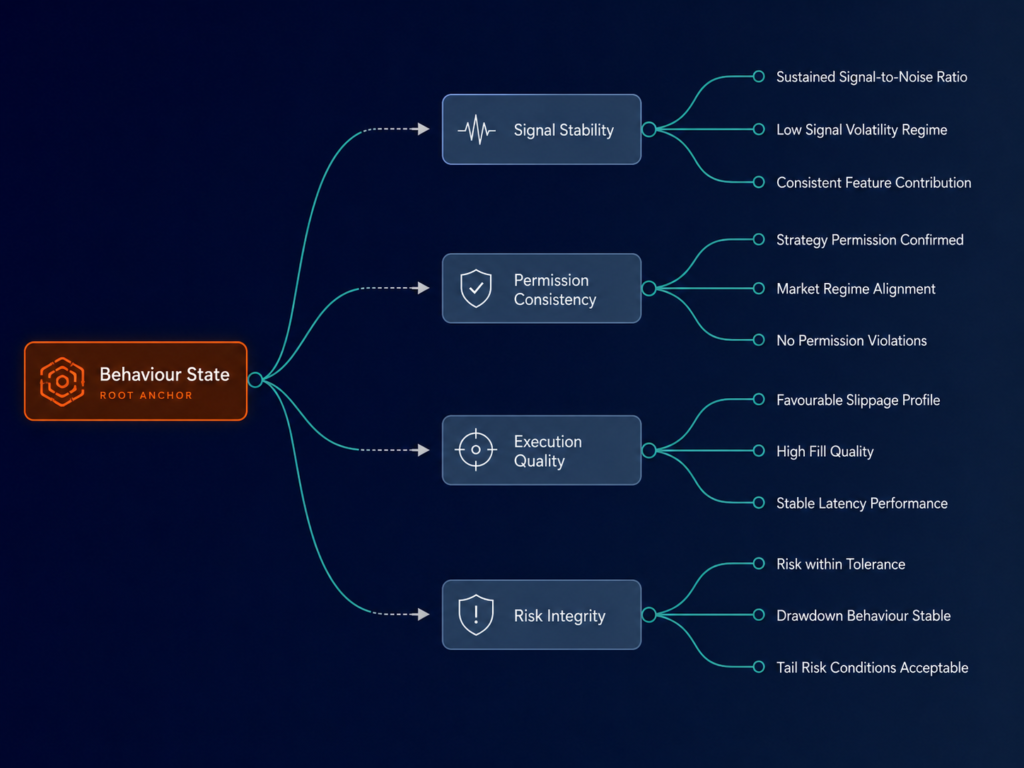
In particular, the framework tracks four observable categories of behaviour. Specifically, those categories cover signal stability, permission state consistency, execution quality, and risk constraint integrity. Each one is measurable. Furthermore, each one stands independent of returns.
Signal Stability and Allocation Scaling
Signal stability measures whether the engine generates entry conditions at expected rates and from expected structures. As such, a system that suddenly generates more signals than usual, or generates them from atypical setups, has started to drift. In addition, the same applies to signal scarcity. The framework should treat signal output as a primary scaling input. A system producing stable, design-aligned signals occupies a state that supports additional capital. By contrast, a system producing erratic or off-pattern signals does not.
Permission State Consistency Across Regimes
Permission state describes whether the engine currently has authorisation to trade, based on regime filters, volatility constraints, and structural conditions. Specifically, a behaviour-stable engine will move between permission states predictably. In practice, the engine stays active during conditions that fit its edge. The engine stays inactive during conditions that do not. The transitions between those states follow the design rules. Furthermore, regime-aware permission behaviour reveals far more than recent returns. Erratic permission behaviour signals a clear warning, regardless of what ROI looks like.
Execution Quality Under Varying Conditions
Execution quality covers slippage, fill rates, and the gap between planned and realised orders. Stable execution means the engine behaves consistently across normal and stressed conditions. Consequently, an engine with deteriorating execution should not receive additional capital, even when returns still look positive. In particular, deteriorating fills often precede broader behaviour drift. As such, watching execution quality gives operators one of the earliest available signals.
The Architecture of Allocation Scaling Discipline
Scaling discipline must remain structural, not discretionary. Specifically, the framework should make scaling decisions before the moments when scaling decisions get emotionally distorted. In this way, the architecture protects allocators from their own behavioural biases when results swing in either direction.
For this reason, well-designed frameworks separate scaling logic from scaling execution. Therefore, operators write and version the rules that govern when to scale up or scale down in advance. The execution of those rules happens mechanically when the conditions hold.
Pre-Defined Allocation Scaling Triggers
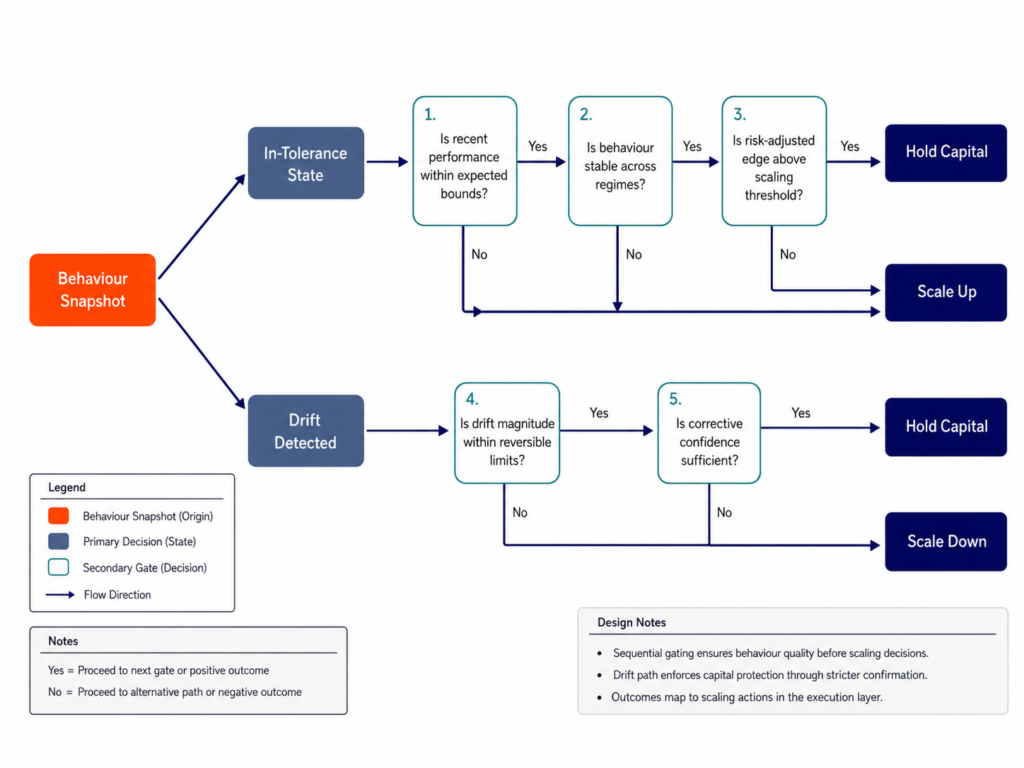
A pre-defined trigger states a condition agreed on before the moment of decision. As such, the trigger removes discretion from the decision point. Examples include “scale up by 25% after 90 days of in-tolerance behaviour” or “scale down by 40% after a behaviour drift alert that persists for two weeks”. Furthermore, this approach mirrors broader institutional discipline. Pre-defined rules form one of the strongest mechanisms for protecting capital decisions from short-term emotional pressure. The principle connects directly to how systematic operators apply pre-commitment rules for decisions made before pain across the engine.
Behaviour Thresholds Before Capital Thresholds
Behaviour thresholds set the conditions under which capital thresholds apply. In practice, capital thresholds without behaviour thresholds become arbitrary numbers. By contrast, behaviour thresholds describe a state the system must occupy for capital actions to make sense. As such, scaling becomes conditional on what the engine is doing internally. Moreover, this protects scaling decisions from getting made during conditions that look good externally but stay unstable internally.
How Allocation Scaling Fails Without Structure
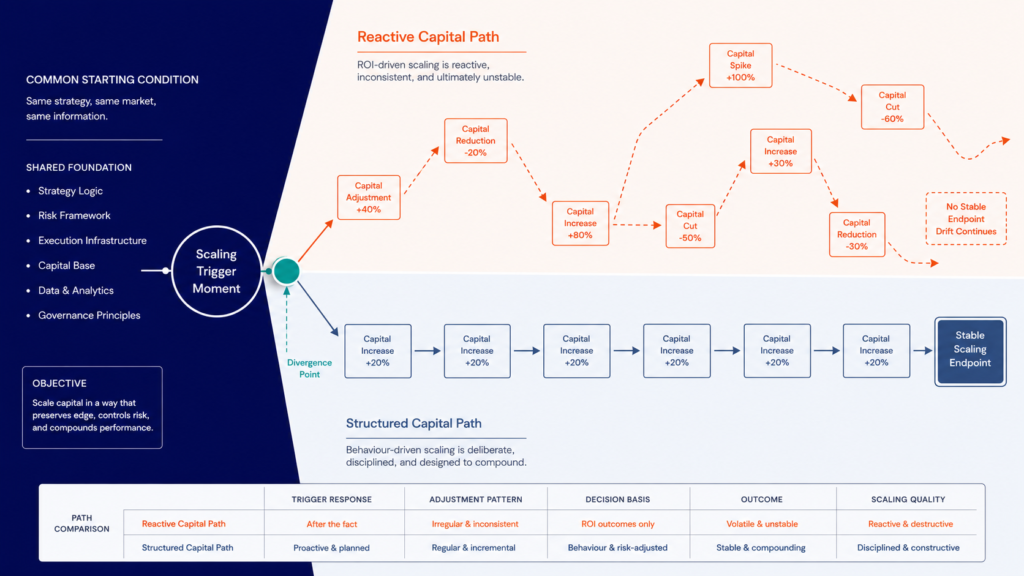
Without structure, scaling becomes a sequence of reactive moves. Each move responds to the latest data point. In practice, the result produces a portfolio that scales up during periods of false confidence and scales down during periods of false fear. Furthermore, that pattern delivers the precise opposite of what allocators say they want.
For this reason, the absence of structure is not neutral. By design, an unstructured allocation process drifts toward performance chasing under almost all market conditions. The drift accumulates gradually, which makes it harder to detect until the damage compounds.
The Drift Toward Performance Chasing
Performance chasing rarely arrives as a single decision. Instead, it accumulates through small adjustments. Each adjustment seems reasonable in isolation. However, over time, the cumulative direction of those adjustments points at recent winners and away from recent losers. As a result, allocations end up inverse to where they should be. Capital concentrates in engines whose edge may be ending. Capital exits engines whose edge may be about to return.
The Cost of Reactive Allocation Scaling
Reactive allocation scaling carries three measurable costs. First, the operator pays the bid-ask spread on capital movements that did not need to happen. Second, the operator misses the recovery period of strategies that got scaled down at exactly the wrong moment. Third, the monitoring framework loses precision because reactive moves overwrite the data needed to evaluate the strategy across a full cycle. Therefore, reactive scaling damages not only short-term returns but the long-term ability to evaluate any engine accurately.
Behaviour Signals That Justify Capital Increases
Capital increases should follow behaviour signals, not performance signals. Specifically, the behaviour signals that justify additional capital do not look exciting. By design, they look deliberately boring. Stable. Consistent. Predictable. Furthermore, the absence of behaviour anomalies carries more information than the presence of strong returns.
In practice, three behaviour categories deserve particular attention before any scale-up decision. Each category covers a different aspect of how the engine produces its output.
Stable Output as an Allocation Scaling Signal
A stable output profile describes an engine that produces the same kind of trades, with the same kind of distributions, across different market conditions. In particular, stable output does not mean identical returns. Instead, it means the engine behaves the same way relative to its design parameters. Moreover, when the engine encounters new conditions, the output adapts in the way the design predicted. As such, stable output offers one of the strongest justifications for adding capital. The principle aligns with monitoring pipelines that act as early warning for behaviour drift in disciplined systematic operations.
Consistent Filtration Outcomes
Filtration outcomes describe how the engine rejects trades that do not meet its criteria. By contrast, a stable filter rejects a consistent proportion of opportunities across regimes. Furthermore, a destabilised filter either rejects too few trades or rejects too many. In the first case, the system takes everything. In the second case, the system goes silent. In practice, consistent filtration over months of operation offers a stronger scaling justification than any return figure.
Allocation Scaling Within Institutional Governance
Scaling decisions sit inside the broader governance layer of any institutional system. Therefore, governance does not constrain scaling. By design, governance forms the architecture that makes scaling decisions defensible.
In particular, governance frameworks document why each scaling decision happened, what behaviour conditions justified it, and what outcomes would trigger a reversal. As such, every scaling decision becomes a record that operators can review across cycles. Moreover, the records build institutional memory that survives staff turnover and market regime changes.
Allocation Scaling as a Governance Function
When allocation scaling becomes a governance function, the decision moves outside individual judgement. Specifically, the framework, not the person, determines the decision. Furthermore, this matches what institutional allocators look for in due diligence. A founder who can explain exactly why each scaling decision happened, against what pre-committed criteria, demonstrates operational discipline. By contrast, a founder who explains decisions as “the numbers were good” provides no governance signal at all.
Documentation Standards for Allocation Scaling
Documentation standards turn scaling from event into record. In practice, each decision should include the behaviour conditions observed, the criteria triggered, the action taken, and the conditions that would reverse the action. Therefore, the record is not retrospective justification. The record becomes contemporaneous structure. Furthermore, the documentation becomes searchable when patterns need review across multiple cycles. In addition, well-documented scaling decisions reduce the burden of explaining the system to new operators or new allocators.
Why Disciplined Scaling Protects Long-Term Operations
Discipline in scaling protects the operation across cycles, not within a single cycle. Specifically, a disciplined scaling framework does not optimise for the best quarter. Instead, it optimises for behaviour continuity across many quarters. As a result, the engine maintains its identity through periods of pressure, drift, and recovery.
In particular, long-term operations require that the engine survive both its good periods and its bad periods. Furthermore, the bad periods produce the most scaling errors. A behaviour-based framework treats both states with the same logic.
Capital Behaviour Versus Capital Growth
Capital behaviour and capital growth describe different objectives. Capital growth measures how much the balance increases. By contrast, capital behaviour measures how the capital responds to conditions. Specifically, capital that grows fast but reacts badly to stress remains fragile. Moreover, capital that grows steadily but maintains predictable behaviour across regimes proves durable. As such, institutional allocators increasingly prefer the second profile. Behaviour-based allocation scaling provides the mechanism that produces it.
Allocation Scaling in Multi-Market Operations
Multi-market operations introduce a new layer of complexity. In particular, the same engine running on different markets will produce different return profiles even when behaviour stays identical. Therefore, return-based scaling becomes incoherent across markets. By contrast, behaviour-based scaling translates directly. The system produces stable signals or it does not. The permission state stays consistent or it does not. As such, scaling across multiple markets becomes possible only when scaling decisions anchor on behaviour metrics that hold across all venues.
Building Allocation Scaling Into System Architecture
Scaling decisions should become part of the system, not a decision laid on top of it. Specifically, the architecture should produce scaling triggers as outputs, the same way it produces signals and risk constraints. Furthermore, this means scaling decisions become an engineered feature of the engine, not a discretionary event.
In practice, this architectural approach removes the operator from the scaling decision at the moment of pressure. By design, the framework has already made the decision before the moment arrives. The operator only verifies that the trigger conditions hold.
Allocation Scaling as a Structural Output
When scaling becomes a structural output, the engine itself surfaces the trigger. Specifically, behaviour metrics feed into a scaling layer that compares current state against pre-defined thresholds. As such, scaling decisions become visible the moment behaviour conditions cross those thresholds. Moreover, this approach turns scaling from a meeting-room conversation into a system observation. The transparency benefits both the operator and the allocator.
Avoiding Common Allocation Scaling Mistakes
Three mistakes recur across scaling frameworks. First, operators conflate strong returns with strong behaviour. Second, operators treat behaviour signals as forecasting tools instead of state descriptions. Third, operators allow scaling decisions to happen retrospectively, after the conditions have already changed. Therefore, avoiding these mistakes requires structural discipline. The framework must enforce decisions at the right moments. In addition, the framework must keep the records that allow the discipline to be reviewed and improved over time.
Allocation scaling sits among the highest-leverage decisions in any systematic operation. By design, the choice to add or reduce capital influences outcomes more than most trading decisions. Therefore, anchoring that choice on behaviour rather than ROI provides structural protection, not preference. In this way, the framework protects allocators from the most common failure mode in capital deployment: scaling toward what just worked. Behaviour-based scaling builds the foundation for systematic operations that survive across cycles.
Continue Learning
Continue learning about systematic behaviour frameworks through ongoing Dovest research on structure-first system design.
About the Author
Dovest Research publishes institutional-grade analysis of systematic trading infrastructure, behaviour-first frameworks, and risk architecture. The Dovest team focuses on engineering-grade reasoning for capital deployment, drawing on operating experience in systematic engine design, monitoring pipelines, and governance discipline. All Dovest content reflects institutional research and foundational frameworks rather than performance claims or trading signals.
Disclaimer
This article is published for educational and research purposes only. It does not constitute financial advice, investment recommendations, or an offer to provide trading services. Allocation scaling frameworks discussed here describe institutional research principles and design philosophy. They do not represent guaranteed outcomes or validated track records. Readers should consult licensed financial professionals before making any capital allocation decisions.