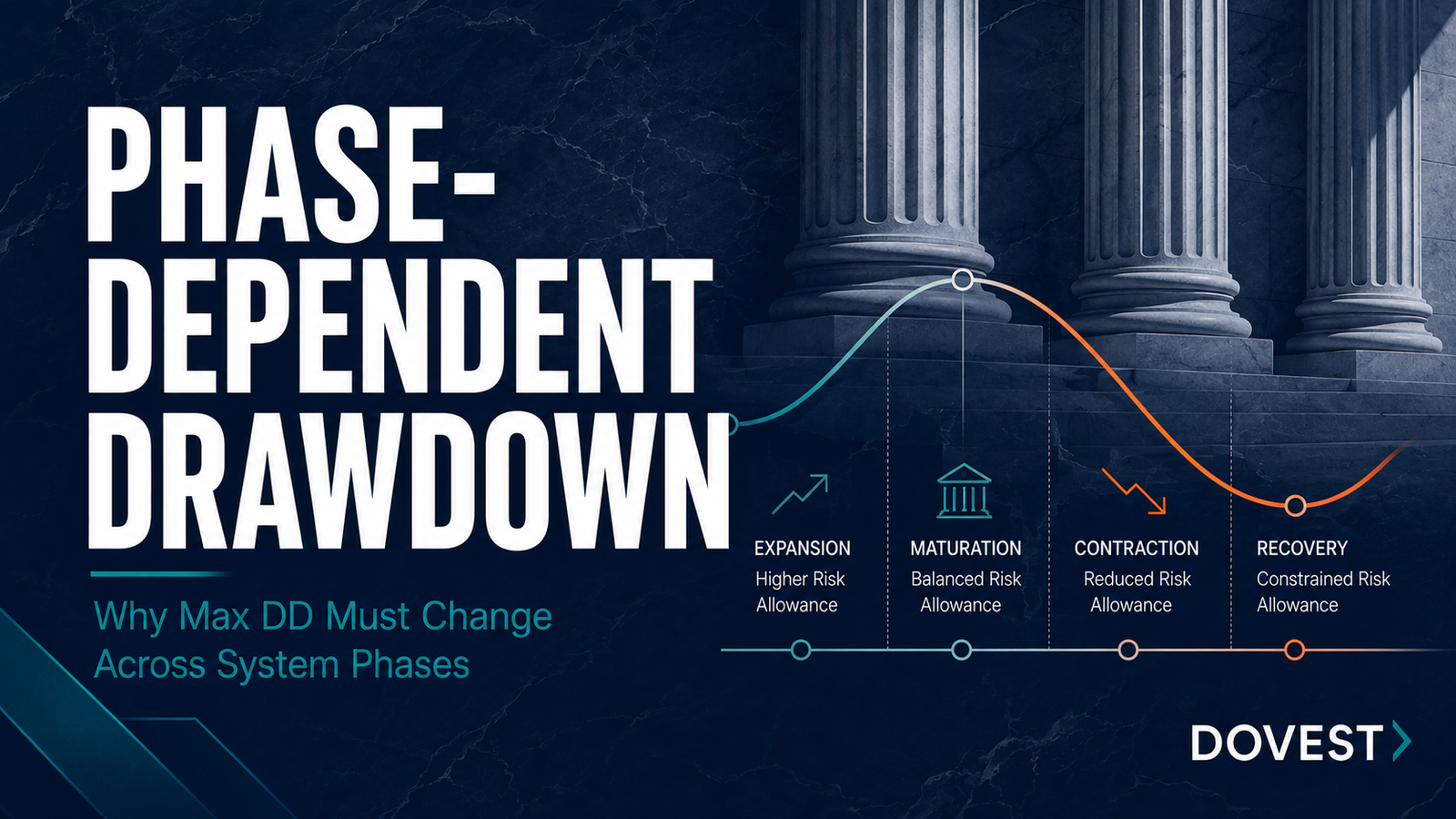
Phase-Dependent Drawdown: Why Maximum Drawdown Must Evolve With Your System
Maximum drawdown is one of the most quoted figures in systematic trading governance. Engineers define it before deployment. Risk teams enforce it as a hard boundary. Many systems treat it as a fixed number, permanent across all stages of operation.
However, this approach misses something fundamental about how systematic systems actually operate. Phase-dependent drawdown governance starts from a different question: not what the maximum drawdown should be, but what it should be right now, given where the system sits in its deployment lifecycle.
A 12% drawdown during early-stage validation is not the same risk event as a 12% drawdown during institutional scaling. The capital base changes. The scrutiny from allocators and investors changes. The track record implications change. Furthermore, the system’s behavioural maturity changes, and the market environment it operates in may also shift. Therefore, the acceptable drawdown limit must evolve alongside these factors.
Phase-dependent drawdown is not a more complex version of static risk management. It is a more honest one. It forces the governance structure to ask: what phase are we in, and what does a drawdown mean in this context? The answer shapes how the system responds and how institutional trust is maintained across the entire lifecycle.
The Problem With Treating Maximum Drawdown as a Fixed Number
Why the Same Loss Threshold Fails Across Deployment Contexts
Many systematic trading systems inherit their drawdown limits from backtests. Engineers run historical simulations, observe the worst losing periods, and set a maximum tolerance from those results. This provides a useful starting framework. However, it anchors the governance structure to historical data rather than to the current deployment context.
A 15% maximum drawdown tolerance applied uniformly across all system phases creates three specific governance problems. First, it ignores the difference between a drawdown during track record building and a drawdown during institutional capital management. Second, it treats the same percentage figure as equivalent regardless of the capital base and the scrutiny attached to it. Third, it removes the incentive to tighten governance as the system matures and the stakes increase.
The fixed drawdown number also sends the wrong signal internally. It suggests that risk tolerance is a permanent property of the system itself rather than a function of its current operating context. In practice, that context shifts significantly across deployment phases. Consequently, governance must shift with it.
Phase-Dependent Drawdown Begins Before Capital Enters the Market
Effective phase-dependent drawdown governance starts at system design, not at the first drawdown event. The team must define, before deployment begins, what constitutes an acceptable drawdown at each stage of the system’s lifecycle.
This pre-commitment approach transforms drawdown governance from a reactive guardrail into a structural discipline. Instead of asking whether trading should stop after a specific loss, the system already has an answer. The decision exists before the pressure arrives. Specifically, the governance layer knows what limit applies at each phase and what the protocol is when that limit is approached. This pre-commitment foundation is where sound phase-dependent drawdown infrastructure begins.
What Phase-Dependent Drawdown Actually Governs
Phase-dependent drawdown governance does not simply adjust a number. It governs three interconnected elements: what capital can lose at each phase, how the system interprets a drawdown event in context, and when a drawdown event triggers a formal governance review. Each element shifts as the system moves through its lifecycle.
The Four System Phases That Define Drawdown Thresholds
Systematic trading systems typically pass through four distinct phases, each carrying different drawdown implications.
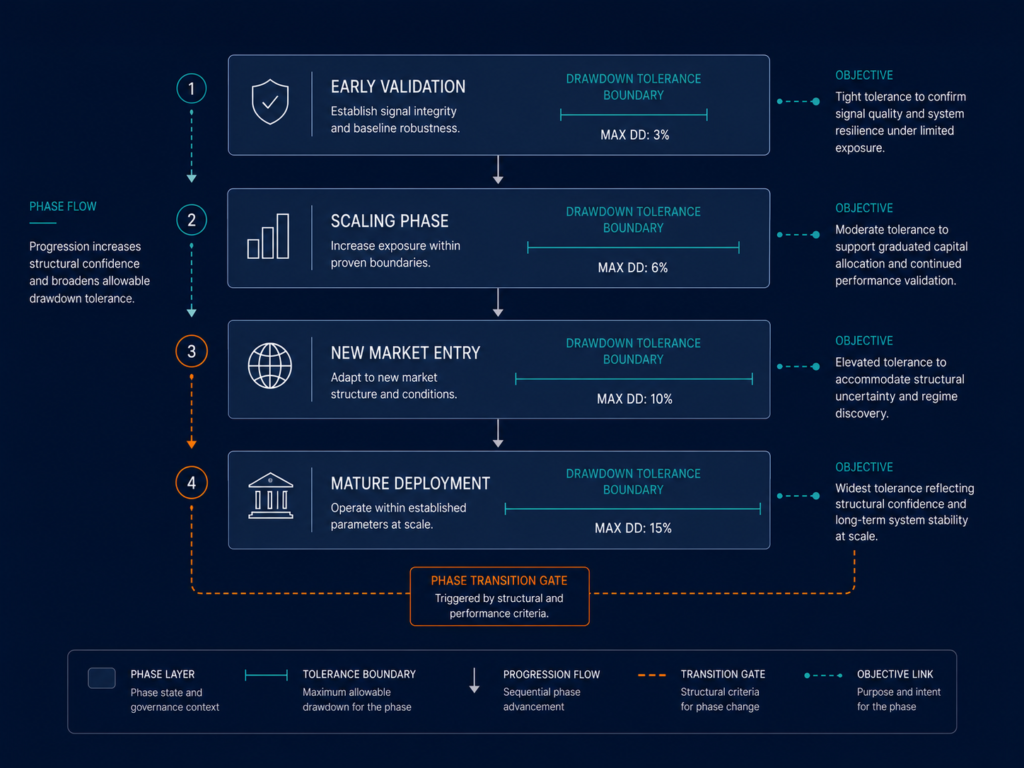
The first phase involves early validation. The system runs on constrained capital, and the primary goal is not return generation but behavioural proof. During this phase, every drawdown carries disproportionate weight. It signals whether the system holds its structure under live conditions, not just in backtests.
The second phase involves scaling. The system has built a credible track record, and capital increases. Additionally, institutional scrutiny increases. A drawdown at this phase affects the raise narrative and the confidence of prospective allocators, not only the trading account.
The third phase involves new market entry. When the system extends into a new market, it carries its core logic but faces unfamiliar microstructure and data characteristics. Therefore, drawdown tolerance should tighten temporarily. The system has not yet demonstrated that its behaviour holds in this environment.
The fourth phase involves mature institutional deployment. The system operates with significant capital under formal governance obligations. Drawdown limits at this phase often align with investor mandates, compliance requirements, and reporting schedules.
Early Validation and Drawdown Tolerance Design
During early validation, many teams make a common structural error. They set drawdown limits appropriate for a mature system and apply them to a system that has not yet proved its live behaviour.
This logic inverts the correct approach. Early validation should carry tighter drawdown limits, not looser ones. The reason is structural. At this phase, the system lacks the track record to distinguish a temporary drawdown from a genuine behavioural breakdown. Furthermore, the capital at risk is often a founding capital pool or a small institutional seed. A significant drawdown at this stage damages both capital and the confidence needed to attract the next phase of funding.
Phase-dependent drawdown governance solves this by defining tighter limits at the validation phase. The system operates with less tolerance for loss precisely because it is still proving that its structure holds under real conditions. As the system demonstrates stability, the governance framework can formally expand that tolerance at the next documented phase transition.
The diagram below maps the relationship between system phase and appropriate drawdown thresholds across the four stages.
New Market Entry and Phase-Dependent Drawdown Recalibration
When a systematic trading system enters a new market, phase-dependent drawdown recalibration becomes essential. A system that has performed stably on ASX for eight months carries strong behavioural evidence in that environment. However, the same system entering US equities faces unfamiliar microstructure characteristics and different execution conditions.
Liquidity profiles differ between markets. Volatility personalities differ. The data quality checks the system relies on may require adjustment for the new market’s feed behaviour and corporate action handling. Consequently, phase-dependent drawdown governance must reflect this uncertainty through a temporary tightening of limits.
This recalibration is not a sign of system weakness. It is evidence that the governance layer understands the difference between proven behaviour and assumed behaviour. The system earns the right to operate with wider drawdown tolerance by demonstrating that its core logic holds in the new environment. Furthermore, this approach protects the track record in the established market. A significant drawdown in the new market, left ungoverned, can undermine the institutional narrative the system has been building across its prior phases.
Mature Deployment and Institutional Drawdown Standards
At mature deployment, phase-dependent drawdown governance integrates with broader institutional obligations. Drawdown limits at this stage reflect not only the system’s own risk architecture but also the expectations of allocators, compliance frameworks, and formal reporting schedules.
A drawdown event at this phase triggers a defined review process. The team examines whether the drawdown reflects normal system behaviour under a challenging regime or whether it signals a structural change in the system’s operating environment. Moreover, the outcome of that review must be documented and auditable. Institutional drawdown standards require that the governance layer can explain every significant drawdown in the context of the system’s phase and its pre-committed limits. This auditability is the foundation on which institutional trust is maintained at scale.
How Phase-Dependent Drawdown Changes System Architecture
Aligning Limits with Phase Objectives
Each system phase carries a distinct primary objective. Early validation prioritises behavioural proof. The scaling phase prioritises track record integrity. New market entry prioritises environmental calibration. Mature deployment prioritises stability and explainability.
Phase-dependent drawdown governance works by aligning the drawdown limit with the primary objective at each phase. In early validation, the limit is tight because the objective is proof, not return optimisation. In scaling, the limit reflects the need to protect a track record that now carries institutional value. In new market entry, the limit is recalibrated because the objective is learning and calibration before full capital commitment.
This alignment ensures that drawdown governance serves the system’s actual goal at each stage. It prevents the misapplication of a generic risk parameter to a context that demands something more specific.
Why Tighter Early-Phase Limits Serve the System
A common objection to tighter early-phase drawdown limits is that they constrain performance. This objection misunderstands the purpose of the early phase.
The early phase does not exist to generate maximum return. It exists to prove that the system holds its structure under live conditions. A larger drawdown at this stage does not only represent a financial loss. It represents a failure to establish the behavioural proof that the next phase depends upon.
Tighter early-phase limits serve the system by forcing it to demonstrate discipline before scale. Similarly, they protect the track record by keeping the system’s worst periods within a range that institutional partners can evaluate and accept. As a result, the system enters the scaling phase with a cleaner behavioural signature and a more defensible governance history.
Governance Structures for Phase-Specific Drawdown Limits
Phase-dependent drawdown governance requires formal structures to function correctly. The limits cannot exist only in the founder’s memory or an informal spreadsheet. They must be documented, version-controlled, and connected to the system’s permission logic.
Pre-Commitment Rules Across System Phases
Pre-commitment is the practice of defining decisions before the conditions that trigger them arise. In the context of phase-dependent drawdown, pre-commitment means the team defines, at the start of each phase, what the maximum drawdown limit will be and what will happen when that limit is approached.
This approach removes discretionary pressure from the drawdown moment itself. When the system approaches its limit, the response is already defined. The team does not need to make a governance decision under financial or emotional pressure. Instead, they execute the pre-committed protocol.
Pre-commitment rules should also define the threshold that triggers a formal phase review. If the system reaches a drawdown that approaches but does not yet breach the limit, the governance layer should initiate a structured assessment. This connects drawdown monitoring directly to the broader governance cadence. Dovest’s note on pre-commitment rules in systematic trading provides further context on how pre-commitment frameworks operate under real conditions.
Version Control for Phase-Dependent Drawdown Parameters
Every change to a drawdown limit must pass through version control. This is not a bureaucratic formality. It is the mechanism that makes phase-dependent drawdown governance auditable over time.
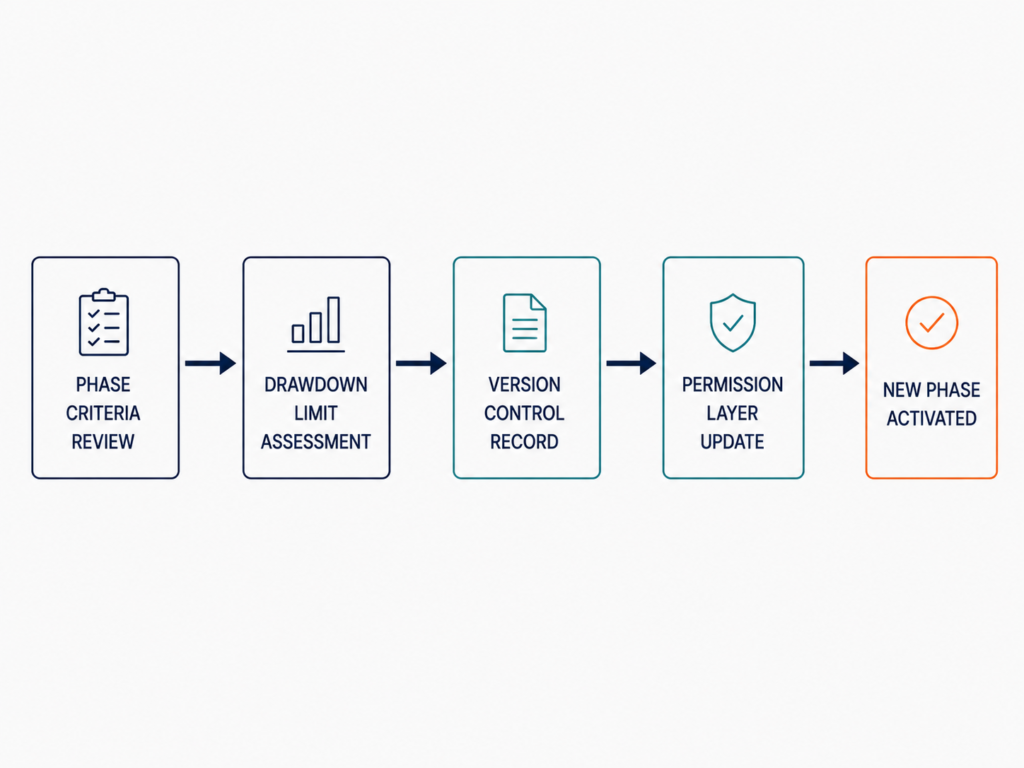
When the system transitions from early validation to the scaling phase, the drawdown limit changes. That change must be recorded formally: what the previous limit was, what the new limit is, the reasoning behind the change, and who approved it. Additionally, the record should capture what phase criteria the system met in order to justify the transition.
Version control for phase-dependent drawdown parameters serves two purposes. First, it creates an audit trail that institutional partners can examine during due diligence. Second, it prevents informal limit adjustments from occurring outside the governance process. In a well-governed system, drawdown limits do not drift without record. Dovest’s broader approach to model governance and change control explains how version control applies across all system parameters, not only to drawdown governance.
The diagram below illustrates the governance review process that connects phase transitions to drawdown parameter updates.
When Governance Fails to Adapt
Static Limits and Structural Risk
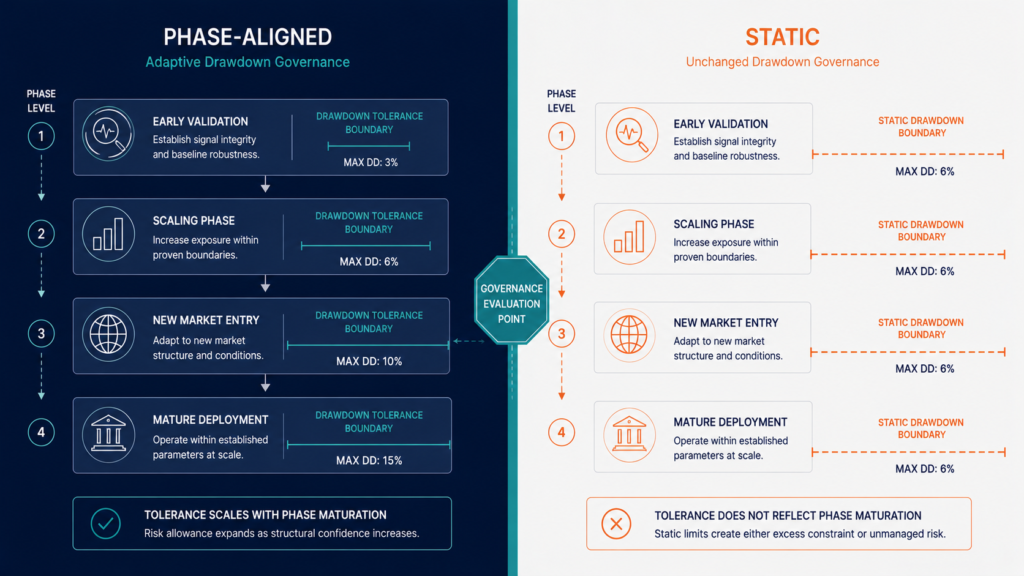
A system that never updates its drawdown limits creates a specific type of structural risk. The limits appropriate during early validation may be too loose for institutional scaling. Equally, the limits suited to a single-market system may be misaligned for a system managing dual-market exposure.
Static drawdown limits create a false sense of governance discipline. The team can point to a documented maximum drawdown figure and believe that the governance framework functions correctly. However, if that figure reflects conditions from two years ago and the system’s phase has changed significantly since, the governance is nominal rather than operational.
Structural risk from static limits tends to manifest during stress periods. A drawdown that the early-phase system would have treated as a halt signal gets absorbed by the scaling-phase system because the limit was set for a different context. The governance layer fails to respond appropriately because no one formalised the phase transition or updated the parameters to reflect it.
How Behaviour Drift Starts With Misaligned Thresholds
Misaligned drawdown thresholds contribute to a broader pattern of behaviour drift. When the system’s governance limits do not reflect its current phase, the team gradually normalises a level of drawdown that would have triggered a review at an earlier stage.
This normalisation does not happen through a single decision. It accumulates through repeated small concessions, each seemingly reasonable in isolation. However, over time the system operates with a drawdown tolerance that its current phase cannot justify.
Behaviour drift from misaligned thresholds is particularly damaging during capital scaling. Investors and allocators who review the track record may observe drawdown behaviour that seems inconsistent with institutional standards. The cause is not poor performance but poorly adapted governance. The distinction matters, and institutional partners can usually identify it.
The diagram below contrasts a system with aligned phase-dependent drawdown governance against one where the governance structure has remained static across phases.
Building Phase-Dependent Drawdown Into Systematic Infrastructure
Building phase-dependent drawdown into systematic infrastructure requires three structural commitments: a formal phase definition framework, a review cadence tied to phase transitions, and a direct connection between drawdown governance and the system’s permission logic.
The Review Cadence for Phase Transitions
The review cadence for phase transitions should not be arbitrary. Each transition requires a formal assessment that covers the system’s live behaviour since the last phase, the quality and consistency of the track record during that period, and the appropriateness of the current drawdown limit for the upcoming phase.
This review should involve the founder, the engineering team, and relevant risk oversight. Furthermore, the outcome should be documented and integrated into the version control system. When the system formally enters a new phase, the drawdown limit for that phase takes effect immediately. A disciplined review cadence prevents phase transitions from happening informally. Without it, systems often drift from one phase to another without governance recognition. Consequently, the drawdown limits governing them remain misaligned with the system’s actual operating context.
Connecting Phase-Dependent Drawdown to Permission Logic
Phase-dependent drawdown governance does not function in isolation. It connects directly to the system’s permission logic. When the system approaches its phase-specific drawdown limit, the permission layer responds by narrowing capital exposure.
This connection is structural, not discretionary. The system does not wait for the team to notice that drawdown is approaching the limit. The permission layer narrows automatically when pre-defined thresholds are crossed. Capital deployment decreases. Position sizing contracts. The system signals that it is operating near its phase-specific boundary.
This integration gives phase-dependent drawdown governance operational force. It does not only define what the maximum loss should be at each phase. It defines how the system behaves as it approaches that maximum. Moreover, it ensures that the response is consistent, auditable, and proportional to the phase in which the system currently operates.
A system that connects phase-dependent drawdown to its permission logic is one where governance operates as a structural property of the system itself, not as a manual intervention layer added after the fact.
Phase-Dependent Drawdown as Institutional Discipline
Phase-dependent drawdown governance is not a refinement of standard risk management. It is a structurally different way of thinking about what drawdown limits exist to accomplish.
Standard risk management asks: how much loss can this system tolerate? Phase-dependent drawdown governance asks a more precise question: how much loss is appropriate given where this system sits in its lifecycle, what it is trying to prove at this stage, and who is relying on its track record?
The answer changes across phases. Therefore, the governance must change with it. Systems that treat max drawdown as a static number are not poorly disciplined. They are applying a useful concept without the structural layer that makes it phase-appropriate.
For systematic trading infrastructure to earn institutional trust, governance must demonstrate that it evolves alongside the system. Tighter limits during early validation. Formal recalibration during new market entry. Version-controlled transitions at every phase boundary. Auditable reasoning for every parameter change.
In practice, phase-dependent drawdown is not primarily a risk concept. It is a governance discipline. It is the evidence that the system and the team behind it understand not only how to define limits but also when and why those limits must change.
About the Author
Bình Trinh is the founder of Dovest, a systematic trading infrastructure company focused on capital behaviour, risk governance, and execution discipline. Dovest designs and monitors systematic trading engines so their behaviour remains stable, explainable, and auditable under real-world stress.
Disclaimer: This article is provided for institutional research and educational purposes only. It does not constitute financial advice, investment advice, trading signals, or a recommendation to buy or sell any financial product. References to systematic trading frameworks describe research and design principles and should not be read as performance claims or product availability statements.