Why System Behaviour Under Stress Regimes Defines Infrastructure Quality
Most trading systems look competent in calm markets. Consequently, the real question is never how a system performs when spreads are tight and liquidity flows freely. The real question is what happens when the environment shifts into a stress regime. System behaviour under stress regimes reveals whether the architecture holds structural integrity or collapses into reactive improvisation.
Stress regimes expose every assumption the engine carries. Therefore, a framework that treats stress as a rare exception will produce fragile outcomes. By contrast, a framework that encodes stress as a structural input will produce behaviour that survives pressure without override. This article explains how institutional systematic infrastructure approaches stress regimes as an engineering problem, not an emotional one.
What Defines a Stress Regime in Market Structure
A stress regime is not a single bad day. It is a structural shift in market behaviour that persists across multiple sessions. Specifically, the transition from calm to stress changes how depth, spreads, halts, and participant behaviour interact at the venue level.
Regime transition versus single-event stress behaviour
A flash crash is not a stress regime. A single earnings miss is not a stress regime. In particular, a stress regime begins when the structural properties of the market change and stay changed. Depth thins and does not recover by next session. Spreads widen and hold their width for days. Halt frequency increases and stays elevated.
Consequently, the engine must distinguish between a transient shock and a regime shift. Transient shocks require patience. Regime shifts require permission changes. The diagnostic question is duration, not magnitude. A 3% drop that reverts in 20 minutes carries different structural meaning than a 1.5% drop that persists for a week. Similarly, a brief liquidity withdrawal that resolves by next open differs fundamentally from a sustained depth reduction that compresses available volume across multiple sessions.
Structural markers that define stress regimes
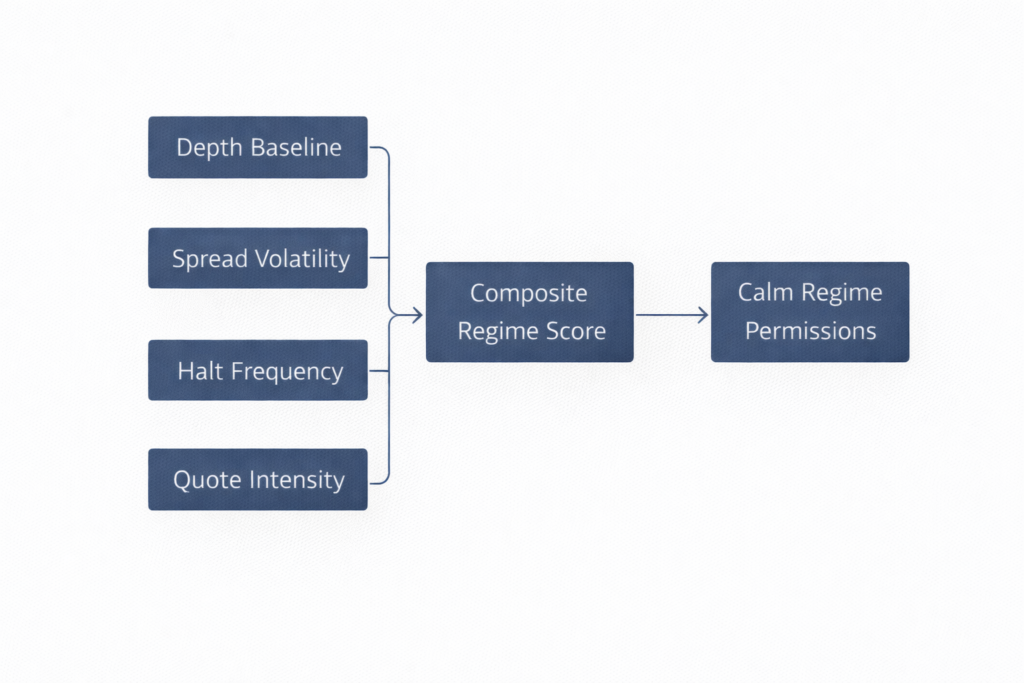
Several observable markers signal a regime transition. Bid depth declines relative to its rolling baseline. Spread volatility increases beyond its calibrated threshold. Additionally, halt frequency rises above session norms. Quote intensity drops as market makers withdraw.
These markers operate together. No single marker confirms a stress regime. Instead, the system evaluates a composite score across multiple structural inputs. For this reason, the filtration layer must ingest all these signals before adjusting permissions.
Moreover, the composite score carries memory. It does not reset after a single session of apparent calm. If depth recovered briefly but spread volatility remains elevated, the score holds its stress classification. This persistence prevents the engine from cycling between calm and stress permissions on noise alone. Consequently, system behaviour under stress regimes remains stable across sessions rather than oscillating with every intraday fluctuation.
Why System Behaviour Under Stress Regimes Exposes Design Gaps
Calm markets forgive poor architecture. Stress regimes do not. In practice, a system that lacks explicit stress logic will produce unpredictable behaviour precisely when predictability matters most.
Latent fragility hidden in calm conditions
Many systems carry hidden assumptions about market conditions. They assume stable depth. They assume consistent fill rates. Furthermore, they assume halt events are rare and isolated. These assumptions hold during calm regimes. They break during stress.
Latent fragility means the system has no explicit plan for conditions it has not recently experienced. The engine continues operating with calm-regime permissions even after the environment has shifted. As a result, position sizing, entry frequency, and exposure accumulate without structural justification.
In particular, latent fragility compounds over time. Each calm session reinforces the assumption that current parameters are sufficient. When stress arrives, the gap between actual conditions and parameter assumptions widens rapidly. Therefore, a framework that explicitly defines system behaviour under stress regimes before the first trade eliminates this compounding fragility at its source.
How stress exposes coupling risk in system behaviour
Stress regimes tighten correlations across instruments and venues. Specifically, assets that appear uncorrelated during calm conditions begin moving together under stress. This coupling amplifies portfolio risk beyond what the calm-regime model predicts.
A behaviour-first framework treats correlation expansion as a stress marker. Therefore, when coupling increases, the engine reduces aggregate permission rather than rebalancing within the same exposure envelope. The response is contraction, not redistribution.
Similarly, cross-venue coupling intensifies during stress. Instruments that normally trade independently across venues begin moving in lockstep. This synchronisation reduces diversification benefit at precisely the moment it matters most. As a result, system behaviour under stress regimes must account for venue-level coupling alongside instrument-level correlation. Without this layer, portfolio risk calculations understate true exposure during the most dangerous periods.
Permission Contraction and System Behaviour Under Stress
Permission contraction is the primary structural response to a stress regime. By design, the engine does not wait for losses to accumulate before reducing exposure. It reads the environment and tightens permissions before risk materialises.
How permission layers contract during stress regimes
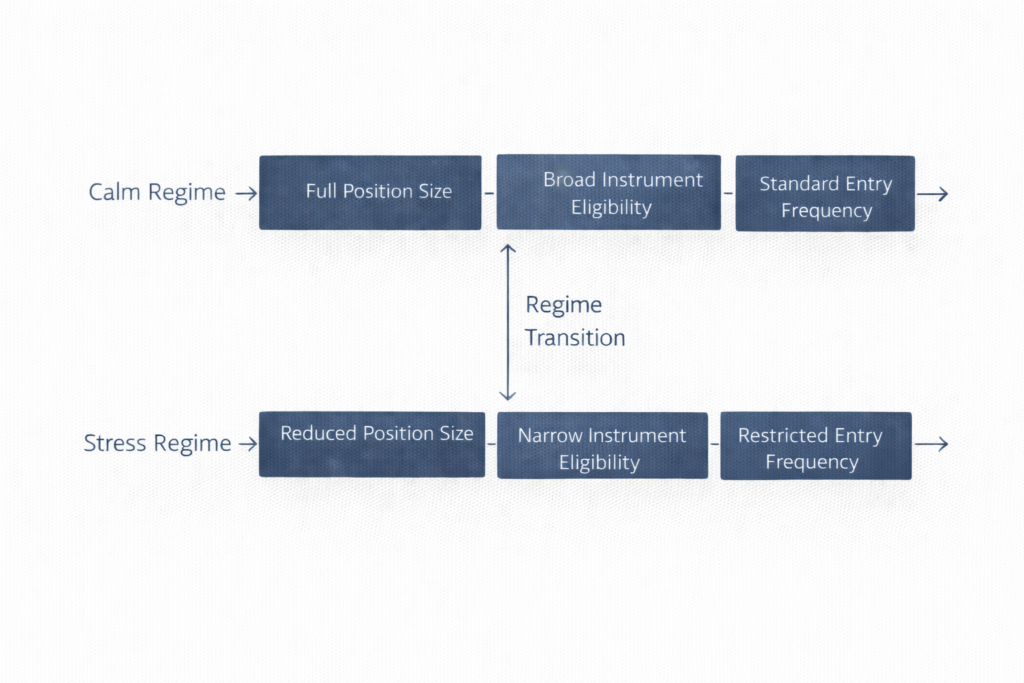
The permission layer governs what the engine may do. In calm regimes, permissions are wide. The engine may deploy full position size across all eligible instruments. However, when stress markers cross their thresholds, permissions contract systematically.
Specifically, three dimensions contract simultaneously. Position size decreases by a pre-defined ratio tied to regime severity. Instrument eligibility narrows as marginal names fail stress-adjusted filtration. Additionally, entry frequency reduces because the engine requires stronger signal confirmation before committing capital.
Position sizing under stress regimes
Position sizing under stress follows a structural formula, not a discretionary judgment. The engine references the stress-regime parameter set, which defines maximum exposure per instrument and per portfolio under each regime classification.
Therefore, no human decision enters the sizing process during stress. The parameters exist before the regime arrives. As such, the system applies the same disciplined logic in stress that it applies in calm, only with tighter constraints.
Moreover, position sizing under stress includes an aggregate cap that limits total portfolio exposure regardless of individual instrument permissions. Even if five instruments pass stress-adjusted filtration, the aggregate cap may restrict deployment to three. This additional constraint reflects the reality that concentration risk increases during stress because correlations expand. Consequently, system behaviour under stress regimes treats aggregate exposure as a first-order constraint, not a residual calculation.
Filtration Logic During Stress Regimes
Filtration is the layer that decides whether a trade opportunity passes through to execution. During stress, filtration thresholds shift to reflect the changed environment. In practice, this means the engine rejects more opportunities, not fewer.
How filtration thresholds shift under stress regimes
Each filtration gate carries a threshold calibrated to the current regime. Calm-regime thresholds allow broader entry. Stress-regime thresholds demand higher confidence before granting permission. Specifically, the system requires wider margins on spread acceptability, deeper minimum depth, and stronger directional confirmation.
This scaling happens automatically. No analyst manually adjusts filtration sensitivity. Instead, the regime classifier feeds directly into the filtration layer. Consequently, the moment the composite regime score shifts, filtration recalibrates in real time.
When filtration rejects an entire session
Some stress regimes are severe enough that filtration rejects every opportunity the session produces. In particular, when depth falls below minimum thresholds and spreads exceed maximum tolerance, no instrument passes filtration.
This outcome is correct system behaviour under stress regimes. The engine does not force trades to justify its existence. It produces zero activity when the environment does not support controlled execution. Understanding drawdown and halt policy frameworks provides additional context for how inactivity becomes a deliberate output.
In practice, full-session rejection carries important information. It confirms that the stress regime is severe enough to suppress all viable opportunities. This data point feeds back into the regime classifier, reinforcing the stress classification and preventing premature permission restoration. Consequently, filtration rejection at scale serves as both a protection mechanism and a diagnostic signal.
Halt Response and System Behaviour Under Stress Regimes
Halts increase during stress. Therefore, the engine must carry explicit logic for halt response that scales with regime severity. A system that treats every halt the same regardless of context will misread the environment.
Cascade logic and system behaviour during stress halts
During stress regimes, halts tend to cascade across instruments. An index-level circuit breaker can freeze derivative books, which in turn pauses related cash instruments. This propagation chain creates a temporary environment where the entire venue stops functioning normally.
The engine must track these cascades explicitly. In particular, a halt on a related instrument changes the risk profile of currently open positions, even if those positions have not been directly halted. For this reason, cross-instrument halt awareness enters the risk layer as a structural input during stress.
Reopen behaviour and stress regime re-entry logic
The period immediately after a stress halt carries elevated risk. Specifically, the first minutes after a halt reopen produce erratic depth, wide spreads, and aggressive order flow. Consequently, the engine does not re-enter immediately after a halt clears.
Instead, the system imposes a reopen buffer period. During this buffer, the engine monitors depth recovery and spread stabilisation before restoring entry permissions. This buffer is not a fixed duration. It is a condition-based gate that requires structural metrics to normalise before the engine resumes.
Furthermore, reopen behaviour under stress differs from reopen behaviour under calm-regime halts. A calm-regime halt typically resolves quickly, with depth recovering to baseline within minutes. By contrast, a stress-regime halt often reopens into continued deterioration. The engine accounts for this asymmetry by applying stricter reopen conditions during elevated regime scores. In this way, system behaviour under stress regimes adapts not only to the halt itself but to the post-halt environment.
Pre-Commitment as the Anchor for System Behaviour Under Stress
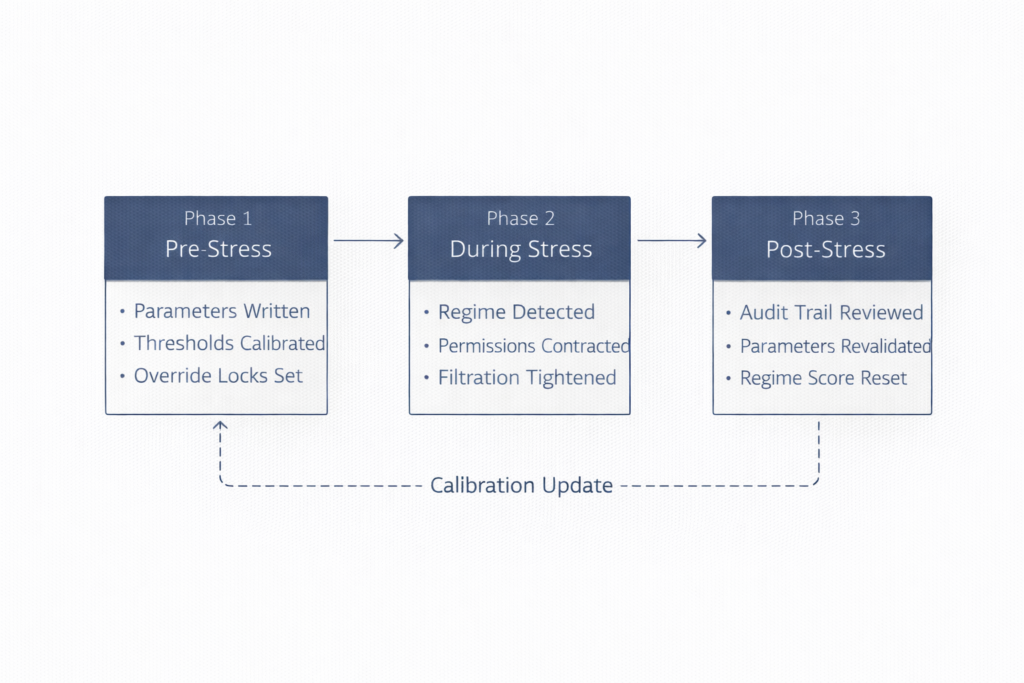
Pre-commitment rules define system behaviour before stress arrives. They are decisions made in advance, written into the engine’s logic, and immune to override during live execution. Specifically, every stress-regime parameter exists because an engineer wrote it during a calm analysis session, not during a drawdown.
Decisions that define system behaviour before stress arrives
The entire stress response framework relies on pre-commitment. Position size reduction ratios, filtration threshold shifts, halt buffer durations, and session-exit triggers all exist as pre-committed parameters. No parameter enters the engine during a stress event. Understanding pre-commitment rules and decisions made before pain explains this principle in detail.
Additionally, the engine does not accept real-time overrides to these parameters. If an operator wants to change a stress parameter, the change must pass through a documented review gate outside of live trading hours. This constraint exists because decisions made during stress carry cognitive bias that degrades structural discipline.
Why manual overrides fail during stress regimes
The instinct to override is strongest during stress. Specifically, when the engine restricts activity and the operator observes apparent opportunities, the temptation to widen permissions grows. However, overrides during stress introduce the exact fragility the framework exists to prevent.
Furthermore, post-trade analysis consistently shows that overrides during stress produce worse outcomes than the pre-committed parameters would have delivered. A pre-committed framework averages across many possible stress scenarios. An override responds to one moment of perceived opportunity. As such, the override carries survivorship bias that the framework explicitly avoids. For this reason, the override lock is not a convenience feature. It is a structural safeguard that preserves the integrity of system behaviour under stress regimes.
Monitoring System Behaviour Under Stress Regimes in Real Time
Monitoring during stress serves a diagnostic purpose. It answers the question: is the system behaving as designed under these conditions? Monitoring does not make decisions. It provides the audit trail that confirms structural discipline.
Real-time diagnostics for system behaviour under stress
The monitoring layer tracks several dimensions during stress. It records permission state changes, filtration rejection rates, position size adjustments, and halt response sequences. Additionally, it logs the composite regime score at every evaluation interval.
These diagnostics serve two audiences. During live execution, they confirm that the engine is following its pre-committed logic. After the stress event, they provide the audit trail for post-trade review. In both cases, the monitoring layer observes. It does not intervene.
Alerting without overreaction
Alerting during stress must balance urgency with restraint. The system generates alerts when regime transitions occur, when filtration rejection rates spike, and when halt cascades propagate beyond expected thresholds. However, these alerts inform the operator. They do not trigger automatic overrides.
By design, the alerting framework avoids false urgency. It does not escalate every market movement into a crisis notification. Instead, it flags structural changes that the pre-committed framework has already accounted for. Operators receive confirmation that the system is responding correctly, not instructions to intervene.
Equally important, the alerting log becomes part of the post-stress audit. It documents every notification sent, every regime transition flagged, and every permission change recorded. This log answers a critical question for post-trade review: did the monitoring layer capture the stress event accurately and in real time? If it did, the audit confirms structural awareness. If gaps appear, governance uses them to calibrate monitoring sensitivity for future stress episodes.
Why Allocators Evaluate System Behaviour Under Stress Regimes
Allocators do not judge a system by its calm-market returns. They judge it by what happens when the environment deteriorates. Therefore, stress-regime behaviour is the primary lens through which institutional capital evaluates systematic infrastructure.
How allocators assess system behaviour under stress
Allocators expect documented evidence of how the system behaves during stress. Specifically, they want to see the pre-committed parameter set, the regime detection logic, the permission contraction ratios, and the post-stress audit trail. These artefacts demonstrate that the system architect anticipated stress and encoded structural responses in advance.
Furthermore, allocators compare stress-regime documentation across managers. A manager who can show explicit pre-commitment logic, documented halt response, and auditable filtration behaviour during stress stands apart from a manager who offers only a drawdown chart and a recovery narrative.
The audit trail under pressure
An audit trail during stress is the single most valuable piece of documentation an allocator reviews. It reveals whether the engine followed its pre-committed rules without deviation. Filtration behaviour appears clearly in the log. Additionally, the trail shows whether the operator intervened or allowed the framework to operate autonomously.
An unbroken audit trail during stress signals two things to an allocator. First, the system architect built explicit stress logic. Second, the team trusted the framework enough to let it run without override. Both signals carry more weight than any backtest or performance chart produced during calm conditions.
Building Stress Regime Awareness Into Every Layer
System behaviour under stress regimes is not a feature bolted onto a finished engine. It is a design principle woven through every layer: detection, filtration, permission, halt response, monitoring, and governance.
Cross-layer consistency in system behaviour under stress
Every layer must respond to the same regime classification simultaneously. Detection identifies the regime. Filtration adjusts thresholds. Permissions contract. Halt response activates cascade tracking. Additionally, monitoring switches to stress-mode logging frequency. All these transitions reference the same composite regime score.
Cross-layer consistency prevents a scenario where one layer still operates under calm assumptions while another has already transitioned to stress mode. This synchronisation is a structural requirement, not an optimisation. Without it, the engine produces contradictory behaviour during the most critical periods.
Governance of stress parameters
Stress parameters require the same governance discipline as calm parameters. They undergo periodic revalidation. They carry version control. Furthermore, any change passes through a documented review gate with clear justification.
In practice, governance cadence for stress parameters often runs on a shorter cycle than calm parameters. Stress events generate new data that may require threshold adjustments. However, these adjustments happen during calm analysis windows, never during live stress events. This cadence preserves the pre-commitment principle while allowing the framework to evolve with market structure changes.
Moreover, version control for stress parameters creates a historical record of how the framework has adapted over time. Each version links to the stress event that prompted the review, the data that justified the change, and the engineer who approved it. Consequently, the governance layer provides allocators with a transparent evolution trail. It demonstrates that system behaviour under stress regimes improves through structured learning, not through reactive patching after losses.
Explore More Behavioural Research from Dovest
System behaviour under stress regimes separates structural infrastructure from fragile systems. Dovest approaches stress as an engineering input, not an exception. Every layer of the framework carries explicit stress logic, pre-committed parameters, and auditable responses. Explore more behavioural research from Dovest to understand how structure, not prediction, defines institutional-grade systematic infrastructure.
About the Author Dovest Research Team. Dovest designs and monitors systematic trading engines so their behaviour remains stable, explainable, and auditable under real-world stress. Focus: structure, constraints, and governance that make performance repeatable.
Disclaimer This article reflects institutional research, foundational frameworks, and behaviour-first philosophy. It does not constitute trading advice, performance claims, or product availability. All frameworks described represent design principles, not validated track records.