
Why Good Systems Don’t Depend on Good Days
Markets rarely fail in obvious ways. Instead, structural fragility tends to surface when conditions appear normal, liquidity feels available, and price action looks cooperative. This is precisely why Why Good Systems Don’t Depend on Good Days has become a central principle in institutional system design. Robust frameworks are not judged by how they perform during favorable environments, but rather by how consistently they preserve integrity when conditions quietly deteriorate.
In systematic trading infrastructure, favorable days often mask hidden dependencies. During these periods, volatility compresses, correlations stabilize, and execution friction remains low. Under these conditions, even poorly structured processes can appear effective. However, the danger lies not in volatility spikes alone, but in the gradual normalization of fragile assumptions. Consequently, a system that only functions when markets behave politely is not resilient—it is conditional.
This article examines how behaviour-first infrastructure is designed to operate independently of market mood. Rather than optimizing for opportunity capture during favorable regimes, the focus shifts to architectural discipline that remains valid across stress, transition, and ambiguity. Ultimately, the goal is not excitement, but durability.
Why Good Systems Don’t Depend on Good Days in Market Structure
Market structure defines the environment in which all execution occurs. Specifically, order flow behavior, liquidity distribution, and fragmentation dynamics shape outcomes long before strategy logic becomes relevant. When these conditions align smoothly, structural weaknesses remain hidden.
A disciplined framework acknowledges that structure changes independently of intent. For instance, liquidity can thin without warning, while fragmentation can intensify during seemingly calm sessions. These shifts do not announce themselves through price alone. As a result, systems designed with structure as a primary constraint remain agnostic to surface-level calm.
Understanding market structure analysis in systematic trading provides context for why architecture must precede opportunity. Fundamentally, structure governs feasibility, not just performance.
Good systems maintain structural independence
A structurally independent system does not infer safety from calm conditions. Rather, evaluation of depth, dispersion, and execution pathways occurs continuously. When structural signals weaken, permissions narrow or close entirely.
This independence ensures decisions are not anchored to short-term comfort. Moreover, gradual drift into environments where assumptions no longer hold becomes impossible. In this way, structural awareness replaces optimism.
Good days versus structural validity
Calm days are descriptive, not prescriptive. They describe observed outcomes without guaranteeing repeatability. Structural validity, by contrast, determines whether participation is justified at all.
By separating environmental assessment from outcome observation, systems avoid conflating luck with design quality. Ultimately, this distinction underpins long-term integrity.
Why Good Systems Don’t Depend on Good Days Through Behaviour Design
Human behavior adapts poorly to ambiguous risk. Typically, comfort encourages overreach while calm reduces vigilance. Behaviour-first design acknowledges these tendencies and removes discretion from moments of perceived safety.
Rather than relying on discipline during favorable conditions, systems encode constraints that operate regardless of sentiment. As a result, behavioural consistency becomes an output of architecture, not personal resolve.
Behaviour-first constraints in good systems
Constraints define what cannot happen, not what should. For example, exposure limits hold during structural ambiguity, while inactivity becomes mandatory when conditions violate requirements.
This approach aligns with behaviour-first trading frameworks, where design absorbs psychological pressure instead of amplifying it.
Removing discretion during good days
Calm days tempt discretionary expansion. Gradually, position sizing creeps upward while filters loosen subtly. Over time, these micro-adjustments accumulate into structural risk.
Predefined behavioural boundaries prevent this drift. Therefore, calm conditions cannot erode discipline when discipline is encoded, not chosen.
Why Good Systems Don’t Depend on Good Days in Filtration Logic
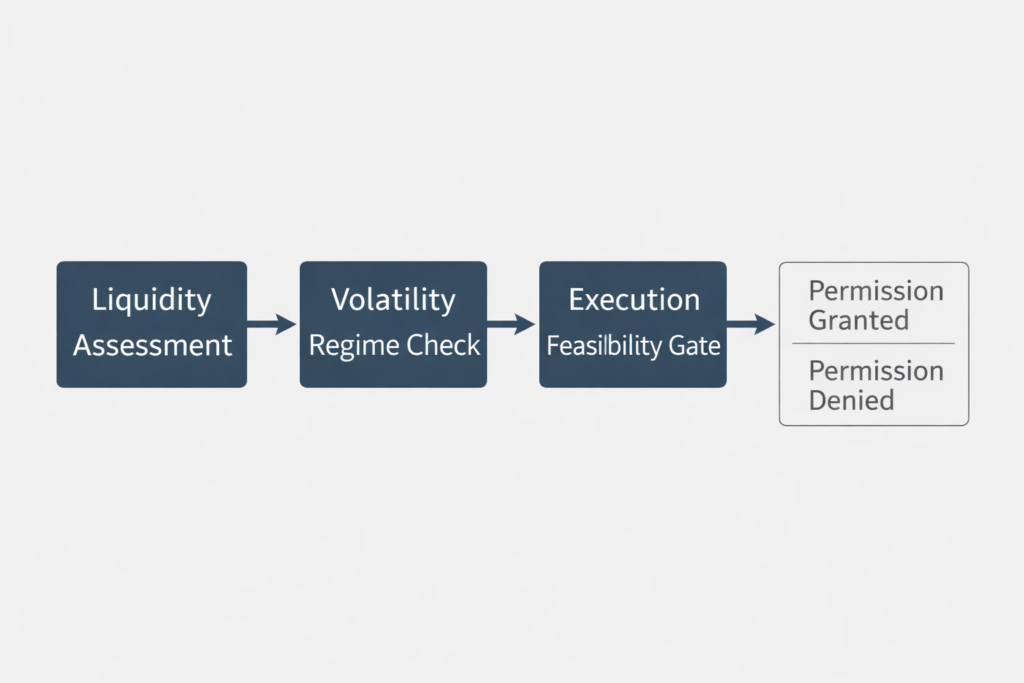
Filtration logic governs participation permission. Specifically, evaluation of whether conditions justify engagement occurs before execution logic activates. This gatekeeping function is central to Why Good Systems Don’t Depend on Good Days as an operational discipline.
Filtration does not predict outcomes. Instead, environmental compatibility receives assessment. When compatibility degrades, execution halts regardless of apparent opportunity.
Filtration operates as structural gate
Effective filtration integrates volatility regimes, liquidity behavior, and microstructure signals. Together, these inputs form a composite view of feasibility.
Understanding filtration logic in systematic trading clarifies how systems avoid forced participation during misleading calm.
Why good days fail filtration tests
Many structurally invalid environments appear calm. For instance, volatility may compress while liquidity depth deteriorates. Similarly, correlations may stabilize while fragmentation increases.
Filtration detects these mismatches. Consequently, participation blocks occur not because markets are turbulent, but because they are deceptively quiet.
Why Good Systems Don’t Depend on Good Days in Risk Architecture
Risk architecture defines exposure boundaries independent of opportunity density. Importantly, the question answered is one of survivability, not profitability. In resilient design, risk always precedes return.
Rather than scaling exposure during favorable regimes, robust systems maintain proportionality anchored to structural conditions. Therefore, risk remains controlled even when opportunity appears abundant.
Risk serves as foundational design input
Risk architecture is not a response mechanism. Instead, it functions as a foundational constraint. Position sizing, capital allocation, and exposure limits are determined before market interaction.
This principle aligns with understanding system integrity as a design philosophy rather than a performance metric.
Good days enable hidden risk accumulation
Favorable conditions encourage leverage creep. During these periods, drawdowns feel distant. Yet hidden correlations and execution fragility accumulate silently.
By enforcing invariant risk rules, systems prevent calm days from becoming precursors to structural failure.
Why Good Systems Don’t Depend on Good Days During Regime Transitions
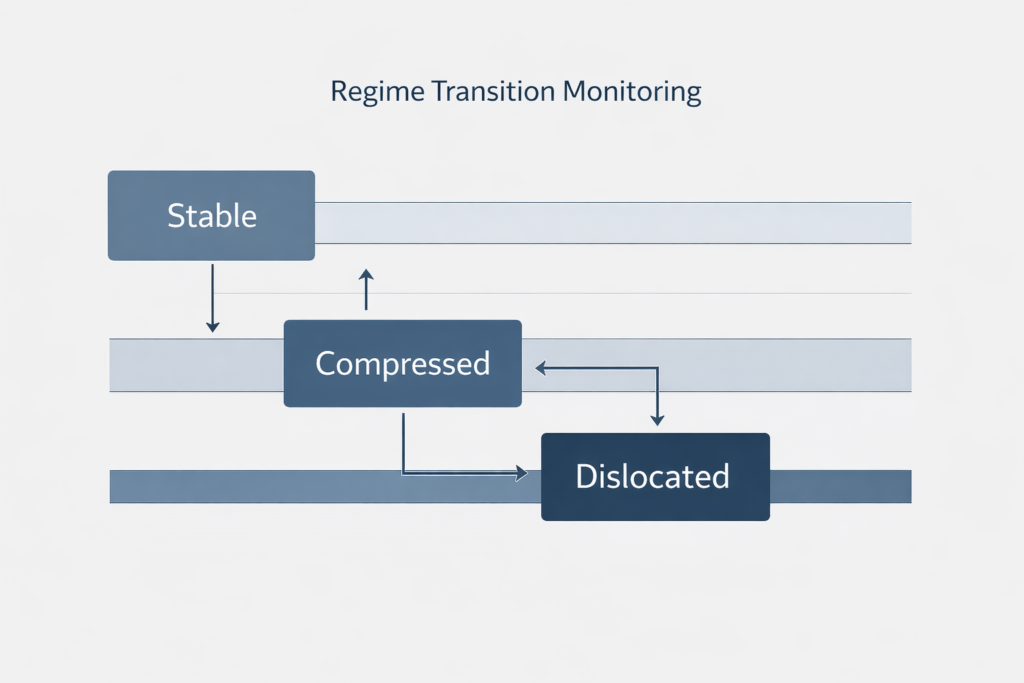
Regime transitions rarely announce themselves. Instead, they unfold through subtle shifts in liquidity behavior, volatility clustering, and execution friction. Systems dependent on favorable conditions often fail precisely during these transitions.
Institutional research from the Bank for International Settlements highlights that market stress reveals vulnerabilities already embedded in infrastructure rather than creating new ones.
Detecting transitions without prediction
Robust systems do not forecast regime changes. Rather, monitoring of structural variables that signal incompatibility occurs continuously. When thresholds are breached, participation adjusts automatically.
This reactive discipline avoids the false confidence of prediction-based models.
Structural withdrawal represents success
Inactivity during transition is not failure. On the contrary, the outcome represents architectural success. By stepping aside when feasibility degrades, systems preserve capital and integrity.
This perspective reframes absence of action as an intentional output rather than a missed opportunity.
Why Good Systems Don’t Depend on Good Days in Execution Feasibility
Execution feasibility determines whether theoretical intent can be realized. Specifically, slippage distributions, spread dynamics, and queue priority change independently of price direction.
Systems that rely on favorable days assume execution stability persists. In contrast, robust design challenges this assumption continuously.
Execution functions as environmental variable
Execution is not static. Rather, response to participant behavior, venue dynamics, and stress propagation occurs continuously. Therefore, feasibility must be reassessed without pause.
Research from the Bank for International Settlements demonstrates that liquidity conditions can deteriorate rapidly despite improvements in average spreads, with skewness and kurtosis increases indicating more frequent episodes of substantial illiquidity.
Protecting good systems against silent degradation
By integrating execution metrics into filtration, systems avoid participating when fills become structurally unreliable. Importantly, this protection operates regardless of apparent calm.
Why Good Systems Don’t Depend on Good Days as Integrity Principle
Integrity is not maintained through vigilance alone. Instead, encoding occurs through design decisions that remove discretion under comfort. Why Good Systems Don’t Depend on Good Days ultimately reflects an integrity-first mindset.
Systems that survive over time prioritize preservation over excitement. Consequently, missed opportunities become the accepted cost of durability.
Integrity prevails over optimization
Optimization seeks improvement under assumed conditions. In contrast, integrity ensures validity when assumptions fail.
By privileging integrity, systems remain coherent across environments that invalidate conventional approaches.
Designing for absence of heroics
Robust systems do not require intervention during stress or calm. Instead, function occurs without heroics, relying on encoded logic rather than reactive judgment.
This removes the human tendency to override constraints during either fear or comfort.
Structural Discipline During Apparent Stability
Apparent stability often precedes structural dislocation. Typically, correlations stabilize before breaking violently, while liquidity appears abundant before evaporating. Similarly, execution friction remains low before spiking unpredictably.
Disciplined infrastructure does not interpret current conditions as predictive of future conditions. Rather, structural assessment remains independent of recent comfort.
Avoiding comfort-driven assumption creep
When markets behave cooperatively for extended periods, assumptions quietly shift. Gradually, position limits that felt restrictive begin to feel excessive. Meanwhile, filters that seemed prudent appear overly cautious.
Encoded constraints prevent this psychological drift. Specifically, parameters do not adjust based on recent experience unless structural evidence supports the change.
Structural vigilance without prediction
Vigilance does not require prediction. Instead, continuous monitoring of structural variables provides early warning when compatibility begins degrading.
This creates space for graceful withdrawal rather than forced exit during panic.
Capital Preservation Through Participation Discipline
Capital preservation is not achieved through superior timing. Rather, preservation emerges from refusing participation when structural conditions do not support engagement.
Often, the most important trades are the ones not taken. Consequently, systems designed around this principle accept forgone opportunity as the cost of avoiding structural traps.
Forgone opportunity as intentional output
Missing favorable moves during structurally invalid periods is not a bug. Instead, the outcome represents intentional design.
Chasing every apparent opportunity leads to participation during environments where structural conditions do not support the assumption of repeatability.
Durability through selective engagement
Durability comes from selective engagement, not comprehensive participation. In fact, systems that operate across all regimes necessarily compromise structural discipline in some environments.
Narrow operating parameters ensure compatibility between environmental reality and system assumptions.
Conclusion: Why Good Systems Don’t Depend on Good Days
Favorable days are temporary. In contrast, structural discipline endures. The central lesson of Why Good Systems Don’t Depend on Good Days is that resilience emerges from architecture, not circumstance. By anchoring decisions in behaviour-first design, structural filtration, and disciplined risk architecture, systems remain valid across regimes.
Durable infrastructure does not chase comfort. Instead, compatibility receives enforcement while inactivity becomes acceptable. Ultimately, integrity preservation occurs long before outcomes are measured.
Markets will always produce periods of apparent calm. However, infrastructure designed around these periods will always fragment when conditions shift. Systems that remain agnostic to market mood—that enforce structural compatibility regardless of recent experience—preserve the capacity to operate when others cannot.
Continue the Exploration
Follow the upcoming series on structure-first system design to explore how behavioural discipline shapes resilient trading infrastructure.
Author
Dovest Research Team
Dovest conducts institutional-grade research into behaviour-first systematic trading infrastructure, focusing on structure, filtration, and risk architecture.
Disclaimer
This article is for educational and informational purposes only. It does not constitute financial advice, investment recommendations, or an offer to provide trading services.