Every institutional trading operation faces a fundamental choice: optimise for headline returns, or build systems designed to survive. In systematic trading infrastructure, system integrity determines whether a strategy’s edge compounds over years or collapses during the first severe drawdown. Yet most performance metrics tell you almost nothing about a system’s structural soundness.
This analysis examines why system integrity — the structural robustness and behavioural consistency of trading infrastructure — should precede performance optimisation in institutional strategy development. We’ll explore what integrity actually means in systematic trading, how it differs from traditional performance metrics, and why institutions that prioritise it build more durable alpha generation.
Past performance does not guarantee future results. Trading involves substantial risk of loss. This content is for educational purposes only and does not constitute investment advice.
What Is System Integrity in Trading?
System integrity in trading refers to the structural robustness, behavioral consistency, and risk management framework that ensures a systematic strategy operates within defined parameters across diverse market conditions, independent of short-term performance outcomes.
Unlike performance metrics that measure what happened, system integrity measures whether a strategy behaves as designed. It encompasses execution discipline, risk parameter adherence, filtration logic effectiveness, and the ability to degrade gracefully when conditions deteriorate. A system with high integrity might underperform during certain periods while maintaining its structural soundness—a feature, not a bug, of institutional-grade infrastructure.
Consider two hypothetical trading systems over a three-year period. System A generates 45% cumulative returns with perfect adherence to risk limits, consistent drawdown characteristics, and predictable behavior across market regimes. By contrast, System B generates 67% returns but violates position sizing rules during favorable periods, shows unpredictable drawdown patterns, and lacks consistent filtration logic. The former demonstrates high integrity; the latter represents performance without structure.
Why Traditional Performance Metrics Miss System Integrity
The Sharpe Ratio Illusion
The Sharpe ratio—returns divided by volatility—dominates institutional performance evaluation. Yet this metric reveals nothing about whether a system will maintain its characteristics going forward. A strategy can exhibit an excellent Sharpe ratio during benign market conditions while containing structural vulnerabilities that emerge only during regime changes.
Furthermore, the Sharpe ratio treats all volatility equally, failing to distinguish between controlled drawdowns from systematic risk-taking and uncontrolled losses from execution failures or parameter breaches. A system that occasionally violates its risk framework might still generate acceptable risk-adjusted returns—until market conditions expose those violations catastrophically.
Maximum Drawdown Without System Integrity Context
Maximum drawdown measures peak-to-trough decline, but without behavioral context, this number means little. Was the drawdown consistent with the strategy’s risk parameters? Did position sizing rules hold throughout? Did filtration logic activate appropriately? A 15% drawdown with perfect systemic discipline differs fundamentally from a 15% drawdown that included multiple risk parameter violations.
Institutional investors increasingly recognize that drawdown magnitude matters less than drawdown character. Controlled losses from systematic risk exposure are manageable; uncontrolled losses from infrastructure failures threaten capital allocation mandates.
The Backtesting Trap vs. Structural Integrity
Backtested performance represents a single path through historical data—one realization from a distribution of possible outcomes. Without understanding the system’s behavioral boundaries, these numbers offer false precision. Did the backtest assume perfect execution? How did it handle instrument delistings, corporate actions, or liquidity constraints? What happens when live market conditions differ from historical patterns?
System integrity asks different questions: Under what conditions does the strategy operate? When should it shut down? How does it respond to data anomalies, execution failures, or regime changes? These structural questions matter more than optimized historical returns.
The Core Components of System Integrity in Trading
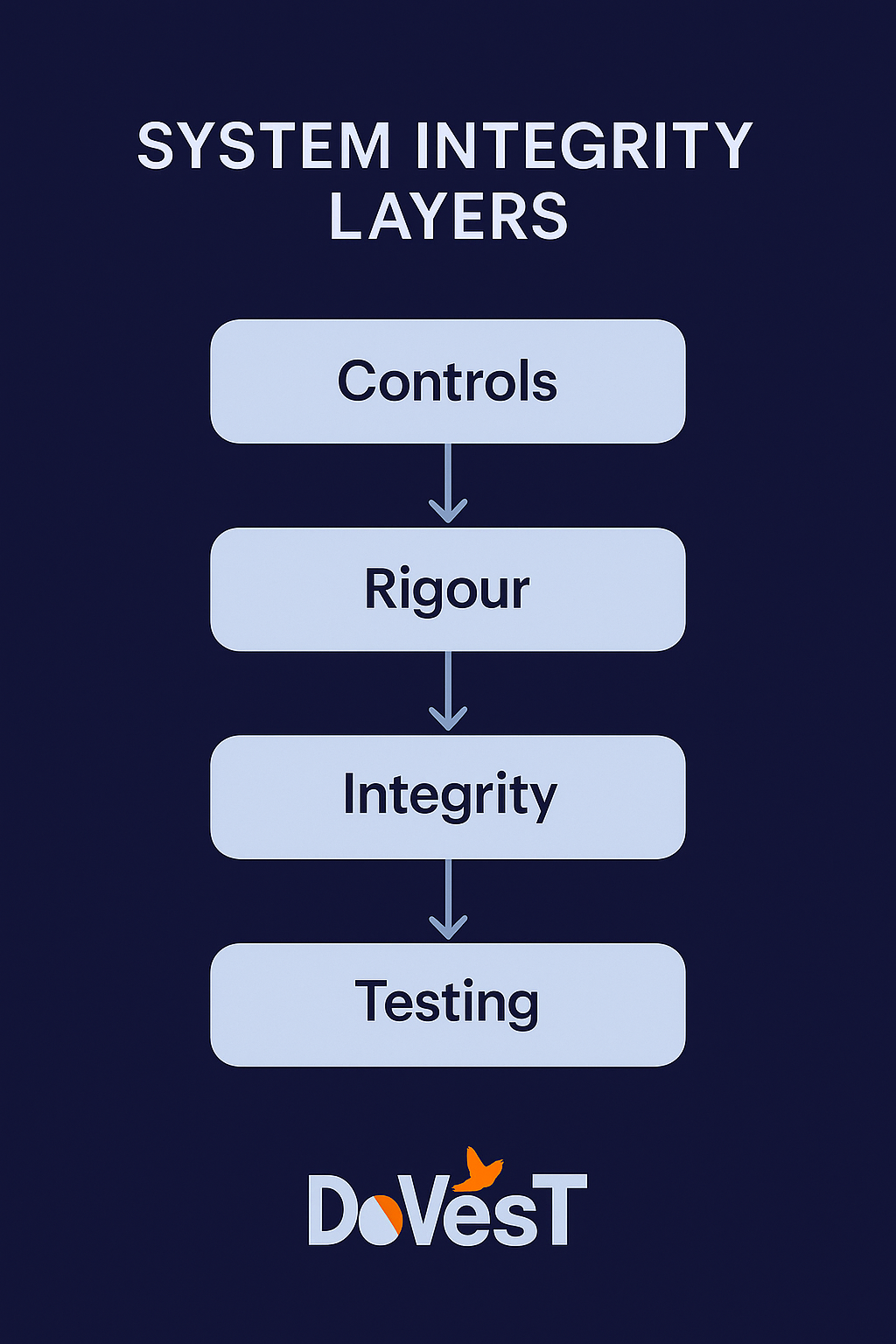
Risk Parameter Adherence
True system integrity begins with unwavering adherence to predefined risk parameters. Position sizing rules must apply consistently—not just on average, but in every single trade. Maximum drawdown limits trigger systematic response protocols, not discretionary interventions. Leverage constraints hold regardless of conviction or opportunity.
Soft Limits Undermine Trading System Integrity
Many systematic strategies maintain “soft” risk limits that serve as guidelines rather than hard constraints. This flexibility sounds practical but undermines structural integrity. When market conditions stress the system, these soft limits become judgment calls, introducing discretionary elements that corrupt systematic discipline.
Hard Constraints Preserve Structural Soundness
Institutional-grade infrastructure implements hard stops that cannot be overridden without explicit process changes. If a strategy specifies 2% maximum portfolio risk per position, the system physically prevents 2.1% allocation. Such rigidity feels constraining during missed opportunities but preserves structural soundness during inevitable mistakes.
Behavioral Consistency Across Regimes
A system with high integrity behaves predictably across different market environments—not because it always profits, but because its decision logic remains constant. Trend-following strategies should generate similar types of trades during trending markets, whether those markets trend up or down, in equities or commodities, in 2015 or 2025.
System Integrity Requires Constant Decision Logic
Behavioral consistency does not mean constant profitability. Rather, it means the strategy’s responses to market conditions follow defined logic without regime-dependent adjustments. When a strategy behaves differently across similar environments, it signals either overfitting to historical patterns or structural instability that will likely fail out-of-sample.
Execution Behavior Must Remain Stable
Such consistency extends to execution behavior. Order routing logic, slippage management, and transaction cost modeling should operate identically whether markets are calm or volatile, whether the strategy is winning or losing. Execution behavior that adapts to performance outcomes introduces path dependency that undermines systematic integrity.
Filtration Logic Effectiveness
Perhaps no component matters more to system integrity than robust filtration—the logic that determines when a strategy should operate versus when it should stand aside. Effective filtration acknowledges that not all market conditions suit every strategy. Attempting to force continuous operation across all environments guarantees eventual structural failure.
Market Structure Drives Filtration Decisions
High-integrity filtration operates on market structure characteristics, not performance outcomes. It identifies environments where the strategy’s core assumptions likely hold versus conditions where those assumptions break down. A momentum strategy might filter out sideways, range-bound markets not because it loses money there (though it might), but because those conditions violate the strategy’s fundamental premise.
Performance-Independent System Integrity
Critically, filtration decisions must be independent of recent performance. Systems that increase activity after wins or reduce exposure after losses introduce behavioral instability that corrupts structural integrity. Filtration should respond to market conditions, not portfolio equity curves.
Graceful Degradation Maintains System Integrity Under Stress
No systematic strategy operates optimally under all conditions. System integrity requires not just knowing when to operate, but how to degrade gracefully when conditions deteriorate. This might mean reducing position sizes, widening stop losses, or temporarily suspending operations—all according to predefined protocols, not panic responses.
Graceful degradation acknowledges limits transparently rather than pushing through adversity with hope. A well-designed system might recognize that its historical edge emerged from specific market characteristics. When those characteristics temporarily disappear, the system scales back rather than forcing trades that violate its structural assumptions.
Why Institutions Should Prioritize System Integrity Over Performance
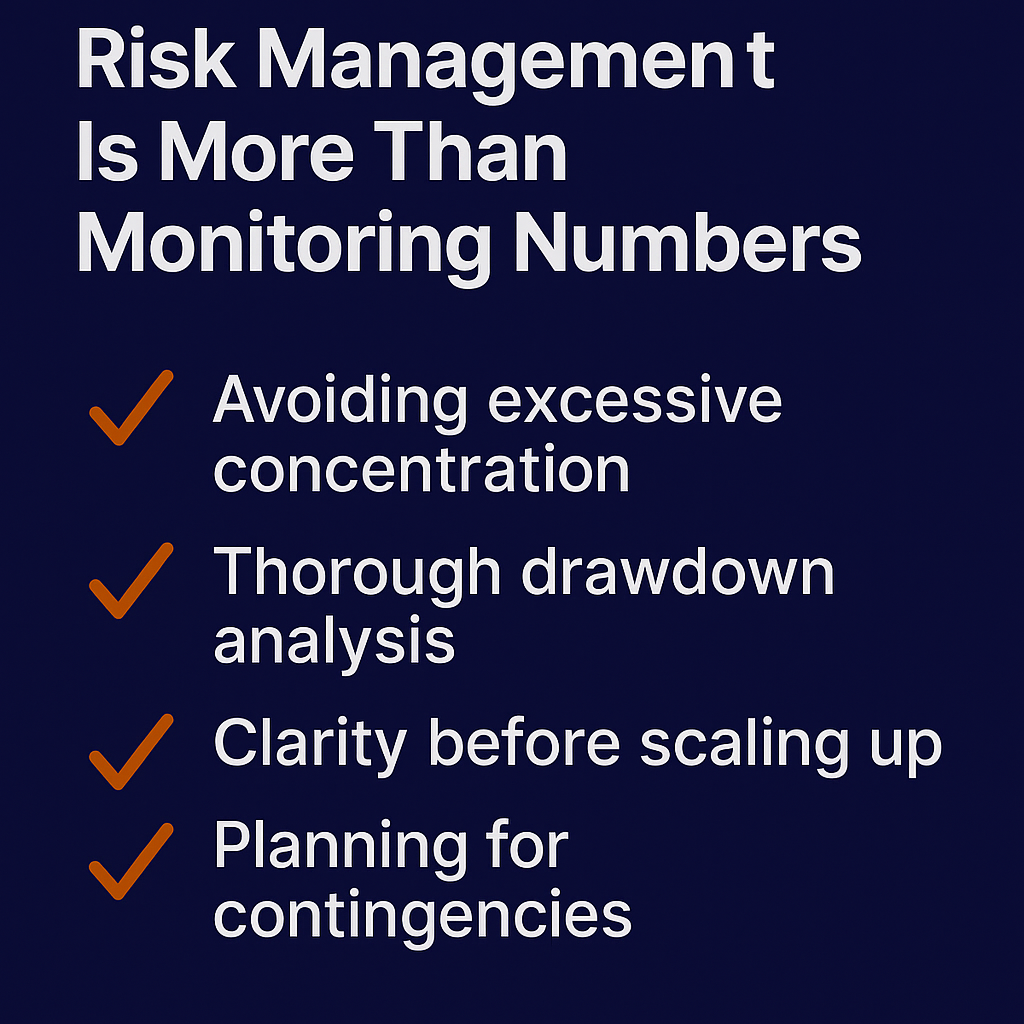
Due Diligence Requires Structural Integrity and Transparency
Institutional capital allocators conduct extensive due diligence before committing funds. Traditional performance metrics answer “what happened”; integrity metrics answer “why and how.” The latter provides far more insight into whether past results might persist.
An allocator evaluating two managers with similar three-year returns faces a critical question: which system is more likely to maintain its characteristics going forward? Performance history offers weak signal; structural integrity provides stronger indication. Did the system operate within its stated parameters? Did behavioral patterns remain consistent? Does filtration logic demonstrate clear rationale?
Transparency about system integrity allows institutional investors to understand not just past returns but future risk. A manager who articulates clear operational boundaries, risk constraints, and filtration logic enables allocators to assess whether that strategy fits their portfolio mandates—regardless of recent performance.
Operational Risk Management and System Integrity
Beyond market risk, institutional investors face operational risk—the possibility that infrastructure failures, process breakdowns, or human errors cause losses independent of strategy quality. System integrity directly addresses operational risk through structural safeguards that prevent catastrophic mistakes.
Consider execution infrastructure. A high-integrity system implements multiple validation layers that catch errors before they reach markets. Position sizing errors, incorrect instrument mappings, or parameter misconfiguration all trigger automatic halts. These safeguards might occasionally stop correct orders, but they prevent the occasional catastrophic error that erases months of gains.
Similarly, disaster recovery protocols, redundant data feeds, and automated monitoring systems all contribute to operational integrity. These infrastructure elements generate no alpha but prevent the operational failures that occasionally destroy funds.
Regulatory Compliance and Audit Trails
Regulatory requirements increasingly demand transparency into systematic trading operations. High system integrity naturally produces the documentation, audit trails, and behavioral consistency that regulators expect. Systems designed with structural discipline from the outset integrate compliance naturally rather than retrofitting it onto performance-optimized strategies.
Every trade decision should trace back to specific logic within the system’s framework. Why did the system enter this position at this size at this time? High-integrity systems answer these questions through transparent decision logs that demonstrate consistent application of stated methodology. This auditability matters increasingly as regulators scrutinize algorithmic trading.
The Performance Paradox: How System Integrity Generates Returns
Reduced Behavioral Errors Through Structural Integrity
Ironically, prioritizing system integrity over short-term performance often generates superior long-term returns by eliminating costly behavioral errors. Strict adherence to risk parameters prevents the overleveraged positions that cause catastrophic drawdowns. Consistent execution discipline avoids the discretionary interventions that typically occur at exactly the wrong moments.
Many strategies fail not because their core logic was flawed but because operational drift, parameter creep, or discretionary overrides corrupted their structural integrity. A mediocre strategy executed with perfect discipline typically outperforms an excellent strategy executed inconsistently.
Capital Preservation During Adverse Regimes via System Integrity
System integrity emphasizes survival during unfavorable conditions as much as exploitation during favorable ones. Effective filtration might cause a strategy to miss some profitable periods—frustrating in the moment—but avoiding severe drawdowns during hostile regimes preserves capital for subsequent opportunities.
The mathematics of compounding make capital preservation paramount. A strategy that generates 25% annual returns but occasionally suffers 40% drawdowns will likely underperform a strategy generating 18% annual returns with maximum 15% drawdowns over long horizons. System integrity focuses on controlling the downside, allowing compounding to work over decades.
Institutional Capital Retention
Perhaps most importantly, high system integrity attracts and retains institutional capital. Allocators redeem from managers not primarily because of underperformance—all strategies experience difficult periods—but because of loss of confidence in the manager’s process. When a system behaves unpredictably or violates stated parameters, allocators withdraw.
Conversely, managers who maintain structural integrity through difficult markets often see capital remain stable or even increase. Institutional investors value predictability and process discipline more than quarterly performance. A manager who explains underperformance through the lens of consistent system behavior maintains credibility; a manager who produces volatile returns without structural explanation faces redemptions.
Common System Integrity Failures in Systematic Trading
Parameter Drift
One of the most insidious integrity failures occurs through gradual parameter drift—small, seemingly justified adjustments that accumulate over time. A strategy initially designed with strict position sizing limits incrementally relaxes those limits based on recent success. Stop losses widen slightly after a series of small losses. Filtration thresholds adjust to reduce periods out of the market.
Each adjustment might appear reasonable in isolation, but collectively they transform the strategy into something fundamentally different from its original specification. The system that generated attractive historical results no longer exists; it has evolved into an untested variant with unknown characteristics.
Performance-Dependent Behavior Undermines Integrity
System integrity requires that operational decisions respond to market conditions, not equity curves. Yet many strategies unconsciously introduce performance-dependent behavior. After a winning streak, position sizes creep larger due to increased confidence. After losses, the system becomes more conservative, reducing exposure exactly when opportunities might emerge.
This creates path dependency where the system’s current behavior depends on its recent performance history rather than current market characteristics. Two identical market environments might generate different responses depending on whether the system recently won or lost—a clear violation of structural integrity.
Discretionary Overrides Corrupt System Integrity
Systematic strategies should operate automatically according to predefined logic. Yet discretionary overrides—manual interventions that bypass system rules—remain surprisingly common. Perhaps the trader believes the system is “wrong” about a particular opportunity. Or recent losses trigger doubt about the methodology, leading to size reductions.
Each override, regardless of outcome, undermines system integrity. Even profitable discretionary interventions corrupt structural discipline because they introduce human judgment into what should be a mechanical process. Over time, these interventions accumulate, gradually transforming a systematic strategy into a discretionary one.
Inadequate Execution Monitoring Compromises Integrity
System integrity extends through the entire execution pipeline. Many strategies implement sophisticated signal generation while treating execution as an afterthought. Poor execution monitoring means slippage, market impact, and transaction costs deviate from expectations without triggering systematic responses.
A high-integrity system continuously monitors execution quality and automatically adjusts when execution characteristics deteriorate. If slippage exceeds modeled estimates, position sizing should decrease or filtration thresholds should tighten. Execution quality deserves the same systematic discipline as signal generation.
Building System Integrity: A Framework for Trading Infrastructure
Define Operational Boundaries Explicitly
System integrity begins with explicit definition of operational boundaries—the conditions under which the strategy should and should not operate. This includes:
- Market condition filters: What characteristics must be present for the strategy to engage?
- Risk parameter limits: What are the absolute, non-negotiable constraints on position sizing, leverage, and drawdown?
- Execution standards: What slippage, market impact, and transaction costs are acceptable before scaling back?
- Data quality requirements: What data integrity issues should trigger automatic shutdown?
These boundaries should be documented before any live trading occurs and modified only through formal process reviews, not real-time adjustments based on performance.
Implement Hard Stops and Validation Layers for Integrity
Convert operational boundaries from guidelines into hard constraints that the system cannot violate. This requires infrastructure that:
- Physically prevents position sizes exceeding defined limits
- Automatically halts trading when drawdown thresholds trigger
- Validates all orders against multiple criteria before execution
- Monitors data quality continuously and suspends operations when anomalies appear
Hard stops feel restrictive—they will occasionally prevent profitable trades—but they prevent the catastrophic errors that end careers. The goal is not optimization but constraint satisfaction.
Separate Signal Generation from Risk Management in System Design
Many strategies conflate signal generation with position sizing, embedding risk decisions within alpha logic. This coupling undermines integrity by making risk management performance-dependent. Instead, maintain strict separation:
- Signal layer: Generates directional views independent of position sizing
- Risk layer: Determines position sizes based solely on risk parameters and current exposure
- Filtration layer: Decides whether to execute based on market condition suitability
This separation ensures that risk decisions follow consistent logic regardless of signal strength or recent performance.
Build Comprehensive Monitoring and Alerting for System Integrity
System integrity requires continuous monitoring of actual behavior against expected behavior. Key metrics include:
- Risk parameter adherence: Are all positions within defined limits?
- Behavioral consistency: Do current trading patterns match historical behavior?
- Execution quality: Is actual slippage consistent with models?
- Filtration accuracy: Is the system correctly identifying suitable environments?
Automated alerts should trigger when any metric deviates from expectations, prompting investigation before small issues become large failures.
Real-World Application: System Integrity in Practice
Consider a hypothetical momentum strategy designed for liquid equity futures markets. The strategy’s core premise assumes that price trends persist over intermediate timeframes due to behavioral biases and institutional positioning dynamics.
System Integrity Implementation Framework
The strategy defines explicit operational boundaries. It operates only when instrument volatility remains between the 30th and 85th historical percentiles—volatile enough for meaningful trends but not so volatile that execution costs dominate. Position sizing uses fixed fractional allocation based on volatility normalization, with absolute maximum position size of 3% portfolio risk per instrument regardless of conviction.
Filtration Logic and Risk Management
Filtration logic assesses trend strength using multiple timeframe alignment. The system engages only when short, intermediate, and long-term momentum signals align directionally. When timeframes conflict, the system stands aside rather than forcing trades. This filtration has no memory—recent profitability or losses don’t influence whether conditions currently meet requirements.
Execution Monitoring and Dynamic Adjustment
Execution monitoring tracks realized slippage against volatility-adjusted models. When actual slippage exceeds modeled estimates by 50% for three consecutive trades, position sizes automatically reduce by 25% until execution quality normalizes. This response occurs regardless of whether those trades were profitable overall.
Real-World Stress Test: 2020 Volatility
During the 2020 pandemic volatility spike, many instruments exceeded the 85th percentile volatility threshold. The filtration logic automatically suspended operations in those instruments, missing some substantial moves but preserving capital during a period when execution costs and gap risk exceeded the strategy’s design parameters. This wasn’t performance-chasing; it was structural integrity maintaining operational boundaries.
What This Approach Sacrifices
This high-integrity implementation sacrifices maximum returns during certain periods. The volatility filters prevent operation during explosive trends. The position size constraints limit profit during high-conviction situations. The execution monitoring reduces exposure during periods that might remain profitable despite poor execution.
What System Integrity Preserves
In exchange, the system maintains behavioral predictability. Institutional allocators understand exactly when and how it operates. Drawdown characteristics remain within expected ranges. Execution costs stay predictable. The strategy survives regime changes because it was designed for survival, not optimization.
Key Takeaways
- System integrity—structural robustness and behavioral consistency—provides greater insight into future performance potential than historical returns
- Traditional performance metrics measure outcomes; integrity metrics measure whether a system operates as designed
- Hard risk parameter constraints, consistent filtration logic, and execution discipline form the foundation of systematic trading infrastructure
- Prioritizing integrity over short-term performance often generates superior long-term returns by eliminating costly behavioral errors
- Institutional capital allocation increasingly values structural transparency and process discipline over recent performance results
- Common integrity failures include parameter drift, performance-dependent behavior, and discretionary overrides that corrupt systematic discipline
Frequently Asked Questions
Does prioritizing system integrity mean accepting lower returns?
Q: Doesn’t prioritizing integrity over performance mean accepting lower returns?
A: Not over meaningful timeframes. System integrity prevents the catastrophic losses and behavioral errors that destroy compounding. A strategy generating 18% annually with perfect discipline will likely outperform a strategy generating 25% annually with occasional integrity failures over 10+ year horizons. Additionally, institutional capital remains more stable when allocated to high-integrity systems, enabling longer-term compounding without redemption disruptions.
How do you measure system integrity quantitatively?
Q: How do you measure system integrity quantitatively?
A: System integrity combines multiple quantitative and qualitative metrics. Quantitatively, track risk parameter adherence rate (percentage of trades within defined limits), behavioral consistency measures (correlation of current patterns with historical behavior), execution quality (actual vs. modeled slippage), and filtration accuracy (whether system correctly identified suitable environments retrospectively). Qualitatively, assess documentation quality, process discipline, and infrastructure robustness. No single number captures integrity; it requires comprehensive systematic evaluation.
When should high-integrity systems modify parameters?
Q: When should a high-integrity system modify its parameters?
A: Parameter modifications should occur only through formal process reviews conducted at scheduled intervals (quarterly or annually), not in response to recent performance. These reviews assess whether market microstructure has changed in ways that warrant structural adjustments. For example, if average bid-ask spreads narrow persistently due to regulatory changes, position sizing models might adjust to reflect improved execution environment. But these changes require documented rationale, out-of-sample validation, and formal approval—not real-time tweaking based on recent wins or losses.
Can discretionary trading achieve system integrity?
Q: Can discretionary trading systems achieve high integrity?
A: Yes, though the implementation differs. Discretionary systems achieve integrity through consistent decision frameworks, documented rationale for every trade, strict adherence to predefined risk limits, and transparent performance attribution. The key is removing arbitrary judgment while acknowledging that some discretion is inherent to the approach. Many successful discretionary traders operate with more structural discipline than self-proclaimed systematic traders who frequently override their systems.
Explore How Dovest Builds Institutional System Integrity
We are currently preparing a full technical brief detailing our validation layers, risk constraints, and behavioural monitoring architecture.
If you’re an institutional allocator or infrastructure-focused operator, you can request early access:
→ Register interest for the technical brief
→ Join the institutional waitlist for system walkthroughs
→ Get notified when documentation becomes available
About This Analysis:
This content synthesises principles from institutional risk management, systematic trading infrastructure design, and quantitative strategy development. Examples are hypothetical and simplified for clarity.
Limitations:
System integrity provides no guarantee of profitable returns. Even perfectly disciplined systems can experience sustained underperformance or complete strategy failure if core assumptions prove incorrect. Integrity addresses process discipline, not market forecasting accuracy.
Author: Dovest Research Team | Systematic Trading Infrastructure Specialists
Last Updated: December 2025
Legal Disclaimer: Past performance does not guarantee future results. Trading involves substantial risk of loss and is not suitable for all investors. This content is for educational and informational purposes only and should not be construed as trading advice or recommendations. Dovest does not provide investment advice or recommendations to buy or sell specific securities. All trading decisions remain the sole responsibility of the investor.