
Pre-Commitment Rules: Decisions Made Before Pain Arrives
Most systematic trading systems fail not because their logic breaks or their data degrades, but because systems still allow critical decisions during periods of maximum stress. Pre-commitment rules eliminate this structural weakness by removing choice at the exact moment when judgment becomes unreliable. In behaviour-first systematic trading infrastructure, pre-commitment rules encode irreversible constraints into system architecture before adverse conditions appear.
These rules shift governance away from reactive oversight and into foundational design, where systems decide once during clarity and enforce automatically during stress. This approach acknowledges a fundamental reality: stress consistently breaks the assumption that operators will execute correct decisions at the worst possible moment.
Why Pre-Commitment Rules Replace Discipline-Based Governance
Discipline-based governance operates on a flawed premise. It assumes that when volatility spikes, when drawdowns accelerate, when time compression narrows attention, operators or systems will maintain clarity and execute optimal decisions. Research from the Bank for International Settlements demonstrates that market stress exposes governance weaknesses already embedded in system design, not failures that emerge during stress itself.
Architectural constraints operationalize this insight by addressing the root cause: governance structures that permit decisions during compromised periods. Rather than asking “Will we do the right thing when it matters?”, these boundaries make this question irrelevant by ensuring certain actions never become available in the first place.
How Pre-Commitment Rules Shift Decision Timing
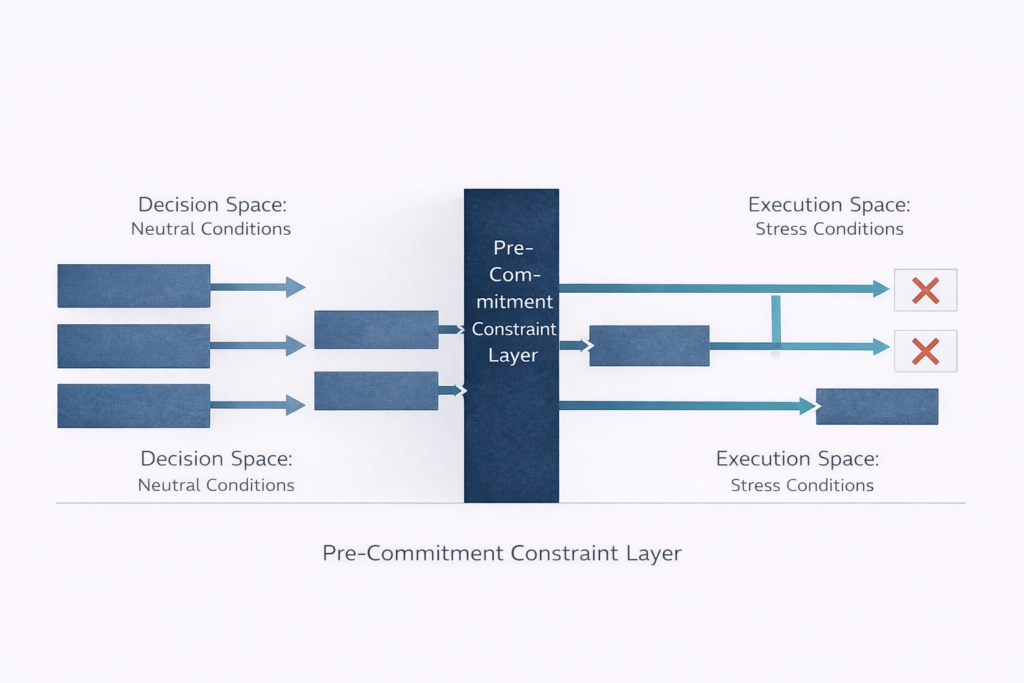
Traditional risk management asks whether systems will execute correctly under pressure. Pre-commitment rules eliminate this uncertainty by encoding boundaries into system design during neutral conditions. Critical choices occur upstream when conditions remain stable and cognition remains intact, not downstream when stress distorts judgment.
This temporal shift protects decision hygiene. The framework ensures that when psychological pressure peaks, when behavioural biases intensify, when cognitive compression narrows focus—at precisely these moments—no decisions remain available to contaminate outcomes.
Pre-Commitment Rules and Cognitive Compression
When stress arrives, systems experience cognitive compression: reduced bandwidth, distorted probability assessment, and urgency-driven reasoning. Governance mechanisms that rely on judgment during these periods fail by design, not by accident.
Eliminating Choice During Maximum Stress
Pre-commitment rules protect against cognitive compression by forcing critical decisions to occur before compression begins. A system defines maximum exposure once per regime. After drawdown onset, exposure increases become architecturally impossible—not discouraged, not flagged for review, but genuinely unavailable within the system’s operational space.
This design contrasts sharply with monitoring-based approaches. Dashboards that display risk metrics during stress preserve the illusion of control while leaving the fundamental failure mode intact: the system can still choose under pressure.
Why Pre-Commitment Rules Prevent Late Governance
If a system permits size adjustments, rule modifications, or exception handling during stress, governance has already failed. The failure does not occur when the exception executes—it occurs when the architecture allows exceptions to exist in the first place.
Pre-commitment rules close these gaps before stress reveals them. They define what actions do not exist within the system’s operational vocabulary, ensuring governance arrives embedded in structure rather than as reactive intervention.
What Pre-Commitment Rules Actually Define
Pre-commitment rules do not activate conditionally. They do not adapt to changing conditions. They do not negotiate with performance metrics or stress indicators. Instead, pre-commitment rules define what actions do not exist within the system’s operational framework.
How Pre-Commitment Rules Specify Forbidden Actions
Rather than optimizing responses to stress, pre-commitment rules remove entire pathways from the decision space. This approach differs fundamentally from dynamic risk management, which continuously adjusts parameters under stress.
Consider a concrete example. A system defines maximum exposure once per regime based on structural analysis during neutral conditions. After drawdown onset, the architecture makes exposure increases impossible. Approval workflows do not exist. Override mechanisms cannot function. The system processes no temporary exception requests. The action simply does not exist within the system’s operational vocabulary.
Creating Irreversible Constraints With Pre-Commitment Rules
Irreversibility defines the core mechanism of pre-commitment rules. Once stress triggers a constraint, the system cannot modify, suspend, or bypass it until the regime ends and verification processes complete. According to research from the Bank for International Settlements, market microstructure effects and transaction costs dominate realized outcomes during regime transitions.
This design prevents the most common failure mode in systematic trading: incremental compromises that accumulate into catastrophic deviation. Pre-commitment rules ensure systems cannot chase apparent recoveries that later collapse, protecting structural integrity precisely when behavioural pressure peaks.
Pre-Commitment Rules vs Monitoring and Alerts
Monitoring systems answer one question: What is happening now? Pre-commitment rules answer a more important question: What is never allowed to happen? This distinction separates observation from prevention.
Why Pre-Commitment Rules Outperform Dashboards
If a system can still choose under pressure, dashboards become decoration. Alerts preserve the illusion of control while leaving the fundamental failure mode intact. The system receives information about deteriorating conditions but retains the capacity to act on that information in ways that compound rather than contain damage.
Pre-commitment rules eliminate this gap. Architecture prevents what monitoring can only observe. Rather than alerting operators to dangerous conditions and trusting discipline to constrain response, the framework makes dangerous responses architecturally impossible.
Where Pre-Commitment Rules Sit in System Architecture
In behaviour-first systematic trading infrastructure, pre-commitment rules sit above execution and risk management layers. They operate before filtration logic decides whether to act, before risk management determines position sizing, before execution deploys capital.
This hierarchical positioning ensures that even when signals fire and risk metrics appear favorable, pre-commitment rules can forbid specific responses based on system state and behavioural history. These constraints function as immutable boundaries that other system layers cannot override.
Types of Pre-Commitment Rules in Systematic Trading
Pre-commitment rules manifest across multiple dimensions of systematic trading infrastructure. Each type addresses specific failure modes that discipline-based governance consistently fails to prevent.
Pre-Commitment Rules for Exposure Irreversibility
Systems define maximum exposure once per regime during neutral conditions. After drawdown begins, exposure increases remain impossible regardless of signal strength or apparent opportunity quality. This type of pre-commitment rule prevents the common failure pattern where systems escalate risk during recoveries that subsequently collapse.
The constraint acknowledges a behavioural reality: apparent recoveries during drawdown periods trigger urgency-driven position sizing that optimization logic would never approve during neutral conditions. By making increases unavailable, the architecture protects against decisions contaminated by loss recovery motivation.
Pre-Commitment Rules as Behavioural Locks
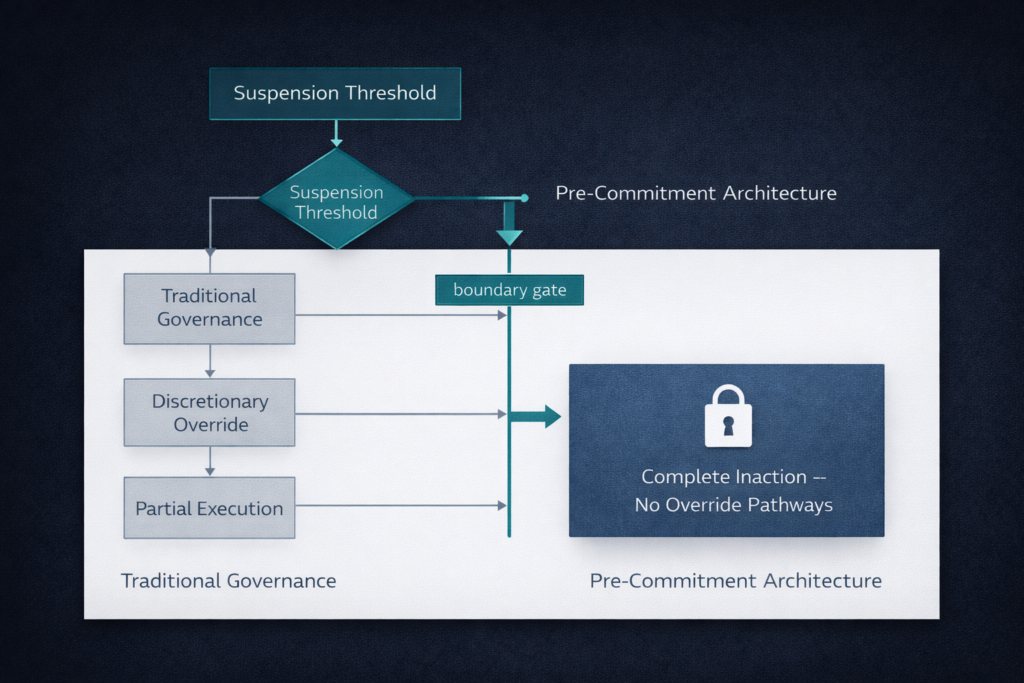
Suspension thresholds function as absolute constraints within pre-commitment frameworks. Once triggered, systems permit no partial execution, no reduced-size compromises, no discretionary exceptions. The architecture enforces complete inaction.
This design prevents behavioural erosion at its source. The first compromise—the moment when operators or systems negotiate with constraints—never occurs because the framework provides nothing to negotiate with. Structural boundaries block the initial deviation that typically cascades into systematic failure.
Pre-Commitment Rules for Structural Inaction
Certain market regimes violate fundamental system assumptions. Pre-commitment rules can designate these regimes as zero-action environments where the framework enforces complete inactivity rather than asking operators to resist temptation.
This approach differs from traditional risk-off modes that reduce but do not eliminate activity. Structural inaction makes all position changes impossible, acknowledging that some environments offer no edge regardless of signal configuration or risk adjustment.
Pre-Commitment Rules for Re-Entry Requirements
After suspension, pre-commitment rules define specific conditions that must exist before the system can resume activity. Time elapsed and verified regime change function as mandatory requirements. Performance recovery alone never triggers re-entry.
This boundary prevents urgency-driven decisions motivated by loss recovery rather than structural evidence. The constraint acknowledges that psychological pressure to recover losses creates contaminated judgment even when surface conditions appear to improve.
Pre-Commitment Rules vs Traditional Risk Management
Risk management adjusts. Pre-commitment rules forbid. This distinction defines the fundamental difference in approach.
How Pre-Commitment Rules Constrain Risk Systems
Traditional risk systems modify stops, scale exposure dynamically, and respond to changing volatility—always operating under stress. Pre-commitment rules define boundaries that risk management cannot cross regardless of conditions or calculations.
Risk management operates inside the space pre-commitment rules define. It optimizes within constraints but never expands the constraint space. This relationship ensures that even sophisticated risk algorithms cannot override architectural protections during periods when those protections matter most.
Why Pre-Commitment Rules Accept Reduced Flexibility
Flexibility feels safe during neutral conditions. Under stress, flexibility becomes liability. Every option preserved during stress represents a potential failure point where contaminated judgment can execute decisions that compound damage.
Pre-commitment rules accept reduced tactical flexibility to guarantee structural integrity. This trade-off acknowledges a non-negotiable reality in live systematic trading: protecting system identity over time matters more than optimizing response to any single market condition.
How Pre-Commitment Rules Prevent Decision Contamination
Catastrophic outcomes rarely stem from obviously bad decisions made during calm periods. They result from context-contaminated decisions made under drawdown pressure when urgency distorts judgment and loss recovery motivation overwhelms structural reasoning.
Changing When Critical Decisions Occur
Architectural constraints fundamentally alter when critical decisions occur. Systems decide once during clarity and enforce automatically during stress. This temporal shift removes contaminated judgment from the decision chain entirely.
The framework ensures that when pressure peaks, when behavioural biases intensify, when cognitive compression narrows focus—at precisely these moments—no decisions remain available to contaminate. The system executes boundaries defined during neutral conditions rather than evaluating options under stress.
How Pre-Commitment Rules Protect System Identity
System identity—the consistent application of structural principles across all market conditions—compounds reliably over time. Small exceptions that seem reasonable under pressure erode this identity incrementally until the system no longer resembles its design specification.
Pre-commitment rules protect system identity by preventing the first exception. When architecture removes pathways, nothing remains to resist, nothing invites debate, nothing allows override. Behavioural integrity emerges because deviation becomes architecturally impossible.
Making Discipline Irrelevant With Pre-Commitment Rules
Systems often attempt to “maintain discipline” through monitoring, alerts, and human oversight. Pre-commitment rules eliminate the need for discipline by removing the choices that discipline exists to constrain.
Removing Temptation From Operational Space
When architecture removes pathways, temptation becomes irrelevant. Nothing exists to resist. Courage is not required to follow constraints because no alternatives present themselves for consideration.
This design acknowledges a simple reality: discipline fails under sufficient pressure. Rather than strengthening discipline, structural boundaries eliminate situations where discipline determines outcomes.
Why Pre-Commitment Rules Make Erosion Impossible
Behavioural erosion typically begins with small compromises that seem reasonable given immediate circumstances. Each compromise establishes precedent for larger deviations until the system operates far outside its design parameters.
Pre-commitment rules prevent this cascade by blocking the initial compromise. When the framework forbids specific actions, precedent cannot establish itself. The system cannot drift because no pathway exists for incremental deviation.
The Cost of Flexibility Without Pre-Commitment Rules
Systems that preserve optionality under stress eventually pay for that preservation. Flexibility compounds behavioural erosion rather than tactical advantage.
Trading Flexibility for Long-Term Integrity
Structural constraints accept that certain tactical opportunities will pass unexploited. During recoveries that prove sustainable, the system remains constrained when other approaches might engage. This cost is real and measurable.
The benefit—guaranteed protection against decisions made under contaminated judgment—exceeds this cost over time. Tactical flexibility that permits one catastrophic error destroys more value than foregone opportunities preserve.
Why Survival Supersedes Optimization
In systematic trading infrastructure, survival supersedes optimization. Systems that optimize tactical response but permit structural compromise eventually fail regardless of average decision quality.
Architectural boundaries prioritize structural integrity over tactical flexibility. This hierarchy acknowledges that dead systems generate no returns, while systems that survive through imperfect periods retain the capacity to compound over time.
Pre-Commitment Rules in Behaviour-First Infrastructure
Within Dovest’s systematic trading framework, pre-commitment rules function as foundational constraints that shape all downstream logic. Filtration logic systematic trading operates within boundaries these rules define, ensuring that even validated signals cannot violate structural protections.
Interaction With Filtration Logic
Filtration logic determines whether market conditions support action. Pre-commitment rules determine whether the system can act regardless of what filtration logic concludes. This layered approach ensures that structural protections supersede tactical analysis.
Even when filtration logic validates opportunity and risk management approves sizing, pre-commitment rules can forbid execution based on system state or behavioural history. These constraints function as absolute limits that other layers respect unconditionally.
Relationship to System Integrity Frameworks
System integrity encompasses the complete preservation of design principles across all conditions. Pre-commitment rules enforce integrity by making violations architecturally impossible rather than merely discouraged or monitored.
This enforcement mechanism ensures that integrity never depends on discipline, courage, or judgment during stress. The architecture itself guarantees consistency because alternatives do not exist within the operational framework.
Implementing Pre-Commitment Rules in Trading Architecture
Implementation requires encoding pre-commitment rules into system architecture at the foundational level. Effective constraints cannot function as configuration parameters that operators can modify. They must exist as immutable structural elements.
Architectural Constants vs Dynamic Variables
Effective implementation treats boundaries as architectural constants rather than dynamic variables. Maximum exposure limits, suspension thresholds, and re-entry requirements become hardcoded constraints that deployment processes cannot modify without complete system rebuilds.
This approach prevents incremental erosion. If changing a boundary requires rebuilding the system, the friction inherent in that process protects against stress-driven modifications.
Documentation Requirements for Structural Decisions
Systems must document the reasoning behind each boundary during neutral conditions. This documentation serves not as justification for potential override but as historical record explaining why specific constraints exist.
When stress arrives and boundaries activate, documentation reminds operators that current conditions are precisely why constraints were encoded. The documentation protects against the common failure mode where present circumstances seem to justify exceptions to boundaries designed for exactly those circumstances.
Long-Term Performance Through Pre-Commitment Rules
Pre-commitment rules sacrifice short-term flexibility for long-term structural integrity. This trade-off defines their value proposition in systematic trading infrastructure.
Protecting Compound Returns Through Survival
Compounding requires survival. Systems that optimize every tactical decision but permit occasional structural failures eventually fail catastrophically. Pre-commitment rules ensure survival by preventing the catastrophic failures that destroy compound returns.
The foregone opportunities—tactical moves that constraints forbid—represent bounded costs. The protected downside—catastrophic failures that boundaries prevent—represents unbounded risk. This asymmetry justifies reduced flexibility.
Managing Regime Transitions With Confidence
Market regime transitions trigger the exact conditions where judgment becomes least reliable and behavioural pressure peaks. Pre-commitment rules prove most valuable precisely during these transitions by removing decision-making when contamination risk is highest.
Systems that permit dynamic adjustment during transitions consistently make errors that neutral-period analysis would never approve. Structural boundaries prevent these errors by forbidding the adjustments entirely.
Conclusion: Pre-Commitment Rules Embed Governance in Design
Governance that still permits decisions during stress has already failed. The failure occurs when architecture allows choice, not when specific choices execute. Pre-commitment rules work because they remove decisions from compromised periods, encode governance into architecture, and eliminate reliance on courage, discipline, or restraint.
Systems that preserve optionality under stress eventually pay for that preservation. Those that adopt pre-commitment rules protect integrity by design. True governance does not ask systems to behave well under pressure—it ensures they cannot behave badly at all.
In behaviour-first systematic trading infrastructure, these architectural constraints function as foundational boundaries that shape all downstream logic. They define what actions do not exist, create irreversible limits that other system layers cannot override, and protect system identity—the only property that compounds reliably over time. Architecture prevents what monitoring can only observe, ensuring governance arrives embedded in structure rather than as reactive intervention.
Continue Exploring Behaviour-First Infrastructure
Discover how systematic trading frameworks prioritize structural integrity over tactical flexibility. Explore more behavioural research from Dovest on architecture-first system design and constraint-based governance.
About the Author
This article was developed by Dovest’s systematic trading research team. Our work focuses on behaviour-first infrastructure design, structural risk management, and the architectural principles that enable consistent systematic trading execution. We specialize in translating institutional trading research into practical framework implementation, with particular emphasis on constraint-based governance and foundational architecture.
Our research draws on market microstructure analysis, behavioural finance principles, and decades of institutional trading infrastructure development. We maintain strict separation between theoretical framework and performance claims, focusing exclusively on structural design principles.
Disclaimer
This article provides educational information about systematic trading infrastructure design principles and does not constitute financial advice, investment recommendations, or trading signals. Constraint-based governance and architectural boundaries represent concepts that require professional implementation tailored to specific use cases.
Systematic trading involves substantial risk including potential loss of capital. No framework guarantees profitable outcomes or eliminates trading risk. Past performance does not indicate future results. Readers should conduct independent research and consult qualified financial professionals before implementing systematic trading strategies.
Dovest provides research and educational content about systematic trading infrastructure. We do not offer investment advice, manage client assets, or guarantee trading outcomes. All content reflects current research and may be updated as frameworks evolve.