Filtration Logic: The Heart of Systematic Trading Architecture
Most trading systems fail for a predictable reason: they permit too much, too early. Signals activate before market structure validates environmental conditions. Execution proceeds while liquidity mechanics remain unverified. Risk adjustments occur only after behavioural integrity has already eroded. Filtration logic systematic trading reverses this sequence entirely, establishing structured rejection as the architectural foundation rather than a performance afterthought.
At the center of robust systematic infrastructure sits a discipline rarely discussed in technical literature: the engineering capacity to say no with precision. Filtration logic systematic trading operates as the behavioural spine that determines what a system cannot do before considering what it might attempt. This framework matters because intelligence without structural constraints amplifies fragility rather than reducing it.
Systems designed to be “smarter”—through faster indicators, more sensitive signals, or adaptive parameters—become more expressive precisely when expression becomes most dangerous. The result is predictable: increased activity during structural invalidity, behavioural breakdown during regime transitions, and long-term erosion masked by short-term statistical noise. This article explores why filtration logic sits at the architectural core of systematic trading infrastructure and how it preserves integrity when conventional approaches break down.
Why Filtration Logic Systematic Trading Precedes Intelligence
Intelligence Without Filtration Logic Amplifies Risk
The conventional path to systematic trading optimization prioritizes signal intelligence: better feature engineering, faster reaction times, more sophisticated pattern recognition. This approach assumes that improved detection leads directly to improved outcomes. The assumption collapses when environmental conditions invalidate the execution layer entirely.
Without filtration, increased intelligence increases activity. The system becomes more responsive, more confident, and more willing to act—regardless of whether market mechanics can support intended behaviour. Spread widening, liquidity fragmentation, and adverse selection intensify precisely when signals appear most compelling. A high-confidence signal in a structurally invalid environment remains invalid. Intelligence cannot compensate for structural breakdown.
Consider a scenario where volatility spikes suddenly while order book depth thins by 60%. A well-designed signal may correctly identify directional opportunity, but execution assumptions embedded in the system—expected slippage tolerances, spread stability, fill probability—no longer hold. Intelligence detects opportunity. Filtration logic systematic trading detects impossibility.
Architecture Replaces Discretion in Filtration Logic
Traditional risk management relies on operator discipline, emotional control, and post-hoc rationalization. These human elements fail predictably under pressure. Filtration logic removes reliance on willpower by encoding rejection into system infrastructure itself.
The architectural distinction matters. Discretionary restraint weakens gradually. Encoded constraints do not. By establishing filtration as a structural layer rather than a behavioural expectation, systematic infrastructure gains the capacity to preserve integrity without requiring judgment calls during market stress.
Filtration Logic Systematic Trading Framework Defined
Core Definition and Purpose of Filtration Logic
Filtration logic systematic trading is a pre-execution decision framework that evaluates whether current market conditions satisfy minimum requirements across three dimensions:
Behavioural consistency: Can the system operate as designed without forced adaptation?
Structural validity: Do market mechanics support the intended execution pathway?
Execution integrity: Will slippage, spread behaviour, and adverse selection remain within defined tolerances?
Only when all three dimensions satisfy their thresholds does the system grant permission for downstream logic to activate. This is not optimization or timing. It is constraint enforcement that operates independently of signal quality or directional conviction.
What Filtration Logic Is Not
Filtration logic does not generate signals, forecast price direction, enhance performance through better timing, or function as a volatility indicator. It does not attempt to predict outcomes. It decides permission. That distinction separates filtration from every other component in systematic trading infrastructure.
Traditional filters select from a set of candidates based on quality rankings. Filtration logic rejects by default and grants permission only when requirements are satisfied. The architectural inversion—from selection to permission—defines the difference between optimization and structural constraint.
The Behaviour-First Architecture Principle
Behavioural Breakdown Precedes Performance Degradation in Filtration Logic
In operational trading systems, behavioural degradation appears before performance visibly deteriorates. Overtrading emerges. Exit timing becomes inconsistent. Position sizing changes reactively. Emotional overrides multiply. These patterns are not performance problems—they are structural warning signals that the system’s behavioural assumptions no longer align with environmental reality.
Filtration logic exists to detect and respond to this misalignment before it cascades into measurable damage. By evaluating behavioural compatibility continuously, the framework identifies when the system would need to behave differently than designed. That detection triggers rejection rather than adaptation.
Rejection as a Valid System State in Filtration Logic
Most trading infrastructure treats “no trade” as an error state or missed opportunity. Filtration logic systematic trading inverts that perspective. Rejection is a positive system output that preserves behavioural integrity when environmental conditions become structurally hostile.
The architectural implication is significant. Systems designed with rejection as a valid state can remain operational during periods when conventional systems would either break behavioural discipline or force invalid execution. Inactivity becomes a feature, not a bug—a deliberate response to structural invalidity rather than a failure to identify opportunity.
Structural Layers Protected by Filtration Logic
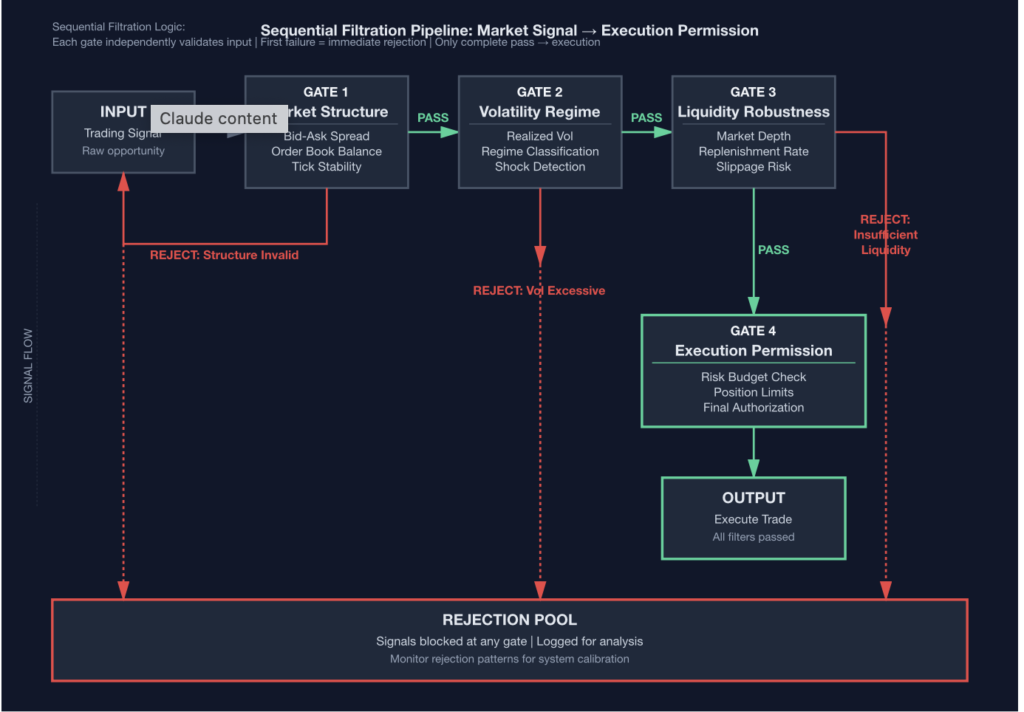
Market Structure Validation
Filtration evaluates whether the market’s operational mechanics—liquidity depth, spread stability, order book replenishment—can support the system’s intended behaviour without inducing forced adaptation. This evaluation occurs independently of signal quality.
A high-confidence signal in a structurally invalid environment remains invalid. The system does not attempt to “manage” structural breakdown through position sizing adjustments or stop-loss modifications. It recognizes the mismatch and blocks execution entirely.
Volatility Regime Compatibility
Not all volatility is dangerous, but incompatible volatility is. Filtration checks whether the current volatility regime aligns with the behavioural assumptions embedded in system design. If volatility exhibits characteristics that would force the system to behave differently than designed—tighter stops, smaller size, accelerated exits—filtration blocks execution.
The system does not attempt to adapt its behaviour to the regime. It recognizes that the regime violates design assumptions and waits for compatibility to return.
Execution Feasibility Assessment
If expected slippage, spread expansion, or adverse selection exceed defined tolerances, execution becomes structurally invalid regardless of signal strength. Filtration treats this as a hard constraint, not a performance penalty to be managed through exposure adjustments.
A position sized at 10% of normal allocation can still be structurally invalid if liquidity fragmentation prevents orderly exit or if spread behaviour induces adverse selection disproportionate to edge magnitude. Filtration recognizes this reality and blocks the trade entirely.
Filtration Logic Systematic Trading vs. Risk Management
Risk Management Reacts; Filtration Prevents
Traditional risk management operates after execution. Position sizing adjusts based on volatility estimates. Stop-losses trigger based on adverse price movement. Exposure scales down as drawdown deepens. These mechanisms respond to problems that have already materialized.
Filtration logic systematic trading operates upstream of execution. It determines whether the trade should exist at all, based on structural and behavioural validity rather than risk-adjusted exposure. This temporal distinction—prevention versus reaction—defines the architectural separation between filtration and risk management.
Risk Limits Cannot Fix Structural Invalidity
Consider a scenario where liquidity has fragmented across venues and spread behaviour has become erratic. A risk management system might reduce position size to 20% of normal allocation in response to increased volatility. The smaller position does not solve the underlying structural problem: execution mechanics cannot support orderly entry and exit.
Filtration recognizes this limitation. Rather than scaling exposure and hoping for structural improvement, it blocks the trade entirely. The system acknowledges that no position size can be structurally valid when the environment violates execution assumptions.
Architectural Independence
Dovest treats filtration as upstream infrastructure, not downstream control. This separation ensures that execution logic never activates when environmental conditions violate minimum structural requirements. Risk management still operates within valid trades, but filtration determines which trades qualify as valid in the first place.
The Filtration Logic Pipeline: Stage-by-Stage
Stage 1: Structural Invalidation Detection
The system first asks: Is the market structurally hostile right now? Indicators evaluated include order book depth relative to historical baseline, spread stability across time intervals, liquidity replenishment speed after large orders, and fragmentation across trading venues.
If any indicator exceeds its threshold, the entire downstream pipeline is blocked. No signal evaluation occurs. No execution logic activates. The system produces a rejection output and waits for structural conditions to improve.
Stage 2: Behavioural Compatibility Verification
Next: Can the system behave as designed without forced adaptation? This stage evaluates whether current conditions would require the system to adjust position sizing reactively, modify exit timing from design specifications, operate with slippage beyond modeled tolerances, or accept execution quality below integrity thresholds.
If any forced adaptation would be required, permission is denied. The system does not attempt to “make it work” through parameter adjustments or exposure reductions. It recognizes the incompatibility and blocks execution.
Stage 3: Execution Permission Granted
Only when structure and behaviour both satisfy their requirements does the system allow execution logic to activate. At this stage, signal evaluation, position construction, and execution pathway selection proceed. This is not “passing a filter”—it is earning permission through environmental alignment.
The sequential nature of this pipeline ensures that computational resources and decision-making capacity are not wasted on scenarios that cannot result in valid execution. Efficiency emerges from structured rejection rather than exhaustive evaluation.
Why Systems Collapse During Regime Transitions
Regime Shifts Attack Assumptions, Not Signals
During market regime transitions, signals often continue to generate statistically valid outputs. Correlations persist. Patterns remain detectable. Indicators trigger as expected. Meanwhile, execution assumptions quietly break. Spreads widen beyond historical ranges. Liquidity depth thins dramatically. Slippage distributions shift. Adverse selection intensifies.
Systems without filtration logic continue executing because signals “work” statistically. The structural breakdown remains invisible to traditional performance metrics until drawdown becomes severe. By that point, behavioural damage has already accumulated—overtrading in hostile conditions, forced exits at disadvantageous prices, reactive size adjustments that violate design discipline.
Filtration Absorbs Regime Shock
By tightening constraints or blocking permission entirely during transitions, filtration logic prevents the system from expressing outdated behavioural assumptions in a structurally different environment. This protective mechanism operates automatically, without requiring operator judgment about “when the regime has changed.”
The system does not attempt to predict regime transitions or time re-entry perfectly. It responds to observable structural conditions in real-time. When those conditions violate requirements, execution stops. When they return to acceptable ranges, execution permission resumes.
This is where longevity is decided. Long-term erosion rarely results from missing upside during favorable periods. It results from participating during structurally invalid periods when execution mechanics no longer support intended behaviour.
Institutional Research on Market Quality
Institutional research consistently demonstrates that market quality deteriorates during stress, complexity, and volatility spikes—impacting execution outcomes far more than directional price movement. These findings directly inform filtration logic design.
The Bank for International Settlements emphasizes that liquidity is conditional and can evaporate precisely when most needed, particularly during transitions between market regimes. This insight underscores why filtration must evaluate structural validity continuously rather than assuming liquidity availability based on historical averages.
Research from the CFA Institute highlights that transaction costs and market microstructure effects dominate realized outcomes during unstable regimes. Filtration logic operationalizes these findings into architectural constraints rather than leaving them as commentary. The framework treats market microstructure as a first-class constraint that can invalidate execution regardless of signal quality.
How Filtration Logic Uses Regime Classification
Stable Regimes: Wider Permission Boundaries
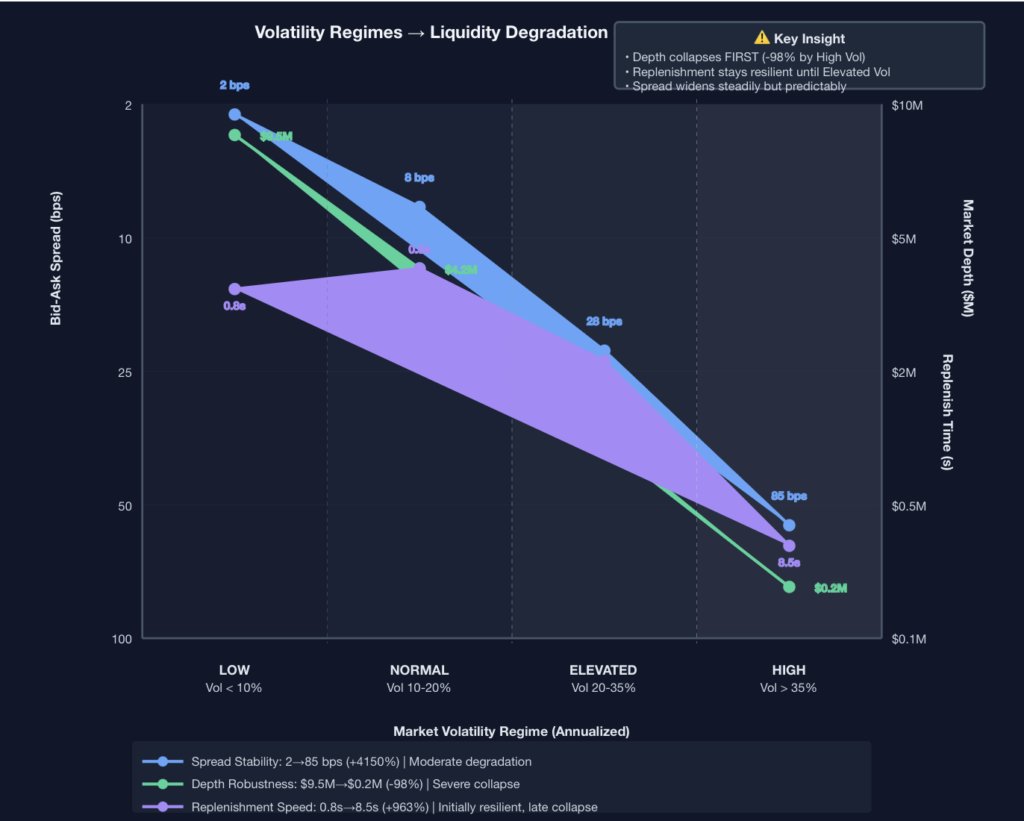
When market structure exhibits consistent liquidity depth, stable spread behaviour, predictable adverse selection patterns, and orderly volatility characteristics, filtration grants wider behavioural permission. The system can express its full designed capability without structural constraint.
This does not mean “trade more”—it means the environment satisfies requirements for the system to behave as intended. Trade frequency depends on signal logic, not filtration relaxation.
Fragmented Regimes: Selective Constraint
When structure shows intermittent liquidity thinning, spread instability without full breakdown, or elevated but not disorderly volatility, filtration tightens constraints. Only the most structurally robust behaviours receive permission. Marginal setups are rejected.
The system continues to operate, but with reduced tolerance for execution complexity or structural ambiguity. This selective approach allows participation when conditions support it while avoiding marginal scenarios likely to degrade into invalidity.
Disorder Regimes: Complete Execution Block
When structure becomes severely fragmented across venues, characterized by disorderly spread expansion, subject to unpredictable adverse selection, or exhibiting volatility incompatible with design assumptions, filtration blocks execution entirely.
The system produces no trades. This is not failure—it is disciplined preservation of integrity. The operator receives no pressure to “do something” because the system architecture enforces inactivity as the correct response to structural invalidity.
Filtration Protects Behavioural Integrity
The Psychological Trap of Activity
Human operators equate action with competence. Inactivity feels like failure, missed opportunity, or wasted preparation. This psychological bias destroys more trading infrastructure than any technical flaw. The pressure to act intensifies precisely when structural conditions make action most dangerous.
Systematic trading systems must be built to resist this bias entirely. Filtration logic removes the psychological burden by making inactivity an automatic structural response rather than a discretionary choice requiring willpower.
Discipline Through Architecture
By encoding rejection into infrastructure, filtration eliminates reliance on restraint, patience, or emotional control. The system does not “choose” to avoid invalid trades through discipline. It structurally cannot execute them. The decision is removed from the operator entirely.
This architectural choice prevents the gradual erosion that occurs when discretionary discipline weakens under pressure. The system maintains the same standards during volatility spikes, drawdowns, or extended periods without trades because those standards exist in code, not in human judgment.
Integrity Over Excitement
A system that excites its operator is usually one that will eventually break them. Excitement correlates with activity. Activity during invalid conditions correlates with long-term damage. Filtration logic systematic trading infrastructure is designed to be boring during invalid periods and active only when structural validity permits.
The operator’s emotional state becomes irrelevant to system behaviour. Whether feeling confident or fearful, eager or exhausted, the filtration layer enforces the same structural requirements. This independence from human psychology is what makes systematic infrastructure truly systematic.
Common Misconceptions About Filtration
“It Reduces Opportunity”
Correct—and intentionally so. Filtration reduces invalid opportunity, which is the only kind that causes long-term damage. Valid opportunity—trades where environmental structure supports intended behaviour—remains fully accessible.
The distinction matters more than total trade frequency. A system that executes 100 trades with 80 structurally valid will likely perform worse than a system that executes 40 trades with 40 structurally valid. Filtration optimizes for validity, not frequency.
“It Makes Systems Slow to React”
Filtration does not slow decision-making within valid trades. It prevents unnecessary decisions altogether. Speed of execution when conditions permit remains unchanged. What changes is the willingness to execute when conditions violate structural requirements.
In fact, filtration can increase effective speed by eliminating computational waste on scenarios that cannot result in valid execution. Resources focus on the subset of market states where execution is structurally possible.
“It’s Just Another Filter”
Filters select from a set of candidates based on quality rankings. Filtration rejects by default and grants permission only when requirements are satisfied. That architectural inversion—from selection to permission—defines the difference between optimization and structural constraint.
A filter asks: “Which of these opportunities is best?” Filtration asks: “Should we participate at all?” The questions operate at different architectural levels and serve fundamentally different purposes.
Why Filtration Logic Sits at the Architectural Core
Filtration is not a module that can be added or removed. It is the organizing principle that defines how the entire systematic trading infrastructure operates.
It establishes system boundaries that cannot be violated, enforces behavioural consistency across all market conditions, preserves structural validity regardless of signal quality, and allows intelligence to operate safely within defined constraints.
Without filtration, architecture collapses into pattern-chasing. Statistical edges get expressed in structurally invalid environments. Execution mechanics break before performance metrics signal danger. The system becomes smarter at doing the wrong thing rather than refusing to do it.
With filtration, systems gain the capacity to do nothing—correctly. That capability matters more than any signal innovation, parameter optimization, or performance enhancement. Longevity comes from knowing when not to trade, not from knowing when to trade better.
Architecture Scales Through Structured Rejection
Scalable trading infrastructure is not built by discovering more reasons to trade. It is built by engineering fewer reasons to break. This principle reverses conventional thinking about system development.
Filtration logic systematic trading ensures that behaviour remains aligned with structure across all market conditions, execution is earned through environmental validation rather than assumed, risk is constrained before it materializes rather than managed after damage begins, and inactivity is treated as disciplined response rather than operational failure.
When a system can survive structural invalidity without participating in it, when it can wait through regime transitions without forcing adaptation, when it can remain dormant for extended periods without operator pressure to “do something”—that is when systematic infrastructure achieves true robustness.
This is why filtration logic is not an accessory in systematic trading design. It is the structural foundation that determines whether a system can survive long enough for its edge to matter. Intelligence finds opportunities. Filtration decides which opportunities are worth taking. That distinction is what separates systems that scale from systems that eventually break.
Continue Learning About Systematic Trading Infrastructure
Explore related insights on behaviour-first trading frameworks and market structure analysis to understand how structural discipline protects long-term system integrity.
About the Author
Dovest Research Team
The Dovest Research Team develops institutional-grade frameworks for systematic trading infrastructure, focusing on behaviour-first architecture, structural validity, and risk engineering. All content reflects foundational research and methodological discipline rather than performance marketing or signal provision.
Expertise: Systematic trading architecture, market microstructure, volatility regime analysis, behavioural consistency frameworks
Approach: Engineering-grade reasoning applied to trading infrastructure design, emphasizing what systems should reject before considering what they might execute.
This article reflects research and methodology. Dovest does not provide trading signals, performance predictions, or guarantee any specific outcomes. All systematic trading involves substantial risk.